Some games seem determined to throw everything they have at you from the moment you press start, while others, like Rollick N’ Roll, simply put a button in front of you and say, “Go on then, see what happens.” It is an admirably simple philosophy, but it hides a surprisingly entertaining puzzle game beneath its colourful toy-box presentation. Developed and published by Crayonix Games, Rollick N’ Roll takes the familiar childhood joys of marble runs, toy cars and tabletop contraptions and turns them into a physics-driven puzzle adventure that is remarkably easy to pick up.
There is an undeniable nostalgic quality to the whole thing. Anyone who has ever sat on the floor with a collection of toy cars, built an elaborate track from whatever happened to be available, and then watched the whole thing collapse spectacularly will immediately understand the appeal. The game captures that sense of experimentation without demanding that you read a lengthy manual or sit through an hour of tutorials before being allowed to play. In fact, the developers proudly declare that no training is necessary, and for once, that is absolutely right.
With 25 courses, 75 vehicles to collect, three difficulty levels and a dedicated Time Trials mode, Rollick N’ Roll manages to turn a wonderfully uncomplicated idea into something that can keep you occupied for considerably longer than its cheerful presentation initially suggests. It is colourful, tactile and occasionally chaotic, but most importantly, it is fun.
Welcome to the Toy Box
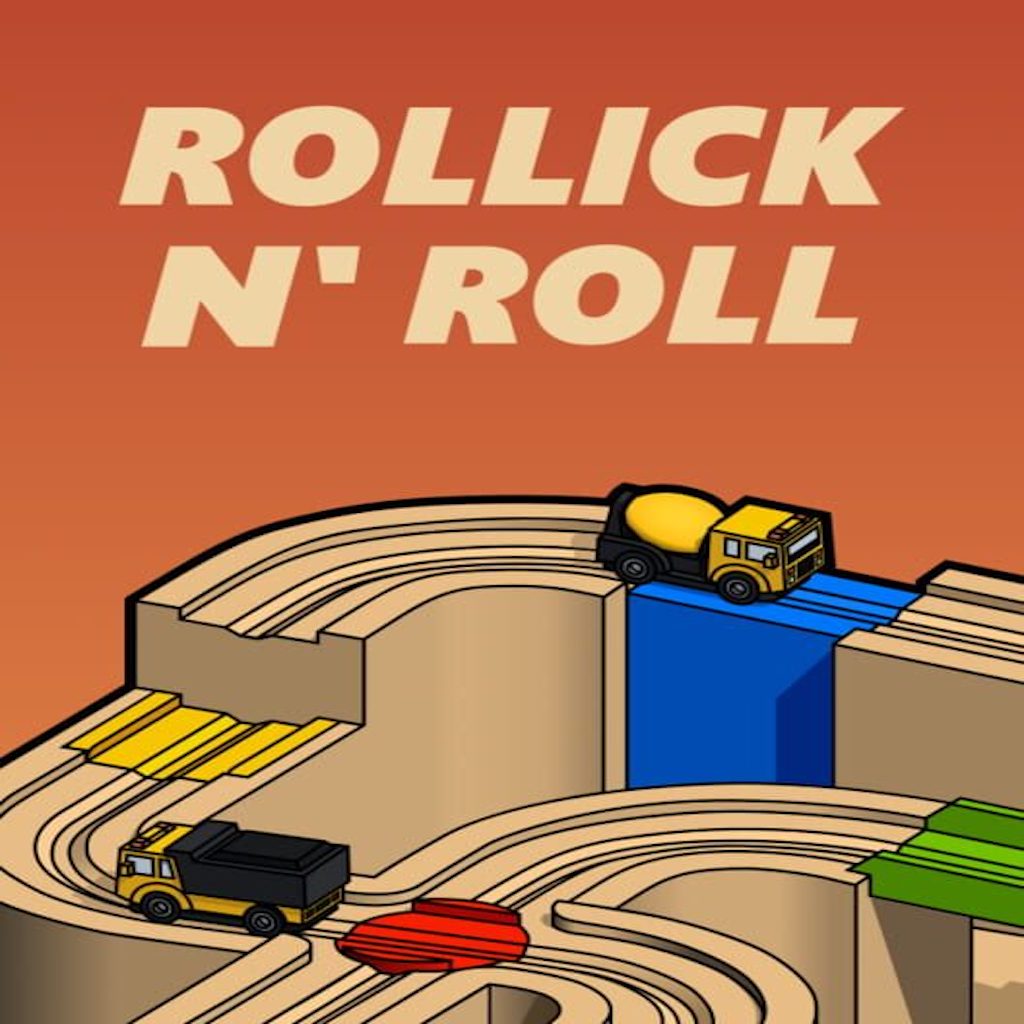
The first thing that stands out about Rollick N’ Roll is how approachable everything feels. The game does not bombard you with complicated control schemes, elaborate skill trees or pages of instructions. Instead, you are presented with a course, a vehicle and a selection of brightly coloured controls that manipulate the environment around you. Press a button and something happens, whether that means raising an elevator, opening a gate, activating a ramp or shifting another part of the course into position.
It is almost comically simple, but that simplicity is precisely what makes the game work. You do not spend your time remembering which button combinations activate which mechanisms because the visual design does much of the communication for you. Once you understand the colour coding and recognise what each mechanism does, the challenge becomes one of timing and observation rather than deciphering an unnecessarily complicated interface.
That makes Rollick N’ Roll the sort of game anyone can sit down and play. Younger players can experiment with the vehicles and enjoy watching them bounce, roll and crash around the courses, while more experienced players will quickly start looking for the most efficient way to complete each stage. It is an unusual combination of accessibility and depth, and it means the game never feels as though it is talking down to its audience.
Watching the Chaos Unfold
The physics are very much the star of the show. Watching your little vehicles negotiate a course is often entertaining in itself, particularly when everything goes according to plan and the various mechanisms trigger in exactly the right sequence. There is something immensely satisfying about pressing a button at precisely the right moment, watching a gate slide open, seeing a vehicle race through it, and then immediately preparing the next part of the route.
Of course, things do not always go according to plan. That is where much of the game’s charm comes from. A vehicle might take a corner slightly too quickly, bounce off an obstacle, or arrive at an elevator at the completely wrong moment. When there is only one vehicle on screen, these mishaps are usually easy enough to correct. Once the game starts throwing multiple vehicles into the mix, however, the carefully controlled toy box can descend into glorious chaos.
That escalation is one of the smartest aspects of the design. The easier courses allow you to get comfortable with the mechanics without making you feel as though you are being tested. As you progress, more vehicles and more environmental interactions are introduced, forcing you to keep an eye on several things at once. Suddenly, that innocent-looking button you pressed a few seconds ago has become part of a much larger chain reaction.
More Vehicles, More Mayhem
The three difficulty levels do more than make the game feel faster or impose harsher time limits. They change how you approach the courses because additional vehicles introduce an entirely different kind of puzzle. When you have only one vehicle to worry about, your attention can remain focused on the immediate route ahead. Add several more, and suddenly you are juggling multiple moving parts, trying to ensure that one vehicle does not interfere with another.
This is where Rollick N’ Roll becomes surprisingly addictive. There is a lovely rhythm to watching everything unfold once you have finally figured out the correct sequence. One vehicle moves, a button is pressed, an elevator rises, another car crosses the track, and you quickly activate the next mechanism before the whole system falls apart. When it works, you get that satisfying feeling of having solved a machine rather than simply completing a conventional puzzle.
When it goes wrong, however, the game can be equally entertaining. Seeing a carefully planned sequence collapse because one tiny vehicle decides to behave differently from what you expected is often enough to raise a laugh rather than a frustrated shout. The physics give the game an unpredictable edge, and while that can occasionally work against you, it also prevents the experience from feeling completely mechanical.
Twenty Five Courses of Toy Box Fun
The 25 courses offer a respectable selection of challenges, and each one feels like another little mechanical playground to explore. The layouts are pleasingly varied, with ramps, sliding gates, lifts and other interactive elements combining in increasingly complex ways. The game does not need enormous environments or sprawling levels because the fun comes from understanding the small space you have been given and working out how all its pieces fit together.
The 75 vehicles are another nice touch. Collecting them adds a sense of progression beyond simply completing the courses, and there is something inherently appealing about seeing what new toy you can unlock next. They also reinforce the feeling that you are playing with a collection of toys rather than controlling anonymous game pieces.
That toy box atmosphere is one of the game’s strongest qualities. The minimalist visual style keeps everything clean and readable, while the bright presentation gives the whole experience a cheerful personality. It is difficult to be particularly miserable while watching a tiny vehicle bounce helplessly off a ramp for the third time, even if you are supposed to be trying to complete the level.
No Tutorial, No Problem
I particularly appreciate the decision to avoid an extended tutorial. Modern games can sometimes become so preoccupied with explaining every mechanic that the joy of discovery gets squeezed out of the opening hour. Rollick N’ Roll trusts the player to experiment, and because the controls are so intuitive, that confidence is justified.
You press the button and see what happens. If a mechanism does something useful, you remember it. If it does something unexpected, you adapt. It is a wonderfully old-fashioned approach to game design, and it suits the subject matter perfectly.
That does not mean the game is devoid of learning. Quite the opposite. The courses gradually teach you how their systems interact by making the puzzles increasingly demanding. You learn through play rather than instruction, which makes solving a particularly complicated course feel like your own achievement rather than something the game has walked you through step by step.
Time Trials Bring the Challenge
For anyone who finishes the main courses and wants something more demanding, the Time Trials offer an excellent reason to keep playing. The relaxed nature of the main game can give the impression that Rollick N’ Roll is purely a casual experience, but the Time Trials reveal a considerably more competitive side.
Completing a course is one thing. Completing it quickly is another. Suddenly, every pause matters. Every button press needs to be timed, and any hesitation can cost valuable seconds. A course that seemed perfectly manageable when played casually can become surprisingly tense when you are chasing a better time. It is a simple addition, but it gives the game a welcome second life once you have worked through the main challenges.
It also encourages experimentation. You start looking for shortcuts, questioning whether you really need to activate a particular mechanism, and trying to shave small amounts of time from your previous attempts. That is exactly the kind of replayability a puzzle game needs, and it works particularly well here because the basic controls are so easy to understand.
A Soundtrack Made for Relaxing
The soundtrack also deserves a mention. Composed by Rest!, the music has a suitably chilled-out quality that complements the game’s toy-box atmosphere rather than trying to dominate it. There is something pleasant about working through a complicated sequence of switches and moving vehicles while a relaxed tune plays in the background.
It helps establish the game’s personality. Rollick N’ Roll is challenging, but it rarely feels aggressive. Even when you are struggling with a particularly awkward course, the soundtrack encourages you to take a breath, reset the level and try again. It is the kind of music that works equally well whether you are concentrating on a puzzle or simply messing around with the physics.
That laid-back atmosphere is important because it makes the game approachable for players who might not normally consider themselves puzzle-game enthusiasts. There is no constant pressure to perform, at least not until you deliberately seek it out in the Time Trials. You can simply sit back and enjoy the toy box.
Where the Wheels Occasionally Come Off
Rollick N’ Roll is not without problems, though, and the camera can occasionally be frustrating. At times, the perspective makes it hard to spot an upcoming obstacle or gauge exactly how much room a vehicle has to manoeuvre. In a game where timing and positioning are so important, that can feel a little unfair when a failed attempt comes down to something you simply could not see clearly.
The relatively brief main campaign may also leave some players wanting more. The 25 courses provide plenty of entertainment, particularly when you start tackling different difficulty levels, but the core experience can be completed without a huge time investment. Thankfully, the Time Trials and vehicle collecting help extend its lifespan, giving dedicated players reasons to return.
Neither issue fundamentally damages the experience, but they are worth mentioning. The best puzzle games make you feel that failure was your fault because you misunderstood the challenge, whereas an awkward camera angle can occasionally leave you wondering whether you were actually given a fair chance. Fortunately, these moments are relatively minor compared with the overall enjoyment.
Final Verdict
Rollick N’ Roll is a lovely reminder that games do not always need complicated mechanics, enormous worlds or endless tutorials to be entertaining. Sometimes all you need is a collection of little vehicles, a handful of buttons and a physics system that is just unpredictable enough to make you smile. Crayonix Games has taken the simple pleasure of toy cars and mechanical playsets and transformed them into a charming puzzle experience that manages to be both relaxing and surprisingly demanding.
The 25 courses provide a good variety of challenges, while the three difficulty levels allow the experience to grow naturally from gentle single-vehicle puzzles into much more chaotic multi-vehicle tests. The 75 vehicles add a satisfying collecting element, and the Time Trials provide the competitive hook that keeps the game from disappearing into the toy box once the main campaign is finished. The lack of tutorials is also refreshing, allowing the player to discover the mechanics naturally rather than being subjected to another barrage of instructional pop-ups.
There are a few bumps along the road, particularly when the camera obscures an obstacle or the relatively short campaign leaves you wishing there were another handful of courses waiting in the wings. Even so, these are small complaints in what is otherwise an incredibly likeable package. The bright visuals, cheerful physics and relaxed soundtrack combine beautifully, and beneath that accessible exterior is a puzzle game capable of demanding surprisingly careful thinking.
Most importantly, Rollick N’ Roll understands something that plenty of bigger games occasionally forget. Playing with things is fun. Watching a little vehicle race down a ramp, hit a switch and fly across the screen can be satisfying simply because it looks and feels good. When everything comes together perfectly, there is a wonderfully childish sense of achievement in watching your little mechanical masterpiece work exactly as planned.