There is something wonderfully nostalgic about the sound of an arcade machine coming to life. Before you have even started playing, there is that familiar combination of electronic bleeps, mechanical buttons, and the promise that the next few minutes are likely to involve considerably more explosions than your wallet can comfortably afford. For anyone who grew up around arcades, Namco was responsible for more than its fair share of those memories, and Xevious occupies a particularly interesting place in that history. It was one of those games that seemed almost impossibly futuristic when it first appeared, and now its 1996 successor offers a fascinating glimpse into another period of arcade evolution.
Originally released in 1982, Xevious became one of the defining top-down shooters of its generation. Fourteen years later, Namco revisited the formula with Xevious 3D/G, taking the familiar concept and dragging it firmly into the polygonal age. Dynamic camera angles, 3D environments, new enemies, and additional weapons transformed the series’ appearance while retaining the basic idea of blasting anything foolish enough to get in your way. Now Hamster has brought this fascinating slice of 90s arcade history to modern consoles as part of Arcade Archives 2, complete with the collection’s excellent preservation features and new competitive options.
The result is not necessarily the purest expression of what made the original Xevious so special, but it is a fascinating piece of Namco history and, more importantly, a seriously enjoyable shooter in its own right. Xevious 3D/G feels like a snapshot of a particular moment when arcade developers were throwing themselves headfirst into 3D technology. Some of those experiments have aged better than others, but there is still plenty here to enjoy.
Xevious Goes 3D
The first thing that hits you when Xevious 3D/G begins is how different it looks from its famous predecessor. The original Xevious was built around a remarkably clean visual concept, with the player guiding an aircraft across a scrolling landscape while dealing with enemies in the air and targets on the ground. It was visually simple but mechanically clever, and that simplicity allowed the carefully designed enemy formations to become the real stars of the show. Xevious 3D/G takes that foundation and gives it a very 1996 makeover.
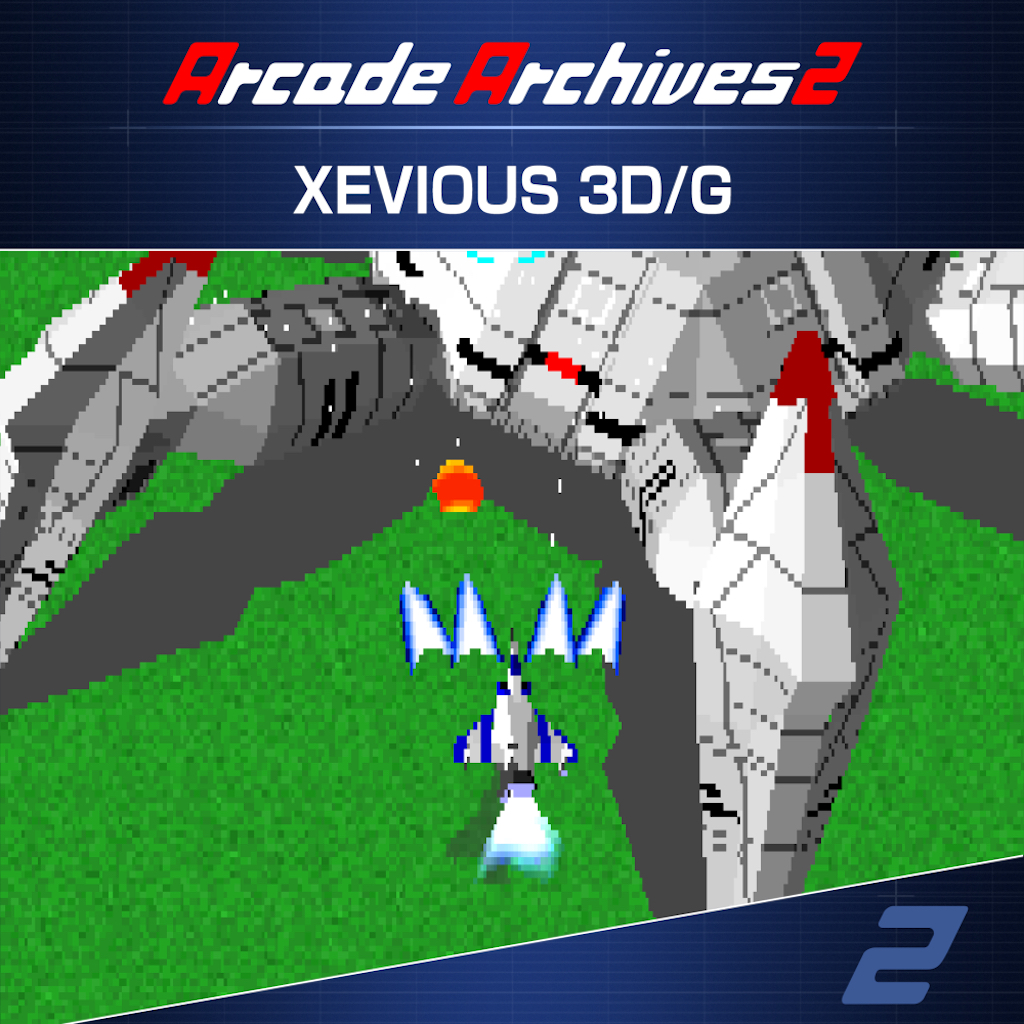
Everything is rendered using polygons, with the game making enthusiastic use of 3D environments, shifting perspectives and dynamic camera movement. Today, some of those visuals inevitably look dated, but there is something rather charming about them, as you can almost feel the excitement surrounding 3D arcade hardware at the time. Developers were discovering what polygons could do, and Xevious 3D/G is very much a product of that enthusiasm. It is not trying to imitate modern 3D graphics, and that is part of its appeal, as the rough edges give it an unmistakable sense of period.
The result is a shooter that feels like a time capsule from the mid-90s. Some of the polygonal effects are surprisingly attractive even now, while others have that unmistakable early-3D wobble that immediately transports you back to the decade. Rather than pretending that almost thirty years have not passed, the game wears its age proudly. For retro fans, that is not necessarily a weakness, as these visual quirks are part of what makes returning to the game so interesting.
Familiar Foundations
Thankfully, Namco did not throw away the gameplay that made Xevious work. At its heart, this remains a vertically scrolling shoot ’em up where you must constantly balance your attention between airborne enemies and ground targets. Your primary weapon deals with airborne threats, while your ground attack lets you bomb targets beneath you. That dual weapon system remains one of the series’ defining characteristics and gives the game considerably more tactical variety than simply holding down the fire button and hoping for the best.
The distinction between air and ground targets is important because it forces you to pay attention to almost everything happening on the screen. Enemies do not simply arrive from one direction, and threats can emerge from several positions while you are already dealing with something else. You are shooting, bombing, dodging and trying to anticipate what is about to happen next, often with very little time to think. When everything starts moving quickly, there is still that wonderful arcade feeling of entering a flow state where your fingers seem to know what to do before your brain has caught up.
That basic gameplay loop remains remarkably satisfying. There is something wonderfully immediate about Xevious 3D/G because it does not waste much time explaining itself. You see something threatening you, and your instinct is to destroy it before it destroys you. It is old-school arcade design in the best sense, with the challenge coming from learning patterns, improving your reactions and gradually becoming better at surviving.
Bigger, Louder and More Complicated
Where Xevious 3D/G differs considerably from its predecessor is in the sheer amount of additional firepower. New weapons and enemy types have been introduced, while power-ups add another layer to the traditional formula. These additions give the game a more contemporary 90s arcade feel, but they also change the character of the experience in ways that may not necessarily appeal to purists.
The original Xevious had a wonderfully stripped-back quality. You knew what your ship could do, you knew what the enemies could do, and success largely came down to positioning, observation, and memorising patterns. Xevious 3D/G is more generous with the toys available to you, and there is genuine satisfaction in collecting upgrades and watching your firepower increase. Some of the new weapons are particularly enjoyable, giving you that lovely arcade power fantasy where the screen suddenly seems to contain considerably more explosions than it did thirty seconds earlier.
The additional systems, however, make the experience feel busier. There is more happening visually, more emphasis on power-ups, and considerably more going on during some encounters. That can occasionally make it harder to immediately read what is happening, particularly when several enemies and effects occupy the same area of the screen. For players who fell in love with the elegant simplicity of the original, this may feel like a slight step away from what made Xevious timeless, but for everyone else it simply adds another layer to the arcade mayhem.
Seven Areas of Destruction
The game takes you through seven areas, each with its own scenery, enemy formations and hazards. There is a pleasing sense of progression as you move from one environment to another, and the changing locations help prevent the adventure from feeling visually monotonous. The desert, complete with its striking geoglyph, is particularly memorable, while the space fortress provides an appropriately dramatic destination as you push further into the game.
The environments also demonstrate what Namco was trying to achieve with the technology at the time. The shifting perspectives and camera angles create a sense of movement that would have been considerably more impressive when the game first appeared in arcades. Even today, there are moments when the combination of scrolling, perspective shifts and polygonal scenery creates a genuine sense of spectacle. It may look primitive compared with contemporary games, but it remains easy to appreciate the ambition behind it.
That sense of history is one of the game’s biggest attractions. Playing Xevious 3D/G now is not simply about revisiting an old shooter, because you are also experiencing a snapshot of how developers imagined the future of arcade gaming in 1996. The game captures the excitement of the transition from sprites to polygons, and even its limitations are part of the story.
The Arcade Archives 2 Treatment
Of course, the real question with any Arcade Archives release is whether Hamster has done justice to the original. The answer here is very encouraging, as the preservation work is once again one of the strongest reasons to pick up the collection. Rather than simply presenting the game and leaving you to deal with its quirks, Arcade Archives 2 provides a useful set of modern conveniences that make the experience much easier to enjoy.
Difficulty and screen settings let you tailor the presentation and challenge to your preferences, while rewind functionality is particularly welcome when an arcade game reminds you it was designed to consume your pocket money. Multiple save slots are another useful addition, and rapid fire gives players a little more flexibility than the original hardware allowed. These may sound like small features, but they make a considerable difference when returning to a game originally designed for short arcade sessions.
The competitive modes are another major attraction. The traditional Original Mode, Hi Score Mode and Caravan Mode return, giving players different ways to approach the game, while online rankings provide a reason to keep practising once you have mastered the basics. The new Time Attack Mode is particularly interesting because it changes the objective completely. Instead of concentrating purely on your score, you are challenged to clear the game as quickly as possible, which encourages you to learn the stages and optimise your route.
That is exactly the kind of addition that works beautifully for a classic arcade release. Once you have played through the game a few times, shaving seconds from your completion time gives the experience a fresh purpose. Suddenly, survival is only part of the challenge because you also need to understand when to attack, when to move and how to maintain your momentum. It turns a game you might otherwise finish and put down into something that can keep drawing you back.
Looking Better Than It Has Any Right To
Modern display technology can be unforgiving to old arcade games. Something that looked fantastic on a CRT television can sometimes appear surprisingly rough when stretched across a modern screen, and fast-moving shooters are particularly vulnerable to poor presentation. Fortunately, the range of display options included here allows you to find a setup that suits your preferences.
VRR support is another welcome addition, particularly for a game that depends so heavily on fast movement and precise reactions. The closer the presentation gets to the original arcade experience, the easier it becomes to appreciate what Namco was trying to achieve. It is easy to overlook these technical details, but smooth performance matters enormously in a shoot ’em up where a fraction of a second can be the difference between continuing your run and watching your ship explode.
Hamster’s approach therefore feels like more than simple preservation. It is about making these old games comfortable to play on modern hardware without stripping away the characteristics that made them special. That balance is not always easy to achieve, but Arcade Archives 2 XEVIOUS 3D/G gets remarkably close.
A Forgotten Gem Worth Rediscovering
Perhaps the biggest compliment I can pay Xevious 3D/G is that it feels exactly the kind of game Arcade Archives was made to preserve. This is not the most famous entry in the series, nor does it have the same historical reputation as the original Xevious. Yet that makes its inclusion particularly interesting, as it gives modern players the chance to discover a game that might otherwise have been left behind by gaming history.
There is something genuinely satisfying about finding one of these forgotten arcade releases and realising it deserves more attention than it received. Xevious 3D/G may not possess the elegant mechanical purity of the 1982 game, but it has plenty of character of its own. Its polygonal visuals, dynamic presentation, additional weapons and more elaborate encounters give it a distinctly 90s identity that is worth experiencing.
The game is not perfect, of course. The early 3D visuals can look busy, the increased reliance on power-ups changes the fundamental character of the series, and some of the effects have inevitably lost their impact after almost three decades. Anyone expecting the clean simplicity of the original may find this version considerably more complicated. Judged on its own terms, however, it remains a fast, entertaining and surprisingly addictive arcade shooter.
Final Verdict
Arcade Archives 2 XEVIOUS 3D/G is a fascinating reminder that not every arcade classic needs to be universally remembered to be worth playing. Namco took one of the most respected vertically scrolling shooters of the early 80s and reimagined it using the technology and design philosophy of the mid-90s. The result is bigger, louder and considerably more colourful, with polygonal environments, shifting camera perspectives, new weapons and a healthy variety of enemy types.
Some of that experimentation has aged better than others. The 3D visuals occasionally look primitive, the screen can become surprisingly busy, and the increased reliance on power-ups removes some of the elegant simplicity that made the original so enduring. Nevertheless, there is still a tremendous amount of fun to be had here, particularly if you approach it as a product of its own era rather than expecting it to recreate the magic of the 1982 original.
More importantly, Hamster’s preservation work gives the game the platform it deserves. The combination of save slots, rewind, display options, rapid-fire, online rankings, multiple game modes, Time Attack and VRR support makes this far more than a basic recreation. It feels like a genuine attempt to preserve an obscure arcade experience while giving modern players plenty of reasons to return to it.
For retro enthusiasts, it is a fascinating piece of Namco history. For shoot ’em-up fans, it is a fast, challenging and surprisingly addictive blast from the past. And for anyone who remembers when the arrival of polygons in an arcade game felt like something from the future, it is an especially enjoyable trip down memory lane. Xevious may have been reborn in polygons, but thankfully the shooting is still as satisfying as ever.