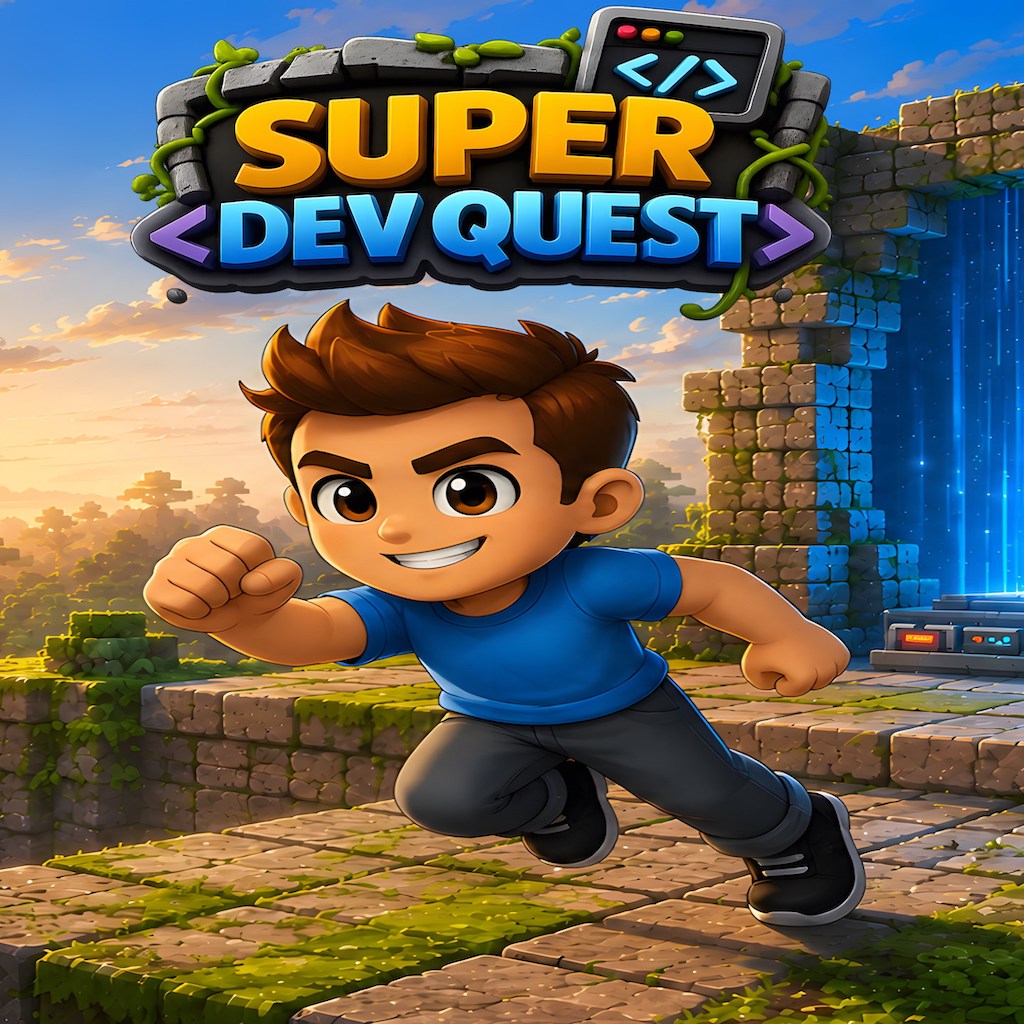
There is something wonderfully appropriate about a game developer being trapped inside his own game. After all, anyone who has ever played a game and thought, “I could make this better,” should probably be careful about saying it too loudly. Super Dev Quest takes that wonderfully meta idea and turns it into a colourful 2D platforming adventure in which the person responsible for creating the world suddenly has to survive it. Unfortunately for him, his unfinished creation appears to contain rather a lot of things designed to kill him.
Developed by Magnific Studios and published in collaboration with Brainium Games, Super Dev Quest wears its retro influences proudly. This is a platformer built around the fundamentals that made the genre so enjoyable in the first place: running, jumping, collecting coins, stomping enemies and trying not to fall into things that are very clearly going to hurt. Add wall jumps, wall slides, dimensional portals and a knowing nod towards classic 16-bit adventures, and you have a game that feels comfortably familiar from the moment you pick up the controller.
It is not trying to reinvent platforming, and that is probably its biggest strength. Super Dev Quest understands that there is enormous pleasure in getting the basics right. The controls are responsive, the movement feels smooth and the levels gradually introduce new challenges without burying the player in unnecessary complexity. It is also a relatively short experience, but rather than pretending to be an epic adventure, it focuses on delivering a concentrated dose of old-school platforming fun.
Welcome to Your Own Creation
The premise is easily the game’s most amusing idea. You are a young game developer who somehow gets pulled directly into one of his own creations, leaving you to navigate the dangerous world you presumably spent hours designing. There is something deliciously ironic about becoming the player character in a game you created yourself, particularly when that game contains traps and enemies that appear to have very little interest in your wellbeing.
The story is not particularly deep, but it does not need to be. The meta premise provides enough personality to distinguish Super Dev Quest from the countless other retro-inspired platformers currently vying for attention. You are not simply an anonymous hero rescuing a kingdom or collecting magical artefacts. You are effectively debugging your own nightmare, even if the game does not take that idea quite as far as it could.
That is one area where I found myself wishing for a little more. The concept opens the door to all sorts of wonderfully clever possibilities, including unfinished levels, broken mechanics, strange developer notes, or enemies that know they are inside a game. Instead, the narrative mostly serves as a charming excuse for the platforming. It is a fun premise, but there is considerably more that could have been done with it.
Old School Platforming at Heart
Once the game gets moving, it becomes clear that the real focus is on traditional platforming. Your character can jump, move around obstacles and defeat enemies by landing directly on their heads. It is a mechanic platforming fans have seen countless times, but there is a reason developers keep coming back to it. When the controls are responsive and the level design knows how to use them, there is something wonderfully satisfying about bouncing from one enemy to another.
The movement here feels particularly important because Super Dev Quest relies heavily on precision. A platform can be just far enough away to require a carefully timed jump, while an enemy might be positioned so you need to decide whether it is safer to leap over it or use your trusty head stomp. These are simple decisions, but they keep you engaged.
There is also a pleasing sense of momentum to the movement. You are encouraged to keep progressing rather than cautiously inching through every section, and the responsive controls make experimentation feel natural. When you miss a jump, you generally understand what went wrong, which is exactly how a good platformer should make you feel.
Wall Jumping Changes Everything
The introduction of the Wall Jump and Wall Slide abilities adds another dimension to movement. These are not particularly revolutionary mechanics, but they give level designers considerably more freedom when constructing challenges. A simple vertical shaft suddenly becomes a movement puzzle, while narrow spaces can be transformed into opportunities to bounce between walls and gain height.
The Wall Slide is especially useful because it gives you greater control over your descent. Rather than simply watching your character drop helplessly towards whatever awaits below, you can cling to a wall and carefully plan your next move. Combined with the Wall Jump, it creates a satisfying little movement system that becomes increasingly useful as the game progresses.
It also provides that lovely moment when a new ability stops feeling like a new ability and simply becomes part of your muscle memory. Initially, you are consciously thinking about when to press the button. Later, you are bouncing between walls almost instinctively, chaining movements together as you navigate the level. That sense of growing familiarity is one of the most rewarding aspects of the experience.
Coins, Portals and the Joy of Collecting
Coins are another important part of the game’s progression. Rather than merely decorative objects scattered around the environment, you need to collect enough of them to unlock the portal to the next stage. This gives exploration a little more purpose and prevents the levels from becoming nothing more than straight lines from start to finish.
It also creates an interesting balance between speed and thoroughness. You might spot a portal and immediately want to head towards it, but if you have not collected enough coins, you will have to explore further. That encourages you to investigate corners of the environment and take slightly riskier routes in search of the currency you need.
There is nothing particularly complicated about the system, but again, Super Dev Quest does not need complexity for its own sake. The simple act of collecting enough coins to open the next portal provides a clear objective, and because the game is fundamentally about movement, searching for those coins naturally becomes part of the platforming challenge.
Colourful Worlds and Classic Charm
Visually, Super Dev Quest embraces the pixel art aesthetic you would expect from a game inspired by classic 16-bit platformers. The environments are colourful without becoming overwhelming, and there is a pleasing clarity to the character designs and level layouts. You can generally see where you need to go and, more importantly, what is likely to kill you along the way.
There is something comforting about this visual approach. Modern games can sometimes become obsessed with visual realism, but pixel art has a wonderful ability to communicate an idea immediately. A dangerous enemy looks dangerous, a platform looks like a platform, and a coin looks like something you should probably collect. There is very little visual clutter between the player and the game.
The nostalgic influence is obvious, but it does not feel as though Super Dev Quest is simply trying to recreate one particular classic. Instead, it borrows familiar ingredients from the genre and combines them into something that feels comfortably retro without being completely trapped in the past.
The Difficulty Curve
The levels gradually become more demanding, though experienced platforming fans may find much of the adventure fairly manageable. Early stages offer a gentle introduction to the movement mechanics, letting you get comfortable with jumping, enemy stomping and collecting coins before the more demanding sections appear.
As the game progresses, the Wall Jump and Wall Slide mechanics become increasingly important. Hazards are placed more carefully, platforms become less forgiving, and you need to think more about the route ahead. It never becomes a brutal test of reflexes, but there are enough moments that demand concentration to keep things interesting.
That accessibility is likely to make Super Dev Quest particularly appealing to players who enjoy retro platformers without necessarily wanting the punishing difficulty associated with some of the genre’s more notorious examples. There is a fine line between challenging and frustrating, and the game generally stays on the right side of it.
When Your Own Game Turns Against You
There is a certain charm to playing a platformer about a developer who suddenly has to survive his own creation. Every trap and enemy feels like a tiny reminder that he might have spent a little more time thinking about player safety before releasing his game into the world.
I would have loved to see the meta concept pushed further, though. Imagine discovering unfinished sections of the game, encountering graphical glitches that are actually part of the story, or meeting characters who complain about bugs left in the code. There are plenty of opportunities for Super Dev Quest to play with the relationship between developer and game, yet the adventure only occasionally scratches the surface of that idea.
Still, what is here works. The concept gives the game enough character to make its familiar platforming feel more purposeful, even when the actual gameplay mechanics remain deliberately traditional.
A Short Adventure
The biggest limitation is probably the game’s length. Super Dev Quest is not an enormous platforming adventure, and players accustomed to spending dozens of hours collecting everything may reach the end relatively quickly.
Personally, I do not think shorter games are automatically a problem. There is something refreshing about an experience that knows when to stop, particularly when the gameplay remains enjoyable throughout. The issue is that the meta premise and movement mechanics leave you wanting a little more.
A handful of additional worlds, more ambitious uses of the Wall Jump, and perhaps a few genuinely surprising moments built around the developer trapped inside his own game could have elevated the experience further. As it stands, it feels like a very enjoyable introduction to a concept that could support a much larger adventure.
Final Verdict
Super Dev Quest is a charming, retro-inspired platformer that understands the importance of getting the fundamentals right. The controls are responsive, the movement feels satisfying, and the combination of jumping, enemy stomping, coin collecting and portal unlocking creates a familiar yet enjoyable gameplay loop. The addition of Wall Jump and Wall Slide abilities gives the platforming a little more depth, while the colourful pixel art provides plenty of nostalgic appeal.
Its biggest weakness is also one of its greatest frustrations. The game is short, and just as you begin to feel completely comfortable with its movement system, you are already approaching the end. The meta narrative is amusing but underused, too, with the idea of a developer trapped inside his own game offering considerably more potential than the story ultimately explores.
Even so, there is plenty to like here. Super Dev Quest does not need an enormous budget or a complicated progression system to be entertaining. It is a straightforward platformer with smooth controls, cheerful visuals and enough clever movement mechanics to keep you smiling as you work your way through its colourful worlds.
Most importantly, it remembers why these games became so beloved in the first place. There is a wonderful satisfaction in making a difficult jump, bouncing off an enemy, grabbing a handful of coins and finally reaching the portal at the end of a tricky section. It is simple, immediate and rewarding, and sometimes that is all a good platformer needs to be.
For anyone with a soft spot for classic 16-bit platforming, Super Dev Quest is an enjoyable little trip down memory lane. It may not reinvent the genre, and its short runtime means it is unlikely to occupy you for weeks, but it delivers exactly the kind of colourful, accessible platforming fun it promises. Perhaps the young developer should have made his own game a little longer, but at least he made it fun to play.