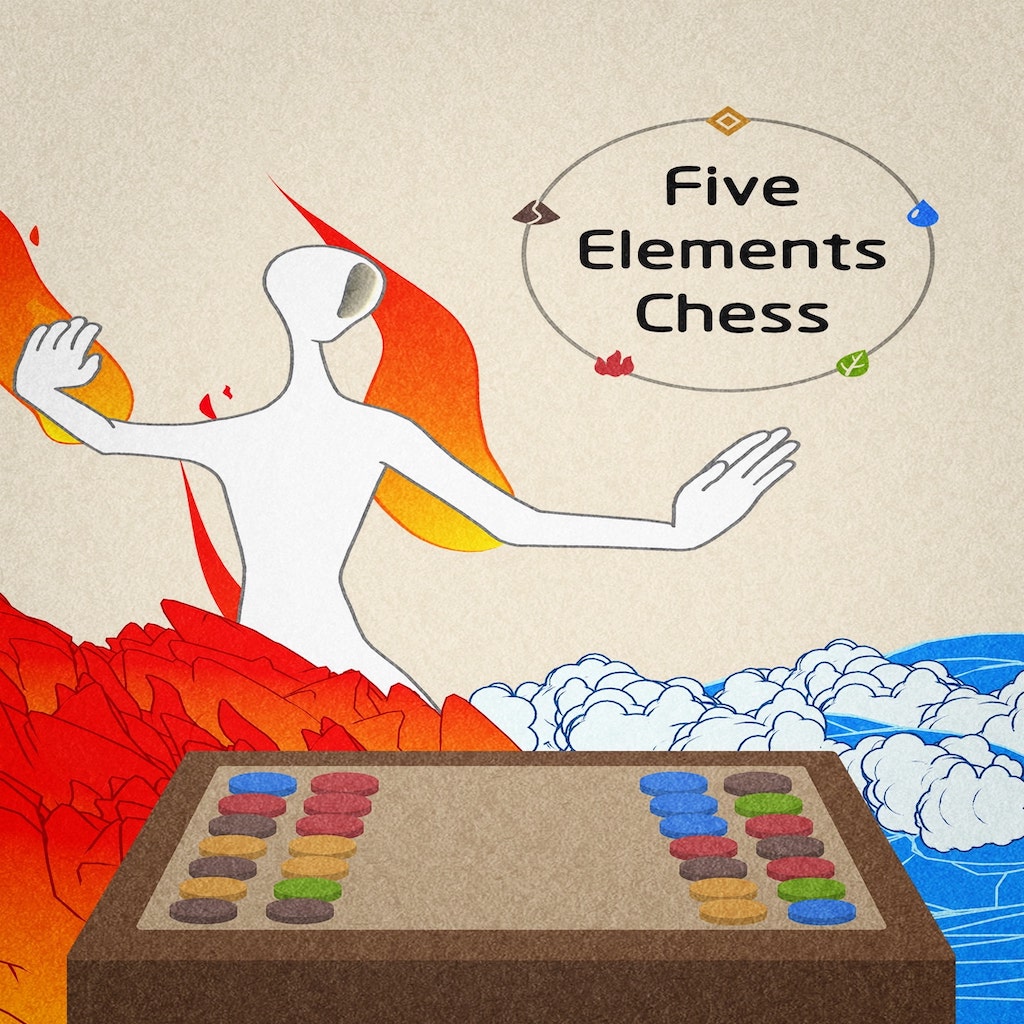
Chess is usually associated with quiet concentration, long stares across a wooden board, and the occasional moment when somebody realises they have made a spectacularly bad decision several moves earlier. Five Elements Chess, however, takes that familiar idea of outthinking your opponent and throws it into a colourful spell duel where Fire, Water, Earth, Metal and Wood are just as important as knowing when to attack. It is not really chess in the traditional sense, and that may initially leave you wondering where the checkmate is hiding. What it actually offers is something considerably stranger, combining match-three puzzle mechanics with elemental strategy to create a game that looks wonderfully simple until you realise just how many nasty little tricks you can pull on your opponent.
Developed and published by Candleman Games, Five Elements Chess is one of those games that is incredibly easy to understand but considerably harder to master. The basic rules can be picked up quickly, making it immediately approachable, yet the elemental relationships and spell mechanics give the experience considerably more depth than its cheerful appearance initially suggests. There is also a wonderfully calm presentation that makes the whole thing feel almost meditative, right up until your opponent turns your carefully constructed defensive strategy against you. That contrast between peaceful presentation and surprisingly ruthless tactical play is one of the game’s greatest pleasures.
Five Elements, One Very Clever Idea
The central concept is the traditional Five Elements theory of Fire, Water, Earth, Metal and Wood. Each element relates to the others, creating a strategic web you need to understand to get the most from your spells and attacks. Rather than simply matching tiles because they look useful, you are constantly thinking about what those matches will do and how your opponent might respond.
That is what gives Five Elements Chess its identity. The match-three foundation makes the game immediately familiar, but the elemental system adds another layer of thought to almost every move. A match is no longer just a match. It can be an opportunity to strengthen your position, disrupt your opponent, or prepare something much nastier for the turn that follows.
It cleverly makes a puzzle game feel like a strategic duel. You can look at the board and see obvious combinations, but the obvious move is not necessarily the best. Sometimes the most valuable play is the one that appears slightly less impressive because it sets up something much more powerful later.
Easy To Learn, Difficult To Outsmart
One of the game’s biggest strengths is its accessibility. You do not need to master a complicated rulebook before you can start playing. The fundamentals are straightforward enough to get into a match and begin experimenting almost immediately.
The depth reveals itself gradually. As you become more familiar with the elemental relationships, you start looking beyond individual matches and considering how the entire board can be manipulated. Suddenly you are thinking several moves ahead, not because the game has buried you under complicated mechanics, but because you have started to understand how those simple mechanics interact.
That is the sort of design I always appreciate in strategy games. Complexity does not necessarily equal depth. Five Elements Chess demonstrates that a handful of understandable systems can create remarkably complicated situations when they are allowed to interact properly.
When Your Defence Becomes Your Enemy
The cleverest moments often arise from the game’s counter mechanics. One particularly satisfying idea lets you overcharge an opponent’s elemental defences, turning their own protective measures into damaging attacks. It is the kind of mechanic that elicits a genuine “Oh, that’s nasty” reaction when you first realise what has happened.
These moments are where the chess comparison starts to make a little more sense. You are not simply reacting to what your opponent has done. You are trying to anticipate their plans and find ways to make those plans work against them. A defensive move can become a liability, while something that looks like an advantage can suddenly turn into a trap.
There is a delicious sense of mischief to it. The best victories are not necessarily the ones where you simply overpower the opponent. They are the ones where you have quietly allowed them to create the conditions for their own downfall. When everything lines up and a carefully prepared counterattack works exactly as intended, Five Elements Chess can feel wonderfully clever.
Match Three With A Brain
The match-three component deserves credit for never feeling completely disconnected from the strategy. It is the mechanism through which your decisions are made, but it also introduces an element of unpredictability. The board can change in ways that force you to reconsider your plans rather than simply following a predetermined sequence of moves.
That element of luck is likely to be the part that divides players. If you approach Five Elements Chess expecting the absolute control of traditional chess, the random nature of the matching system may occasionally frustrate you. Sometimes you can make a sensible strategic decision and still find yourself dealing with an unfavourable board.
Personally, I think that uncertainty works reasonably well because it prevents matches from becoming entirely predictable. You have to adapt, and adapting is part of the challenge. The important distinction is that luck can influence the outcome without completely replacing strategy, because there are still plenty of decisions you can make about how to use what the board gives you.
A Zen Battlefield
Visually, Five Elements Chess takes a refreshingly calm approach. The presentation has a Zen-inspired quality that makes the game feel peaceful, even when two players are trying to dismantle each other’s plans.
There is no need for excessive visual noise here. The elemental themes provide enough colour and personality, while the overall aesthetic gives the experience a sense of tranquillity. It is the sort of game that looks as though it should be played while sitting quietly with a cup of tea, although your peaceful mood may disappear quickly when somebody pulls off a devastating counter.
That calm presentation is particularly well suited to the game’s strategic nature. It encourages you to slow down and think rather than rushing through every move. Even when a match becomes tense, there is an underlying sense that the game wants you to consider your options rather than simply react.
Playing Against The World
The inclusion of both local and online PvP is important because this is ultimately a game about outthinking another human being. Playing against an opponent who understands the elemental systems can create situations that feel considerably more unpredictable than simply working through a campaign.
Local multiplayer is particularly appealing for a game like this because the simple rules make it easy to hand a controller to someone else and start a match. You do not need to spend an hour explaining the entire system before the fun can begin. Once the basics are understood, the battle is really about who can make better use of the board.
Online play gives the game another layer of longevity. The more you play, the more familiar you become with the elemental interactions, which naturally encourages you to improve. Losing can be frustrating, particularly when luck appears to have played a part, but it can also make you want to try again with a better understanding of what went wrong.
Strategy, Luck And The Human Factor
The relationship between strategy and luck is perhaps the most interesting thing about Five Elements Chess. There is enough randomness to keep matches unpredictable, yet enough control to make your decisions meaningful. That is a difficult balance to strike, and while there will inevitably be moments when the board seems to have decided you are having a bad day, the strategic systems generally give you enough tools to fight back.
It also makes the game more approachable than a purer strategy title might be. You can enjoy it casually, experiment with different approaches and gradually learn the deeper mechanics without feeling as though you need to study an opening repertoire beforehand.
For more serious strategy players, the luck may occasionally prove irritating. That is understandable, because anyone coming from traditional chess or highly deterministic strategy games may find the uncertainty difficult to accept. But Five Elements Chess was never really trying to recreate traditional chess. It uses the idea of strategic confrontation as the foundation for something else entirely.
A Little Game With A Lot Going On
What surprised me most about Five Elements Chess is how quickly the simple concept becomes engrossing. At first, you are simply matching elements and trying to understand what each one does. Then you begin recognising patterns, anticipating counters, and deliberately setting up situations that force your opponent into difficult choices.
That progression is the real achievement. The game does not overwhelm you with systems from the start. Instead, it lets you discover the depth naturally through play. Before long, you find yourself staring at the board, thinking about several possibilities at once, wondering whether the obvious attack is actually a trap or whether you can tempt your opponent into strengthening something you can later turn against them. There is a wonderful little competitive game hiding beneath the tranquil presentation, and discovering it is half the fun.
Final Verdict
Five Elements Chess is an inventive little strategy game that successfully combines two genres that might not seem to go together. The match-three mechanics provide an accessible foundation, while the Five Elements system, spellcasting and counter mechanics add considerably more depth than you might expect. The result is a game that can be picked up quickly but rewards players who are willing to spend time understanding what lies beneath the surface.
The luck introduced by the matching system will not appeal to everyone. Players looking for the absolute predictability and control of traditional chess may occasionally find themselves frustrated when the board refuses to cooperate. Yet for those willing to accept that uncertainty as part of the challenge, it creates an enjoyable layer of adaptability that keeps matches from becoming too formulaic.
The Zen-inspired presentation is another highlight, giving the game a distinctive identity and providing a lovely contrast to the tactical battles taking place underneath. Local and online PvP add plenty of longevity, while the accessible rules make it an easy game to introduce to someone who might normally avoid strategy titles.
Most importantly, Five Elements Chess understands the joy of turning a simple idea into something deeper than expected. What initially looks like a peaceful match-three puzzle quickly becomes a battle of anticipation, elemental relationships and wonderfully sneaky counters. There are moments when victory feels less like winning a puzzle and more like outsmarting somebody, and those are the moments that make the game special.
It may not be traditional chess, but perhaps that is precisely the point. Sometimes the most interesting games are the ones that take a familiar idea, throw a few unexpected ingredients into the pot and see what happens.