There are games that ask you to save the world, defeat an ancient evil, or perhaps manage a small village through an unforgiving winter. Then there is The Trolley Solution, a game that examines one of philosophy’s most famous thought experiments and essentially asks, “What if we made this stupidly entertaining?” It is an unusual question, but the trolley problem has never exactly been the most conventional subject for a video game. Somehow, by taking something that has occupied philosophers for decades and turning it into a collection of bizarre interactive experiments, The Trolley Solution manages to make philosophy feel surprisingly approachable.
Originally proposed by British philosopher Philippa Foot in 1967, the trolley problem has become one of those philosophical questions that seems almost impossible to escape. The basic scenario is simple enough: a runaway trolley is heading towards several people, and you have the opportunity to pull a lever to divert it towards a smaller number of people. Do you intervene, or do you allow events to continue without interfering? The Trolley Solution takes that familiar dilemma and gleefully dismantles it, producing twenty variations alongside the original problem and giving each one its own bizarre little minigame.
The result is a game that is difficult to describe without making it sound completely ridiculous. One moment you are considering the morality of sacrificing one person to save several others, and the next you might be playing something that feels like it wandered in from an anime visual novel, a Tamagotchi clone, or a game about Sisyphus. The fact that all of these things somehow connect back to the trolley problem is part of the fun. The Trolley Solution knows that its premise is inherently absurd when translated into a video game, and instead of fighting that absurdity, it embraces it wholeheartedly.
Philosophy Has Never Been This Silly
The first thing that becomes apparent is that The Trolley Solution has absolutely no interest in presenting philosophy as a dry academic exercise. There are no lengthy lectures, no pages of complicated terminology, and no expectation that you arrive with a university-level understanding of moral philosophy. Instead, the game presents you with a situation, asks you to make a decision, and then finds increasingly strange ways to turn that decision into interactive entertainment.
That approach works remarkably well because the trolley problem itself is easy to understand. You do not need to know anything about Philippa Foot or the history of moral philosophy to appreciate the basic dilemma. What the game does is take that familiar foundation and keep asking what happens if you change one little detail. The scenarios become increasingly unusual, and before long you are no longer entirely sure whether you are playing a philosophical game or witnessing an elaborate practical joke.
The humour is very much the driving force behind the experience. Some jokes are subtle, while others are about as subtle as a trolley travelling at full speed towards a brick wall. The writing regularly pokes fun at philosophy, video games, pop culture and internet culture, and there is a wonderfully self-aware quality to the whole thing. It feels as though the developers had a list of increasingly ridiculous ideas and simply kept asking themselves whether they could somehow connect each one back to a runaway trolley.
Twenty Ways to Make a Moral Decision
The variety of scenarios is arguably the game’s greatest strength. If every variation simply asked you to pull the lever or leave it alone, the novelty would disappear very quickly. Instead, the developers constantly change the circumstances, presentation and tone, so you never quite know what the next scenario will throw at you. That unpredictability gives the game a genuine sense of momentum, even though the individual challenges are relatively small.
There is also a pleasing sense that the game is constantly trying to catch you off guard. You may think you understand what a particular scenario is asking before something completely unexpected happens. Sometimes the comedy comes from the situation itself, while on other occasions the punchline arrives after you have already made your decision. It creates a strange little cycle in which you approach each new problem with genuine curiosity, wanting to see what the developers have thought of next.
The best moments are those where the philosophical question and the ridiculous scenario complement one another. Beneath the jokes, you can still see the original idea at work, with each variation asking you to consider how changing the circumstances might alter your decision. You might make one choice in a particular situation and a completely different one when the game changes a crucial detail. Even though The Trolley Solution is primarily interested in making you laugh, there is still a surprisingly effective philosophical experiment hiding beneath the nonsense.
Then Comes the Minigame
The decision to give each trolley variation its own minigame is what stops The Trolley Solution from becoming little more than a collection of philosophical multiple-choice questions. Instead of simply reading a scenario and clicking an answer, you are asked to interact with a bizarre interpretation of the situation. This gives the game a much broader range of gameplay than its premise initially suggests, and it is also where many of its funniest surprises come from.
One particularly memorable example takes the form of an anime-style visual novel involving a schoolgirl who falls in love with a tram. It is the sort of sentence that sounds as though it should not exist, yet somehow it fits perfectly into the wonderfully unhinged world the game creates. Elsewhere, the game plays around with Tamagotchi-style mechanics, Sisyphus-inspired scenarios and various other genre parodies that seem to have absolutely nothing to do with philosophy until the trolley connection becomes apparent.
This variety keeps the experience fresh, but it also creates an interesting problem. When you move between so many different gameplay styles, not every minigame can be expected to work equally well. Some are genuinely clever and entertaining, while others feel more like extended jokes that would have benefited from being considerably shorter. Fortunately, the weaker sections never completely derail the experience, largely because the game is usually happy to move on and throw another strange idea at you before things become too repetitive.
A Game That Knows How Ridiculous It Is
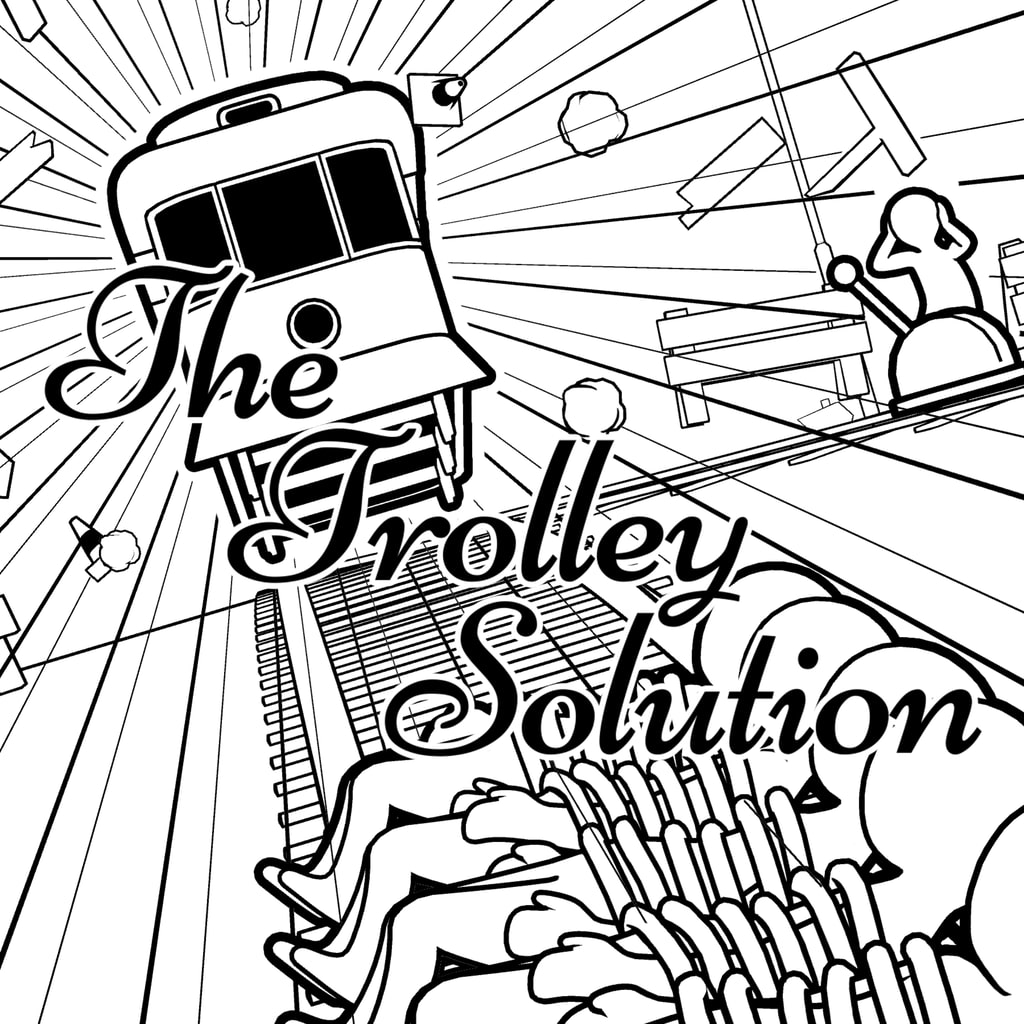
The minimalist black-and-white visual style is another aspect of The Trolley Solution that works surprisingly well. Rather than disguising its modest production values, the game embraces a deliberately stripped-back presentation that gives everything a slightly theatrical look. It almost feels like watching a bizarre philosophical sketch show where the performers have been given a trolley, a handful of questionable moral decisions, and far too much creative freedom.
The visual simplicity also allows the writing and scenarios to take centre stage. There are no elaborate environments competing for your attention, and the game does not need expensive visual effects to sell its ideas. Instead, the presentation creates a consistent identity that helps tie together the wildly different minigames. Given how varied the gameplay can be, that visual consistency is surprisingly important.
There are moments when the controls are not quite as slick as they could be, particularly in some of the more unusual minigame sections. These problems are rarely serious enough to make the game frustrating, but they can interrupt the comedy when you are wrestling with an interaction rather than enjoying the joke. A funny idea can lose some of its impact when the player spends too long trying to work out what the game actually wants them to do.
When the Joke Goes Too Far
Comedy is always difficult to judge because what makes one person laugh can leave another completely cold. The Trolley Solution is particularly reliant on its sense of humour, and while much of it works wonderfully, there are sections where the joke simply goes on too long. A gag that would have been funny for thirty seconds can become considerably less effective when the associated minigame stretches it into several minutes.
This is where the pacing occasionally becomes uneven. The game is at its best when it introduces an idea, lets you enjoy the absurdity, and then moves on before the joke becomes stale. Unfortunately, a few sections do not show the same restraint, leaving you waiting for the punchline rather than actively enjoying the journey towards it. It is not a huge problem, especially given the game’s relatively accessible runtime, but it is noticeable.
Thankfully, the variety helps keep these weaker moments from becoming too damaging. Just when one idea begins to feel tired, another completely different scenario arrives and reminds you why you started playing in the first place. The unpredictable structure means there is always the possibility that the next minigame will be something completely bonkers, and that anticipation does a lot of work in keeping the experience moving.
There Is Actually Some Philosophy Here
For all its silliness, The Trolley Solution deserves credit for making philosophical concepts accessible. The game does not require you to have studied ethics or moral philosophy, and its scenarios are presented in a way almost anyone can understand. More importantly, it lets you make your own decisions rather than constantly telling you which answer is supposed to be correct.
That matters because the trolley problem has remained relevant precisely because there is no universally satisfying solution. The game can make fun of the scenarios, but beneath the jokes there is still a genuine question about how people make difficult moral choices. Changing one detail can completely alter how a decision feels, and The Trolley Solution uses that idea to create both comedy and reflection.
Will you emerge from the game with a dramatically expanded understanding of philosophy? Probably not. Will you learn something useful about yourself when faced with a ridiculous moral dilemma involving a runaway trolley? Perhaps, although I suspect you are more likely to learn that your personal ethical framework has surprisingly little defence against a tram romance. Either way, the game deserves credit for making something that could have been intimidating feel approachable and entertaining.
Final Verdict
The Trolley Solution is exactly the sort of game that could have gone horribly wrong. Take a famous philosophical thought experiment, create twenty variations, attach a different minigame to each, and you have the ingredients for an incoherent collection of half-baked ideas. Instead, the developers have created something surprisingly cohesive, largely because they understand that the only sensible response to such an absurd premise is to have as much fun with it as possible.
The humour is undoubtedly the game’s biggest attraction. The writing has personality, the dialogue is often genuinely funny, and the constant genre-switching means you rarely know what is coming next. The black-and-white presentation gives the game a distinctive identity, while the variety of minigames ensures the experience never settles into a predictable pattern for too long.
It is not flawless, of course. Some minigames feel padded, certain controls can be slightly clunky, and a handful of jokes would have been stronger if they had been allowed to end sooner. The game’s deliberately silly approach will also not appeal to everyone, particularly players who prefer their philosophical games to take their subject matter more seriously.
For me, however, the sheer personality of The Trolley Solution carries it through those shortcomings. This is a game that could have been a one-joke novelty but instead keeps finding new ways to make its central concept entertaining. It is clever without being pretentious, silly without being completely brainless, and, most importantly, willing to take risks with its humour.
You probably will not expand your mind by playing The Trolley Solution. You may not learn anything remotely useful either. But you will almost certainly spend a few hours asking yourself some very strange moral questions, wondering how on earth somebody managed to turn the trolley problem into an anime romance, a virtual pet and a collection of video game parodies. And honestly, that sounds like philosophy worth studying.