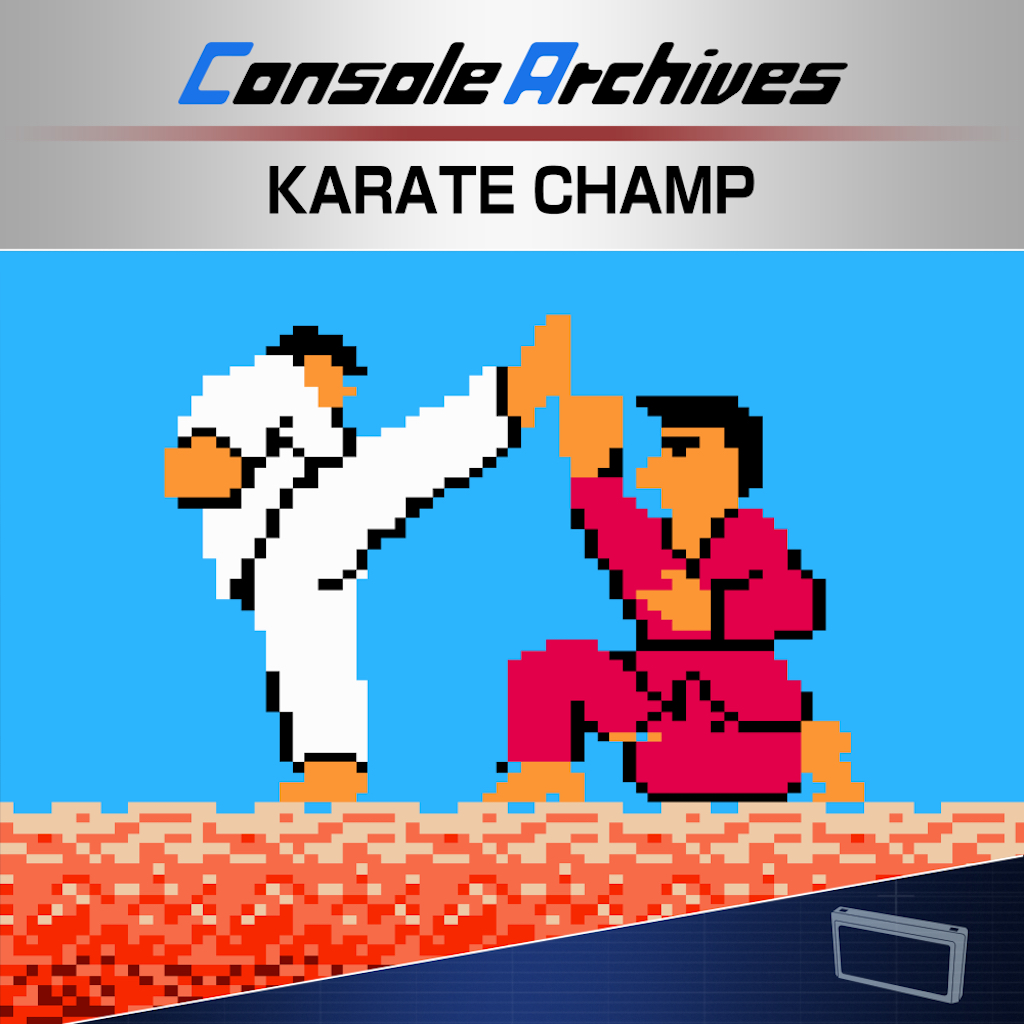
Before Street Fighter, Mortal Kombat and the countless fighting games that would eventually turn virtual martial arts into a global phenomenon, there was KARATE CHAMP. Data East’s 1984 arcade original helped establish many of the ideas that would become familiar in fighting games, and the 1986 home console version brought that experience into living rooms. Looking back at it today is an interesting experience because you are not simply playing an old karate game. You are playing a small piece of gaming history that helped lay some of the foundations for an entire genre.
Console Archives KARATE CHAMP brings that 1986 version to modern hardware through Hamster’s ongoing preservation series. It is a deliberately faithful recreation rather than a lavish remake, so you get the original gameplay, presentation and quirks largely intact, along with the conveniences modern players have come to expect. Save states, display options and customisable controls make it considerably easier to live with than the original hardware, although no amount of modern polish can completely disguise the limitations of a game designed almost four decades ago. This is a fascinating preservation piece, but whether it remains an enjoyable fighting game for a modern audience is another question entirely.
Welcome To The Dojo
The basic premise is wonderfully straightforward. You take control of a karate fighter and face opponents using a collection of punches, kicks and defensive moves, with different techniques executed through combinations of the available controls. Successfully executing powerful moves earns points, and the ultimate goal is to demonstrate enough skill to reach the coveted status of “CHAMP”.
There is something wonderfully uncomplicated about it. You are not dealing with huge character rosters, elaborate storylines, cinematic super moves or dozens of special meters. There is just you, your opponent and the question of whether you can actually land the move you intended.
That simplicity is both charming and occasionally brutal. The game expects precision, and once you start playing, it becomes obvious that knowing what you want your character to do and actually making them do it are two very different things.
Karate Before The Fighting Game Explosion
It is important to understand what KARATE CHAMP represents historically. Modern fighting games have inherited countless conventions from the games that came before them, and KARATE CHAMP occupies an important place in that history. Its one-on-one combat, multiple attacks and emphasis on timing were remarkably distinctive at the time.
The 1986 home console version is unlikely to feel revolutionary to someone who has spent years playing Tekken, Street Fighter or Mortal Kombat. That would be rather like looking at an early motor car and complaining that it does not have adaptive cruise control. The point is not that this version can compete mechanically with modern fighting games. The point is that you can see some of the ideas that would eventually become enormously important to the genre.
That historical context makes the game more interesting than its relatively simple presentation might initially suggest. You can almost feel the design experimentation taking place. Here was a game asking players to think about timing, positioning and different attacks in a way that was still relatively new for home gaming.
Simple Controls, Complicated Results
The control system is where modern players are likely to have the biggest adjustment period. The game uses relatively simple control combinations, but executing them requires considerably more precision than you might expect.
On paper, that sounds ideal. Simple controls should mean an accessible game, right? Unfortunately, the conversion of the original arcade experience to an eight-bit home console means that controlling your fighter does not always feel as intuitive as you might hope.
Movement can feel stiff, and attacks do not always appear to connect as modern players expect. There is a certain rigidity to the animation and hit detection that can make the game feel unresponsive, particularly when you are trying to react quickly to an opponent.
That said, there is a strange satisfaction in eventually getting a move right. When you have spent time learning the controls and finally execute a technique at precisely the right moment, it feels earned. The problem is that the game does not always make it obvious whether your failure was caused by poor timing, an incorrect input, or the limitations of the original hardware.
Learning To Think Like A 1986 Gamer
This is where patience becomes essential. You cannot approach KARATE CHAMP expecting it to behave like a modern fighting game. The timing is different, the movement is less fluid, and the control system requires some experimentation.
Once you accept those limitations, the experience becomes considerably more interesting. Instead of fighting against the game because it does not behave as expected, you begin to learn how it actually works. You discover the range of your attacks, learn which moves are reliable, and start paying closer attention to your opponent’s movements.
There is a certain old-school satisfaction in that process. Games from this period were often less interested in making the player feel powerful and more interested in making the player learn. KARATE CHAMP can be unforgiving, but mastering its peculiarities provides a genuine sense of achievement.
The Referee Steals The Show
One of the game’s most charming features is the referee and his digitised voice samples. They are undeniably primitive by modern standards, but that is precisely why they are so enjoyable.
Hearing the referee announce what is happening gives the matches a personality that the relatively basic visuals might otherwise struggle to convey. There is something wonderfully authentic about those old speech samples, particularly when you consider how impressive digitised voices could seem on home consoles at the time.
It is also one of those features that immediately transports you back to the period. Modern games can produce astonishingly realistic voices, but sometimes a handful of crunchy, slightly distorted speech samples can have considerably more character. The referee may not sound like he has just stepped out of a modern sports broadcast, but I would argue that is part of the charm.
A Fighter Without The Flash
Visually, KARATE CHAMP is as straightforward as you might expect from an eight-bit game. The character animations are basic, the environments are simple, and there is very little of the spectacle that would eventually define the fighting genre.
Yet there is something appealing about the restraint. The game is focused almost entirely on the action, with little visual clutter getting in the way. You can clearly see your fighter and your opponent, understand the basic situation, and concentrate on timing your attacks.
The animation does show its age, though. Movement can look choppy, and the limited number of frames makes some actions feel abrupt. This is not necessarily a problem when viewed historically, but it can make the game considerably harder to enjoy if you are approaching it purely as a modern fighting experience.
Where The Console Archives Treatment Helps
This is where Hamster’s Console Archives presentation earns its keep. The ability to save and load progress at any point is especially welcome for a game that can demand repeated attempts to master its mechanics.
The freedom to experiment without worrying about losing progress makes a huge difference. You can practise a particular technique, try a different approach, and reload when things inevitably go wrong. For an old game with notoriously unforgiving controls, that convenience removes a significant amount of unnecessary frustration.
The display options and customisable button layouts are also useful. Modern screens can make older games look unpleasant if they are simply stretched across a large display, so having options to adjust how the game is presented allows players to find something that feels comfortable.
None of these features changes the underlying game, which is exactly as it should be. This is preservation rather than reinvention, and Hamster’s approach respects that distinction.
The Missing Arcade Magic
One of the more noticeable limitations of this version is that it does not fully recreate the experience of playing the arcade original. The home console version had to work within considerably more restrictive hardware, and those compromises are obvious.
The absence of in-fight music is particularly noticeable against modern expectations. The game can feel strangely quiet between its sound effects and referee announcements, although that is part of the release’s historical character.
For players seeking the definitive version of KARATE CHAMP, this home conversion may therefore feel more like an interesting snapshot than the ultimate way to experience the game. For preservation enthusiasts, however, that is exactly what makes it worthwhile. It captures how this important arcade concept was adapted for the living room.
A Piece Of Gaming History
Ultimately, Console Archives KARATE CHAMP is perhaps more interesting as a historical artefact than as a competitive fighting game. That is not meant as an insult. Quite the opposite. There is genuine value in experiencing an early attempt at something that would eventually become one of gaming’s biggest genres.
You can see the ambition in the design, and the limitations of the technology. Together, those two things make the game fascinating, offering a glimpse into a period when developers were still working out how best to translate physical martial arts movements into simple button inputs.
It is easy to forget how experimental games like this were. Today, we take responsive controls, complex animation systems and enormous fighting rosters for granted. KARATE CHAMP reminds us that somebody had to start somewhere.
Final Verdict
Console Archives KARATE CHAMP is an interesting and worthwhile piece of gaming preservation, though it comes with a significant warning for anyone expecting a smooth, modern fighting game. Its historical importance is undeniable, and there is something genuinely enjoyable about experiencing one of the genre’s early foundations on modern hardware.
The trouble is that the 1986 home console conversion has not aged particularly gracefully. Stiff movement, awkward control combinations, imprecise hit detection and choppy animation can make even basic encounters surprisingly difficult. These issues are understandable given the technology of the time, but understanding them does not necessarily make them any less frustrating.
Fortunately, Hamster’s modern conveniences make the experience considerably easier to appreciate. Save states, display options and customisable controls allow you to explore the game without being quite as restricted by its original limitations. The referee’s digitised speech remains an absolute delight, and there is a genuine sense of satisfaction in learning the peculiar timing and control system.
This is not a game I would recommend to somebody simply looking for a great fighting game to play in 2026. It is, however, a fascinating experience for anyone interested in gaming history, retro design or the origins of the fighting genre. KARATE CHAMP may feel primitive today, but there is something rather special about stepping back into 1986 and seeing the foundations being laid. Sometimes you need to go back to the beginning to appreciate just how far something has come.