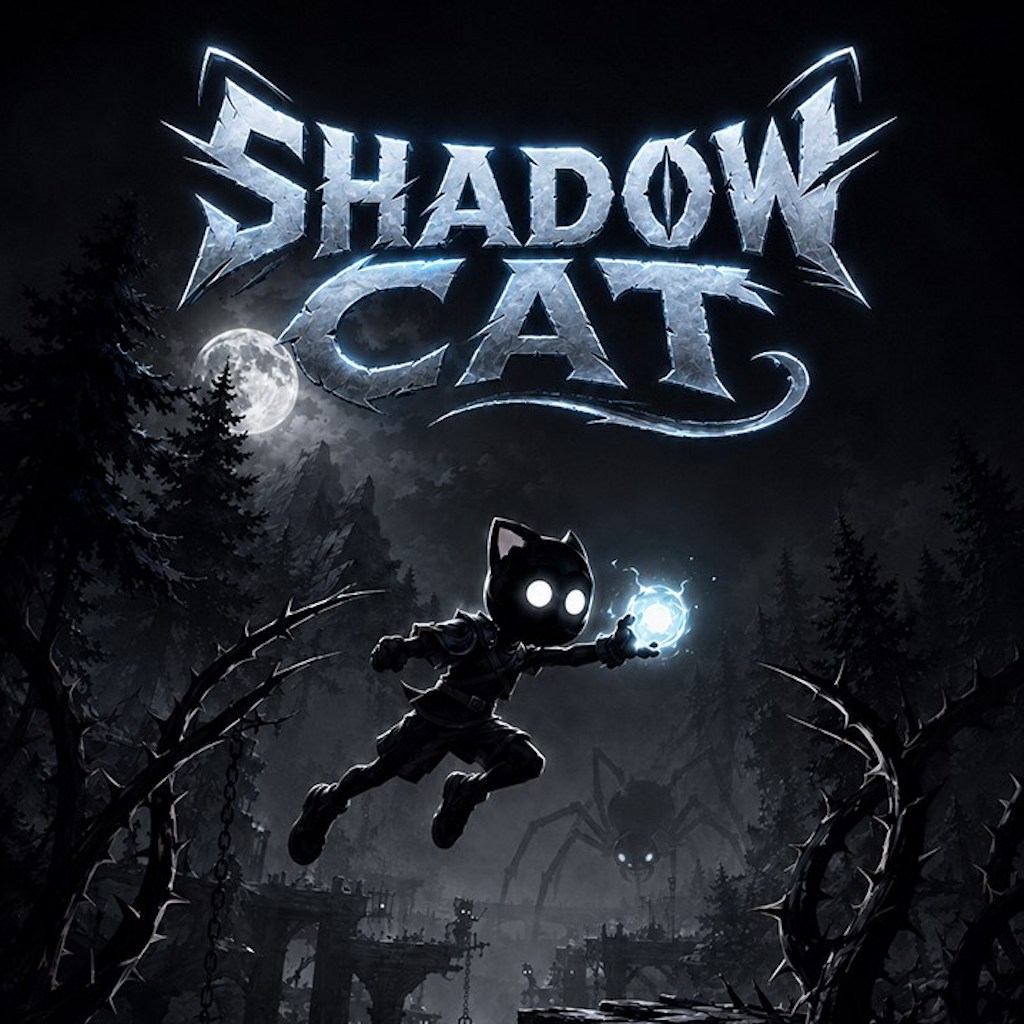
There is something wonderfully appealing about a tiny hero taking on a world that seems determined to swallow him whole. Shadow Cat understands this immediately, dropping you into a dark, hostile landscape where being small, quiet and incredibly nimble is far more useful than charging headfirst into danger. Developed and published by AVGAM, this compact 2D action platformer puts you in control of a fearless cat boy as he fights his way through a world overrun by evil creatures, deadly traps and some decidedly unfriendly machinery.
At first glance, Shadow Cat looks like the sort of platformer you can pick up, play for a few minutes and put down again. The controls are straightforward, the objective is simple and the stages are relatively compact, but there is considerably more going on beneath that dark exterior. As the adventure progresses, movement, timing, exploration and resource management all become important, while the game’s shadow mechanics add an interesting stealth element to what could otherwise have been a fairly familiar platforming experience.
The result is an adventure that does not need dozens of hours to make an impression. Its approximately two-hour runtime is one of its strengths, because Shadow Cat knows what it wants to be and gets on with delivering it. There is very little unnecessary padding here, just a focused journey through a dangerous world that steadily asks more of you as you move towards its final confrontation.
A Cat With Plenty Of Moves
Getting around in Shadow Cat feels satisfyingly responsive, which is exactly what you want from a game where a badly timed jump can send you straight back to the latest checkpoint. Running and jumping form the foundation, but the ability to dash adds another useful layer to your movement. Suddenly, a gap that looked impossible becomes manageable, while laser grids, spikes and moving hazards become problems that require a little more thought than simply holding forward and hoping for the best.
There is also a pleasing sense of weight to the cat boy’s movement. The animations help sell the idea that you are controlling something agile rather than a generic pixelated character, with jumps, landings and quick movements all having a certain feline grace. Wall running and wall jumping become particularly useful when the levels start throwing more vertical challenges at you, and mastering those movements can be the difference between sailing through a section and repeatedly introducing your furry hero to the nearest hazard.
Then there are the fireballs. Apparently, even a shadowy cat boy needs to carry magical ammunition around with him. Fireballs provide a straightforward way of dealing with the creatures scattered throughout the levels, but ammunition is limited, meaning you cannot simply throw them around like confetti. Finding life points and additional fireball ammo encourages you to explore rather than blindly rush towards the exit, and that small resource management element adds another reason to look around before moving on.
Where Light Becomes The Enemy
The most interesting aspect of Shadow Cat is its relationship with light and darkness. The game is described as a stealth-focused experience built around blending into shadows, which gives the platforming a distinct flavour. Instead of every obstacle being something you simply jump over or destroy, certain areas become puzzles where you need to consider where the light is coming from and where the shadows fall.
Switches, lights, environmental objects and destructible bulbs can all become part of the solution. Manipulating the environment to create a safe patch of darkness gives the game a pleasing sense of interaction, particularly when security systems and patrolling enemies are involved. There is something satisfying about standing in the darkness while a threat passes by, knowing that stepping a little too far into the light could turn a quiet moment into a frantic escape.
This is where Shadow Cat feels like more than just another retro platformer. The stealth mechanics are not incredibly complicated, but they give the levels another dimension and encourage you to observe your surroundings. You are not always asking, “How do I get over there?” Sometimes the better question is, “How do I make it safe to get over there?” That small difference makes a surprisingly big impact.
Sneaking Past Trouble
The sentry drones and security systems add plenty of tension to the later stages. Rather than simply throwing enemies at you and expecting you to fight everything, Shadow Cat often asks you to think about positioning, timing and distractions. You can use your surroundings to draw attention away from important areas, while objects can be knocked from ledges or thrown to create opportunities to slip past danger.
There is also something amusing about the idea of a cat using a simple meow as a tactical distraction. It is such a wonderfully feline solution to a serious problem. Why engage in a complicated battle when you can make a noise, watch something investigate it, and quietly disappear in the opposite direction?
The pouncing mechanics add another option when stealth fails or when you simply decide that a particular guard has been annoying enough. They create a nice balance between avoiding confrontation and taking control of a situation. Shadow Cat is at its best when it gives you a problem and lets you decide whether to sneak around it, manipulate the environment or take the more direct approach.
Twenty Five Levels Of Trouble
The adventure takes you through 25 handcrafted levels, with environments ranging from dark forests and dangerous caves to abandoned factories and forgotten tunnels. The variety is important because the game could easily have become visually repetitive given its reliance on darkness and silhouettes, yet each setting brings its own hazards and atmosphere.
The further you progress, the more demanding the platforming becomes. Early sections give you room to learn the basic mechanics, while later stages combine moving hazards, enemies, tricky jumps and environmental puzzles. This gradual escalation works well because it feels like the game is teaching you through play rather than throwing everything at you immediately.
Checkpoints are particularly welcome. Taking damage costs a life and sends you back to the latest checkpoint, while losing all your lives means restarting the level from the beginning. That can sound harsh, and there are certainly moments when the game feels unforgiving, but the short levels prevent failure from becoming completely frustrating. You might grumble after making the same mistake for the fourth time, but there is usually an immediate temptation to have another go.
A World Of Shadows And Neon
Visually, Shadow Cat has a style that suits its subject beautifully. The high-contrast pixel art uses deep silhouettes against glowing lights, neon effects and industrial-orange flares, creating a world that feels bleak without becoming visually dull. There is a clear presentation too, which matters enormously when the game asks you to judge jumps and hazards quickly.
The cat boy himself is particularly well animated. There is a fluidity to his movements that gives the character more personality than the simple premise might suggest. Watching him creep through a dark environment, leap across a gap or spring from one wall to another makes the character feel surprisingly alive.
The Xbox Series X|S version also benefits from 4K Ultra HD support on compatible hardware and displays. That extra sharpness helps the game’s silhouettes, glowing attacks and environmental details stand out, although the underlying appeal comes from the artistic direction rather than technical fireworks. This is pixel art that knows exactly when to keep things simple.
Listen To The Darkness
The audio adopts the same restrained approach. Rather than filling every second with an enormous soundtrack, Shadow Cat uses minimalist, dark synth music to set the mood. The music can swell during tense moments, but it generally knows when to step back and let the environment do the talking.
Small sound effects also make a difference. Pawsteps across metal grates, the hum of security systems and the presence of nearby lasers give certain areas a wonderfully unsettling atmosphere. You begin to listen as much as you look, which works particularly well during the stealth sections.
It is a subtle soundtrack rather than one you are likely to be humming for days afterwards, but that is not really the point. Shadow Cat uses sound to create atmosphere and tension, and in that respect it does its job very well.
Cute Hero, Serious Challenge
One of the things I like most about Shadow Cat is that it does not mistake its cute protagonist for an invitation to make the game ridiculously easy. This is a game that will happily punish impatience, poor timing and the occasional moment of overconfidence. Those spikes do not care that you are controlling an adorable cat boy, and neither do the security systems.
Trial and error can occasionally feel a little strict, particularly when later levels combine several hazards at once. Instant-death situations can be frustrating when you know exactly what went wrong but have to repeat a section to try again. Thankfully, the compact nature of the levels means the frustration rarely has time to become overwhelming.
There is also a satisfying feeling when everything finally clicks. You learn the timing of a moving hazard, understand where a shadow needs to be created, conserve your fireballs and make the sequence look effortless. Of course, it was not effortless at all. You just had to fail enough times first to make it look that way.
A Small Adventure With Plenty Of Heart
With an adventure lasting around two hours, Shadow Cat is never going to compete with enormous platforming epics in sheer content. What it offers is arguably more valuable for this particular style of game: focus. The 25 levels have a clear purpose, the mechanics are introduced at a sensible pace, and the challenge increases without completely losing sight of accessibility.
There are also collectables and exploration opportunities for players who want to investigate every dark corner. Those secrets provide another reason not to rush towards the exit, particularly if you enjoy squeezing a little more out of a compact game. The achievement list adds another layer for completionists, giving the adventure a little more staying power once you have reached the end.
Most importantly, Shadow Cat has personality. It is not trying to reinvent the entire 2D platforming genre, but it takes familiar ingredients and combines them with a clever light-and-shadow mechanic, a stealthy approach, and a protagonist who is difficult not to like.
The Final Confrontation
Eventually, all that sneaking, jumping, dashing and fireball-throwing leads to the game’s final confrontation with a giant spider and its relentless minions. It is an appropriate way to finish an adventure that has spent so much time making you feel small and vulnerable in a hostile world. By this point, you have learned the controls, understood the hazards and, hopefully, developed enough patience to deal with whatever the game throws at you.
The final stretch provides a satisfying conclusion to a compact adventure rather than dragging things out simply to extend the runtime. That is perhaps the biggest compliment I can give Shadow Cat. It knows how long it needs to be, and it leaves you with the feeling that you have completed a proper little adventure rather than simply played the first chapter of something much larger.
Final Verdict
Shadow Cat is a charming, stylish and surprisingly tense 2D platformer that blends traditional movement with stealth, environmental manipulation and light-based puzzles. Its responsive controls make jumping and dashing enjoyable, while the shadow mechanics give the familiar platforming formula a welcome twist. The dark pixel art looks fantastic, the minimalist synth soundtrack creates an appropriately eerie atmosphere, and the 25 handcrafted levels provide enough variety to keep the short adventure moving at a satisfying pace.
It is not without its rougher moments. The trial-and-error approach can occasionally be unforgiving, and some of the later hazards feel designed to test your patience as much as your reflexes. There is also no escaping the fact that two hours is a fairly short adventure, particularly if you are looking for a huge amount of content.
Even so, Shadow Cat understands that a compact game can still leave an impression. There is something genuinely enjoyable about guiding this tiny feline hero through a world of darkness, creating shadows, avoiding mechanical sentries and eventually bringing a little light back into a place that has almost completely lost it. It is cute without being childish, challenging without becoming relentlessly cruel, and stylish without relying on spectacle.
For fans of retro platformers, stealth puzzles and games that reward careful movement, Shadow Cat is well worth spending a couple of evenings with. Sometimes you do not need a hundred-hour adventure to have a memorable journey. Sometimes all you need is a brave cat, a handful of fireballs and enough darkness to hide in.