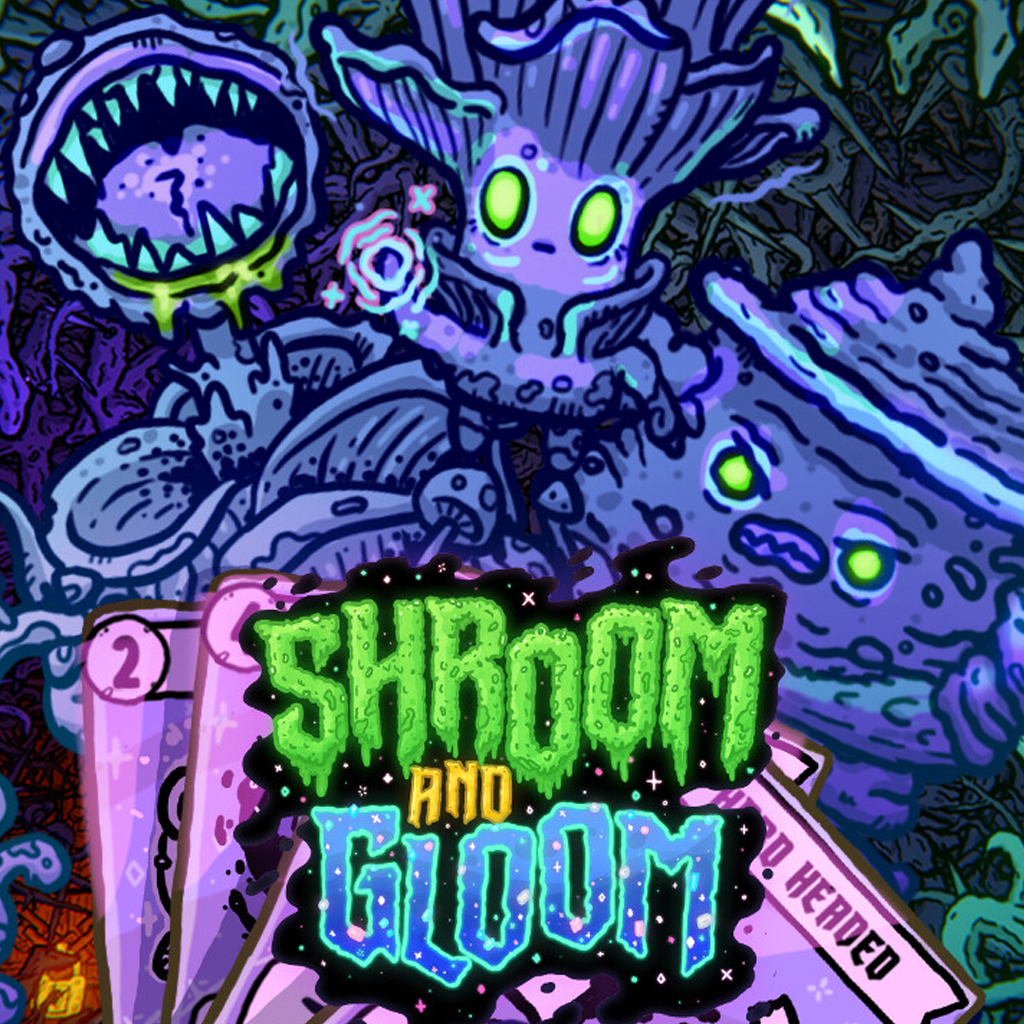
There are plenty of roguelike deckbuilders out there, but very few of them look at a mushroom, decide it would make an excellent meal, and then build an entire combat system around the idea. Shroom and Gloom is gloriously weird in exactly the right way. Developed by Team Lazerbeam and published by Devolver Digital, this first-person dungeon crawler throws you into a subterranean world packed with grotesque fungal creatures, hundreds of cards, ridiculous combinations, and enough mushrooms to make you question whether you have accidentally wandered into the world’s strangest woodland kitchen.
What makes it particularly interesting is that this is not simply another deckbuilder with a slightly unusual setting. Shroom and Gloom splits its card system into two separate decks, one dedicated to combat and another to exploration. That simple idea changes the way you approach almost everything, because fighting enemies and moving through the dungeon are treated as distinct strategic challenges. Add infinitely upgradeable cards, edible enemies, bizarre soups, and a roguelike structure to the mix, and you have a game that feels wonderfully unpredictable from one run to the next.
Welcome To The Gloom
The first thing that strikes you about Shroom and Gloom is how strange its world looks. The game takes place beneath the surface in a fungus-infected realm known as The Gloom, and it manages to make the entire place feel simultaneously fascinating, threatening and slightly ridiculous. Hand-drawn enemies inhabit richly detailed three-dimensional environments, creating a visual style unlike most other games in the genre.
The fungal creatures themselves are particularly memorable. They are grotesque, colourful and often rather funny to look at, which is quite an achievement, considering many of them are actively trying to murder you. There is a wonderfully exaggerated quality to the artwork that gives every enemy plenty of personality, while the darker dungeon environments provide an effective backdrop for all that mushroomy madness.
It is a visual style that suits the game’s personality perfectly. Shroom and Gloom clearly does not want to take itself too seriously, but that does not mean the world lacks atmosphere. The strange combination of eerie underground spaces and almost cartoonish fungal horrors gives the game a wonderfully surreal identity that sticks in the mind long after you have stopped playing.
Two Decks Are Better Than One
The central mechanical idea here is the dual-deck system. Instead of a single deck handling every situation, you have a Combat deck and an Explore deck, and learning to use both effectively becomes the foundation of a successful run.
The Combat deck is fairly self-explanatory, but there is considerably more to it than simply playing attack cards until the enemy disappears. You need to consider your available actions, how your cards interact, and how to build combinations that grow increasingly powerful as a battle develops. The more you understand the possibilities within your deck, the more you start looking at apparently ordinary cards and wondering what ridiculous thing you could eventually turn them into.
Then there is the Explore deck, which is where Shroom and Gloom really begins to distinguish itself. Exploration becomes a card-based activity, with abilities that let you reveal areas, search for useful items, break obstacles, unlock paths, ignite campfires, fix things, and interact with the environment. Instead of simply choosing a direction and walking through a dungeon, you are effectively playing another little strategic game every time you move forward.
That separation creates some fascinating decisions. You might have an excellent Combat deck but find yourself struggling to make progress because your Explore options are lacking. Equally, you can prepare beautifully for the journey ahead only to discover that your carefully constructed combat strategy falls apart when confronted with an unexpected enemy. The two decks constantly feed into one another, and learning how to balance them is one of the most satisfying parts of the game.
Eat Your Enemies
Then there is the cooking. Yes, cooking. One of the most entertaining ideas in Shroom and Gloom is that defeated fungal enemies are not simply piles of experience points waiting to be collected. They are food. You can skewer them, season them, roast them and eat them to restore health, or throw them into a pot to make soups with useful effects. It is completely bonkers, and it works brilliantly.
There is something wonderfully satisfying about defeating a horrible mushroom creature and immediately deciding how best to prepare it for dinner. It also gives combat a little more strategic flavour, because an enemy is not necessarily valuable simply for the damage it can deal or the rewards it provides. You are also thinking about what it might become once it is on your plate.
The cooking system could easily have been a pointless gimmick, but here it fits naturally into the wider survival mechanics. Health management is important during a roguelike run, and turning your defeated enemies into something useful creates another reason to think carefully about what happens after a battle. It is hard not to smile when your carefully planned dungeon crawl suddenly turns into a rather disgusting episode of MasterChef.
Breaking The Game Is Part Of The Fun
Card upgrades are where things become particularly addictive. Shroom and Gloom allows cards to be modified repeatedly, with the potential for basic starting attacks to evolve into immensely powerful weapons. Rare cards can also be pushed to ridiculous levels, leaving plenty of scope to discover combinations that feel completely broken. And that is clearly the point.
There is a special kind of satisfaction in taking a card that initially seems fairly ordinary and slowly turning it into something capable of demolishing an enemy in one spectacular move. The game encourages experimentation rather than insisting there is one perfect way to build your deck. Every run gives you another opportunity to try something different and see just how far you can push a particular strategy.
The possibilities become particularly entertaining when several effects begin to interact. Suddenly, a card that seemed useful becomes essential because it works beautifully with another ability you picked up twenty minutes earlier. Then another upgrade appears and changes the equation again. Before long, you are staring at your collection wondering whether you have accidentally created a tactical masterpiece or simply something that should probably be illegal in several countries.
That sense of discovery is exactly what a good roguelike needs. Even when a run ends badly, you have usually learned something that can influence your next attempt.
Every Journey Is Different
The roguelike structure ensures that Shroom and Gloom rarely feels completely predictable. You will encounter different enemies, cards, opportunities and routes as you progress, while branching dungeon paths give you reasons to make meaningful choices rather than simply following one fixed corridor.
The Early Access release currently provides two distinct dungeon paths leading towards The Gloom, each with its own card pools. There are also five playable characters and a selection of quests designed to unlock additional content. That is already enough to provide a healthy amount of experimentation, particularly when you start combining different characters with different cards and approaches.
Naturally, Early Access means the game is still growing. More cards, enemies, dungeons and other content are planned as development continues, so what exists today should be viewed as the foundation rather than the finished structure. The important thing is that the foundation is already strong, because the underlying mechanics are enjoyable enough to make you want to see where the developers take them next.
There is also something wonderfully compelling about knowing that the game has room to become even stranger. When a game already lets you roast monsters and transform basic attacks into absurd weapons, it is difficult not to wonder what Team Lazerbeam might come up with next.
A Dungeon With Character
The presentation deserves plenty of credit because Shroom and Gloom could easily have felt like a collection of disconnected ideas. Instead, the hand-drawn art and three-dimensional environments create a coherent visual identity. The fungal creatures stand out beautifully against the darker dungeon backgrounds, while the animations and effects give combat a lively sense of impact.
The sound design helps maintain that unusual atmosphere. Underground echoes, strange ambient effects and subtle electronic music create a slightly unsettling backdrop, while the sounds of combat and cooking provide satisfying feedback. Hearing a card activate, an attack connect, or something sizzling in a pan adds a pleasing physical quality to the otherwise abstract business of playing cards.
There is also a nice contrast between the unsettling world and the game’s sense of humour. One moment you are exploring a dark cavern that feels genuinely ominous, and the next you are deciding which seasoning to use on the mushroom monster you just defeated. That tonal balance could have been disastrous in less capable hands, but Shroom and Gloom manages to make the ridiculous and the eerie coexist surprisingly comfortably.
One More Run
Like any good roguelike, Shroom and Gloom has mastered the dangerous phrase “one more run”. You might finish an unsuccessful attempt knowing exactly where things went wrong, and convince yourself that another go will be different. Perhaps you will find a better card. Perhaps the next dungeon route will suit your build. Perhaps you will finally discover the combination that turns your character into an unstoppable fungal killing machine.
That constant possibility makes failure considerably easier to accept. Losing a run does not feel like wasted time, because every attempt teaches you something about the cards, the enemies and the ways the systems interact. The next run starts with the knowledge gained from the last, and that gradual understanding becomes almost as rewarding as progression itself.
There are moments when the sheer number of possibilities can feel a little overwhelming, particularly when you start experimenting with more complicated combinations. However, that complexity is ultimately part of the appeal. Shroom and Gloom wants you to experiment, make mistakes and occasionally stumble across something gloriously ridiculous.
Final Verdict
Shroom and Gloom is one of those games that is almost impossible to describe without sounding slightly ridiculous. It is a first-person dungeon crawler in which you manage two separate decks, fight horrible mushroom creatures, cook your enemies, endlessly upgrade your cards, and attempt to create combinations powerful enough to break the game. Somehow, rather than becoming a confused collection of gimmicks, all of those ideas fit together into a remarkably cohesive roguelike experience.
The dual-deck system is the star of the show, giving exploration and combat their own identities while forcing you to consider both when planning a run. The card-modification system provides enormous room for experimentation, while the cooking mechanics add a wonderfully strange survival element that makes every fungal enemy potentially useful. Add the distinctive artwork, atmospheric audio, branching dungeon routes, and the promise of considerably more Early Access content, and there is plenty here to keep card-battler fans coming back.
It is not quite perfect. The wealth of systems can take some time to fully understand, and the Early Access structure naturally means there is still a sense of unfinished business surrounding the wider adventure. Yet the core experience is already remarkably entertaining, and the game’s personality carries it a long way.
Most importantly, Shroom and Gloom feels like it has a clear idea of what it wants to be. It wants to be strange, creative, unpredictable, and a little bit disgusting, while giving players the tools to create increasingly ridiculous card combinations. It succeeds on all four counts.
If you enjoy roguelike deckbuilders and fancy something that feels genuinely different, Shroom and Gloom is well worth crawling into. Just remember to bring an appetite. You never know when the next mushroom trying to kill you might also make a surprisingly good soup.