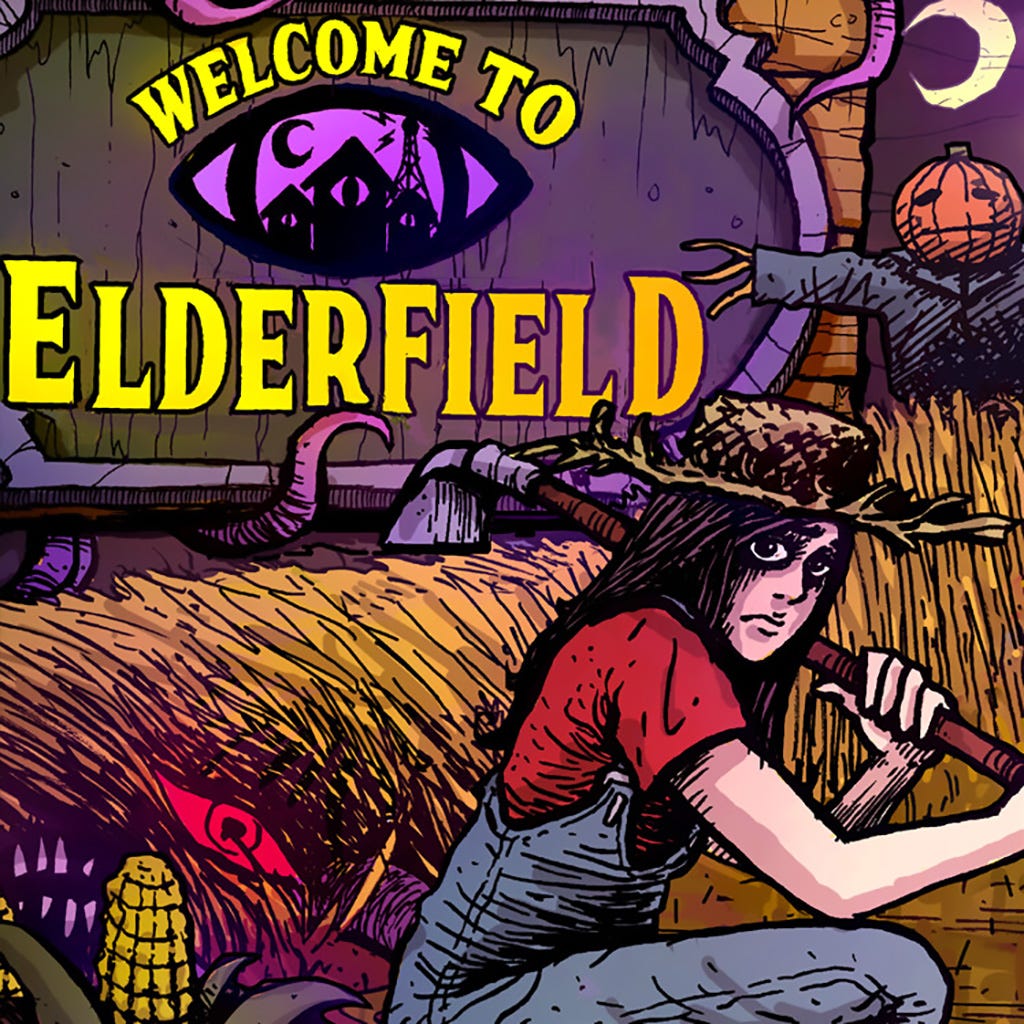
There is something wonderfully wrong with Welcome to Elderfield. At first glance, it looks like a cosy life simulator where you might spend your mornings watering crops, your afternoons fishing and your evenings chatting to the friendly locals before heading home for a good night’s sleep. Then you notice that some of those crops are eyeballs, the livestock is decidedly unnatural, the woods are full of things that should not exist, and there is a rather worrying possibility that going to bed might result in your untimely demise.
That strange contradiction is exactly what makes Welcome to Elderfield so fascinating. Developed by solo creator Chris Cote and published by Kwalee, this unusual RPG takes the familiar routines of farming, fishing, cooking, mining and building relationships and drops them into a world inspired by horror manga and Lovecraftian fiction. It is a game where you can spend an afternoon lovingly tending your pumpkins before heading into the darkness to fight an ancient horror, and somehow the two activities feel like they belong together.
Welcome To Elderfield
Elderfield is not your typical sleepy little town. The people are odd, the local news seems increasingly bizarre, and eldritch beings watch from somewhere beyond the edges of everyday life. The strangest part is that nobody seems particularly surprised by any of it. In Elderfield, abnormal is simply normal, which makes the setting considerably more unsettling than a world where everyone is constantly screaming about the latest supernatural disaster.
The storytelling has a wonderfully understated quality. Rather than throwing every horror directly into your face, the game lets the weirdness seep into everyday life. A strange conversation here, an unsettling news report there, and suddenly you begin to wonder how much everyone else knows about what is happening around them. It creates an atmosphere where even something as innocent as walking into town can feel like the start of another mystery.
That balance between the mundane and the disturbing is one of the game’s greatest strengths. You might be thinking about what crops need harvesting while wondering whether something has been watching you from the woods. It gives even the most ordinary activities a slight sense of unease, and that is a difficult feeling to create without turning everything into relentless horror.
Farming Has Never Been This Disturbing
The farming mechanics provide the comforting backbone of the experience, but Welcome to Elderfield has no intention of letting you enjoy a peaceful vegetable patch without planting a few nightmares in the soil. Alongside familiar crops such as corn and pumpkins, you can grow considerably stranger things, including teeth and eyeballs.
It is a wonderfully grotesque twist on a familiar formula. Planting, watching it grow, and harvesting should feel comforting, yet there is something deeply unsettling about pulling an eyeball from the ground and casually adding it to your inventory. The game understands that juxtaposition and uses it repeatedly to create an experience that can be charming one minute and deeply uncomfortable the next.
Your farm is also not entirely safe. Unruly tentacles can spread across your land, while strange creatures from the surrounding woods may decide to pay a visit. Looking after your homestead therefore becomes more than simply maximising your harvest. You have to think about protecting what you have built and ensuring your resources are sufficient for whatever Elderfield decides to throw at you.
There is also a pleasing sense of progression in managing the farm. Crops, livestock, and gathered resources all feed into the wider RPG systems, giving you reasons to keep improving your little patch of land. Rather than existing as a separate mini-game, farming becomes part of the larger survival loop, and that makes every successful harvest feel useful.
A Cosy Life With A Dark Side
Away from the horrors, there is a surprisingly relaxing life simulator hiding within Welcome to Elderfield. You can fish, mine, forage, cook, customise your character and decorate your home, while getting to know the people who live in the town. There is even the possibility of romance and marriage, because apparently nothing says commitment quite like settling down together while eldritch gods loom overhead.
The relationship system gives Elderfield some much-needed warmth. The townsfolk may be strange, but they are also the people who make the town feel like a community rather than simply a backdrop for your adventures. Spending time with them, learning more about their lives and unlocking new conversations create another reason to explore the town beyond simply collecting resources.
Home customisation adds another welcome layer. After spending hours wandering through dark mines and dealing with supernatural horrors, being able to return to a place that feels like your own provides a sense of sanctuary. You can gradually shape your surroundings and create somewhere that feels comfortable, even if the rest of the world seems determined to make you question your sanity.
That contrast is important because Welcome to Elderfield never becomes pure horror. The cosy elements are not simply decoration around the frightening parts. They are what make the frightening moments work, because you have something peaceful to lose.
When The Old Gods Come Calling
Eventually, the relaxing side of Elderfield has to give way to something considerably more dangerous. Combat is turn-based and demands more thought than simply choosing the strongest attack available. Equipment, resources, buffs and strategic decisions all play important roles when facing the Lovecraftian horrors lurking beneath the town and beyond.
Combat can be surprisingly punishing, particularly if you approach it without proper preparation. Your equipment matters, your resources matter, and the decisions you make before an encounter can have consequences once the fighting begins. This gives the RPG side of the game a satisfying sense of weight, because you cannot simply wander into every dangerous location expecting to survive through brute force.
There is also a welcome choice of difficulty. Players looking primarily for a relaxed farming and exploration experience can choose a cosy setting, while those who want the full survival challenge can embrace the harsher side of Elderfield. That flexibility is important because the game’s unusual mixture of genres means different players will naturally want different things from it.
Personally, I like that the game allows both approaches to coexist. Sometimes you want to spend an evening fishing and tending crops without worrying too much about being eaten by something ancient. Other times, you want to venture into the darkness and see whether your carefully prepared character can survive. Welcome to Elderfield gives you room to decide how much suffering you are prepared to endure.
Death Is Part Of The Journey
The game’s approach to failure is another interesting part of its design. The basic philosophy of “die, learn, farm and forage, then die again” tells you quite a lot about what to expect. Death is not necessarily the end of the adventure, but another step in learning how Elderfield works.
That fits the RPG structure particularly well. Every dangerous expedition teaches you something, whether it is an enemy’s attack pattern, the value of a particular resource, or the importance of preparing properly before heading into a dangerous area. Over time, you become more capable not simply because your character has improved, but because you have learned how to approach the world.
The sleep system also adds an interesting wrinkle. There is no rigid curfew forcing you home at a specific time, so you can continue exploring into the night if you are willing to accept the consequences. Fatigue and increasingly unpleasant encounters make staying out late a genuine gamble, which creates wonderfully tense moments when you realise you probably should have gone home half an hour ago.
There is something beautifully appropriate about that mechanic. A cosy life simulator usually encourages you to head home, sleep, and start another pleasant day. Elderfield instead makes you wonder whether bedtime itself is the dangerous part.
Horror Manga In A Cosy World
Visually, Welcome to Elderfield has a distinctive identity that immediately sets it apart. The hand-drawn artwork draws on horror manga, conjuring grotesque creatures and unsettling imagery that sit alongside much more charming town environments. The result is a world that feels familiar enough to be welcoming yet strange enough to keep you slightly uncomfortable.
That visual contrast works beautifully. The town itself can feel almost quaint, while the creatures lurking outside it look as though they have escaped from a particularly unpleasant nightmare. The horror does not simply come from darkness and shadows. Sometimes it is the creature itself, sitting there in all its bizarre glory, daring you to get closer.
The audio adopts a similarly restrained approach. A dark lo-fi soundtrack provides a surprisingly soothing backdrop for your everyday activities, while environmental sounds and creature noises help sustain the uneasy atmosphere. There is something particularly effective about listening to relaxing music while doing something completely ordinary, only to hear a sound that reminds you something horrible is lurking nearby.
It gives the game an identity that is difficult to mistake for anything else. Welcome to Elderfield looks and sounds like a cosy game that has spent far too much time reading forbidden books.
There Is Always Something To Do
One of the most impressive things about the game is how naturally its systems overlap. Farming provides resources, which help with crafting and cooking, and cooking helps you survive. Exploration reveals new areas and mysteries, relationships unlock additional content, and combat lets you deal with whatever stands between you and the secrets Elderfield is hiding.
That interconnectedness keeps the experience moving. You are rarely doing something simply because the game tells you to. Instead, there is usually another reason to continue. A trip to the mine might yield materials for an upgrade. Fishing might give you something useful for cooking. Spending time with a villager might reveal a new part of their story. Even wandering around town can uncover another strange little piece of the larger mystery.
The result is an experience that constantly encourages curiosity. You want to know what is behind the next door, what is happening in the woods, and why the town’s inhabitants seem so strangely comfortable with everything around them. More importantly, you want to understand what Elderfield actually is.
That sense of curiosity carries the game through its quieter moments. Even when you are simply gathering resources, there is usually a lingering feeling that something is waiting just beyond the edge of what you can currently see.
Final Verdict
Welcome to Elderfield is a wonderfully strange game, and I mean that as a compliment. It takes the familiar comforts of a farming and life simulator and mixes them with Lovecraftian horror, turn-based RPG combat, relationship-building, exploration, and a wonderfully unsettling, manga-inspired art style. The result should not work as well as it does, yet the contrast between cosy routines and eldritch nightmares becomes the game’s defining strength.
The farming system gives you somewhere to call home, while fishing, mining, cooking, and foraging provide plenty of reasons to keep exploring. Relationships add warmth and personality, while combat gives the RPG systems genuine weight. The ability to choose between a more relaxed, cosy difficulty and a tougher experience also means the game can accommodate players looking for different levels of challenge.
There are moments when the sheer number of ideas can make Elderfield feel slightly busy, and players expecting a straightforward farming simulator may be surprised by just how dark things can become. The combat and resource management also demand more attention than the cute presentation initially suggests. Yet these are not flaws that undermine the experience. They are part of what gives the game its character.
What I particularly love about Welcome to Elderfield is the way it understands that horror is often more effective when placed next to something comforting. Growing a crop feels different when you know something might be watching from the woods. Going to bed feels different when nightmares are a possibility. Even making friends feels slightly strange when everyone around you seems perfectly comfortable with the impossible.
It is cosy, but never completely safe. It is horrifying, but never completely bleak. Somewhere between those two extremes, Welcome to Elderfield finds a wonderfully distinctive identity that makes it very difficult to put down.