There are games designed to make you think, games to test your reflexes, and then there are games that simply make you smile before you have even taken your first turn. Flamecraft sits very comfortably in that last category, although beneath its adorable dragons, colourful shops and wonderfully cosy presentation lies a surprisingly clever little strategy game. It takes the familiar ideas of resource management, worker placement and engine building and wraps them in such a warm, welcoming world that even players who normally run screaming from anything described as a strategy game might find themselves tempted to pull up a chair.
You take on the role of a Flamekeeper, wandering around a bustling fantasy town where dragons are not mythical creatures hiding in distant mountains but an everyday part of life. These aren’t enormous beasts setting castles on fire either. Instead, they are tiny artisan dragons who bake cakes, brew potions, forge metal and generally make themselves useful around the town’s collection of shops. Your job is to bring these dragons together, gather resources, improve the shops and build enough reputation to become the Master of Flamecraft. It sounds simple, and thankfully it is easy to understand, but there is enough depth beneath the surface to keep your brain quietly ticking away.
Welcome To A Town Full Of Dragons
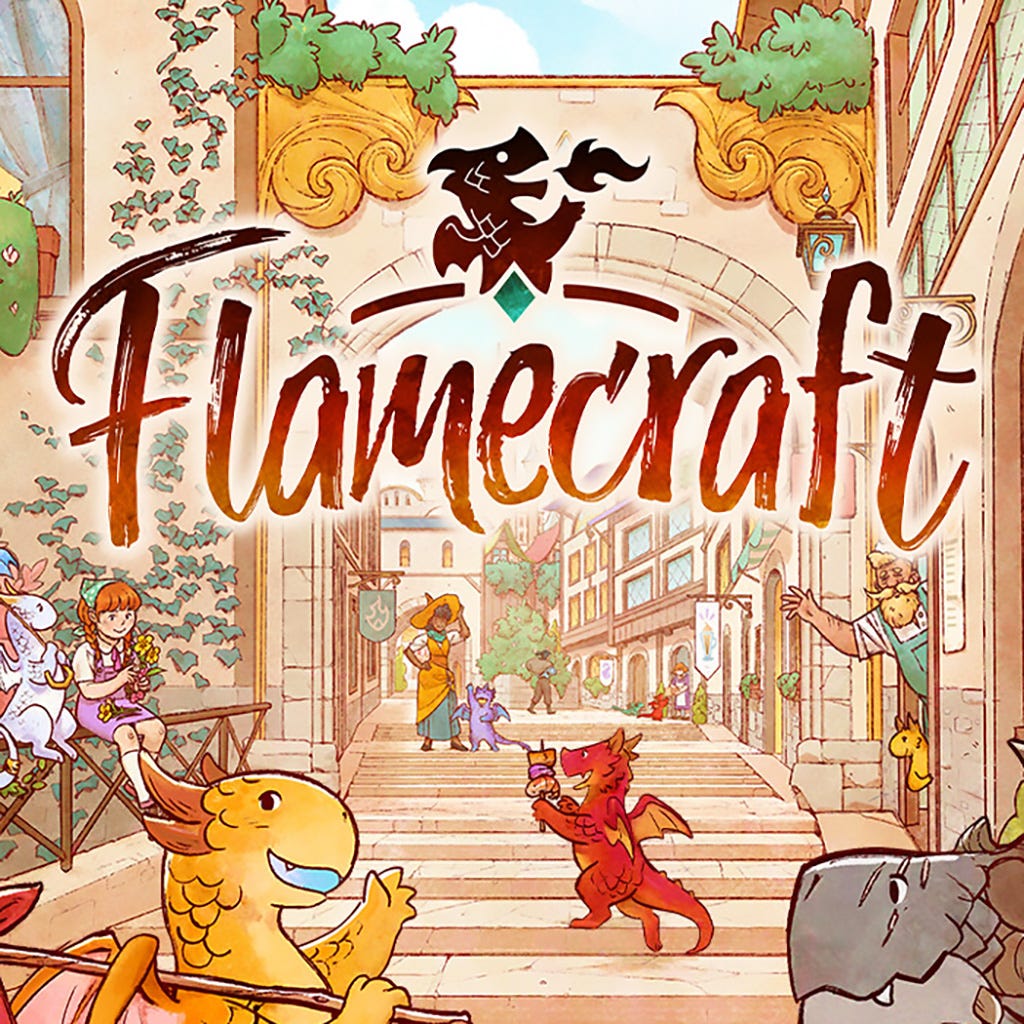
The first thing that grabs you about Flamecraft is the world itself. Sandara Tang’s artwork gives the game an almost storybook quality, filling the town with expressive dragons, charming buildings and little details that make every shop feel like somewhere you genuinely want to visit. There is something wonderfully inviting about looking across the board and seeing a collection of tiny dragons happily getting on with their jobs. Even the resources have a lovely tactile quality that fits perfectly with the game’s overall personality.
The digital version gives that artwork a little extra life. The shops become vibrant 3D locations, dragons animate as they work, and the whole town feels considerably more alive than a static board game might suggest. It is not trying to be visually spectacular in the traditional blockbuster sense, because that would completely miss the point. Instead, it aims for warmth, colour and charm, and it succeeds beautifully.
Then there is the music. The whimsical score does a great deal of work in creating the right atmosphere, giving the whole experience a gentle, relaxing rhythm. It is the sort of soundtrack that can sit happily in the background while you consider your next move, rather than constantly demanding attention. Together, the artwork, animation and music create an experience that feels almost like stepping into a beautifully illustrated children’s book.
Gather, Build And Make Some Magic
The core gameplay is remarkably approachable. On your turn, you generally visit one of the shops in town and decide whether to gather resources or enchant the shop. Gathering lets you collect the resources produced there and place Artisan Dragons in available slots. Enchanting, meanwhile, lets you spend the resources you have gathered to improve the shop and trigger its special ability.
That sounds straightforward, but this is where Flamecraft starts revealing its strategic side. Every decision feeds into another, and the most satisfying turns are the ones where everything suddenly falls into place. You might gather a few resources, trigger a dragon’s ability, gain another resource, complete an enchantment, and then receive another reward for doing so. Watching these little chains develop is a major source of the game’s appeal.
It never feels as though you are drowning in spreadsheets or forced to calculate dozens of variables before making a move. Instead, Flamecraft gives you enough information to make meaningful decisions without turning every turn into homework. There is a lovely balance between planning ahead and simply seeing what opportunities are available in front of you.
The Dragons Are The Stars
The Artisan Dragons are arguably the real stars of the show. There are more than 70 dragons to encounter, each with their own role and personality, and they give the town enormous character. One might specialise in baking while another helps with potions or metalwork, and placing the right dragons in the right shops becomes an important part of building your little resource engine.
What makes this particularly satisfying is that the dragons don’t feel like anonymous workers being moved around a board. They feel like part of the world. You are effectively building a little community as you play, bringing together creatures with different talents and watching the town grow around them. It is a small thing, but it gives the resource management a sense of purpose that many strategy games struggle to achieve.
There are also the Fancy Dragons, which add another layer of strategic thinking. These creatures come with their own abilities and can help you increase your reputation, while their objectives encourage you to think about the longer game rather than simply grabbing whatever resources happen to be available. Working out how to satisfy these objectives without disrupting your broader plans adds just enough hidden information and personal strategy to keep things interesting.
When The Combos Start Rolling
The best moments in Flamecraft come when your careful planning pays off and you suddenly find yourself chaining several actions together. Resource management is at the heart of everything, so knowing when to gather and when to spend is crucial. You do not want to hoard everything indefinitely, but you also do not want to waste valuable resources simply because you can afford an enchantment.
The enchantments are particularly enjoyable because they give you that satisfying little feeling of making your engine more efficient. Improving a shop can unlock new opportunities, generate reputation and create combinations that make future turns more productive. It is satisfying without becoming overwhelming, which is exactly what Flamecraft needs to maintain its cosy identity.
There is also a clever little touch when another player is already occupying a shop you want to visit. Rather than blocking you completely, you simply pay a resource to the other player and carry on. It keeps the interaction friendly and stops the game from becoming unnecessarily aggressive. You can still benefit from what another player has built, while they receive something in return, creating an unusual sense of cooperation within what is still a competitive game.
Growing The Town
One of the most enjoyable aspects of Flamecraft is watching the town develop during a game. When a shop’s dragon slots are full, a new shop can be revealed, expanding the possibilities available to everyone. This means the board gradually becomes more interesting as the game progresses, rather than presenting the entire decision space from the start.
That gradual growth works particularly well for new players. At the start, you only need to worry about a relatively small set of options, but as you become more comfortable with the systems, the town expands and offers more possibilities to consider. It is a gentle way to introduce players to the game’s deeper mechanics without throwing everything at them at once.
It also gives every game a slightly different rhythm. The shops that appear and the combinations you discover can change how you approach the game, while the Fancy Dragon objectives give you additional reasons to adapt your plans. There is enough variety here to encourage repeat plays without losing the accessibility that makes Flamecraft so appealing in the first place.
A Strategy Game Anyone Can Enjoy
Perhaps the biggest compliment I can pay Flamecraft is that it knows exactly what kind of game it wants to be. It is not designed for hardcore strategists who want an enormous decision tree and several hours of analysis. It is a lighter, more welcoming strategy experience that lets families, newcomers and experienced players sit around the same table and enjoy playing together.
That does not mean there is no strategy. Far from it. There are plenty of decisions to make, particularly once you understand how resources, enchantments, dragon abilities and reputation work together. Experienced players will naturally get more out of those combinations, but the rules never become intimidating enough to push less experienced players away.
The solo mode is also a welcome addition, while multiplayer supports up to five players and gives the town a little more energy as everyone competes for the most useful opportunities. Playing against AI at different difficulty levels gives digital players another way to practise and experiment, while custom games make it easy to create something more relaxed when you simply want to enjoy the setting.
Cosy From Start To Finish
There is a growing number of games that describe themselves as cosy, but Flamecraft genuinely understands the appeal of the genre. There is no pressure to save the world from an ancient evil, no enormous tragedy hanging over every character, and no desperate race against the clock. Instead, you are helping dragons bake cakes, brewing potions, collecting resources, and improving little shops.
That simplicity is incredibly refreshing. The game creates a sense of progression without relying on constant danger or dramatic stakes. Your reward is watching your little town become more impressive, discovering new combinations, and seeing your reputation steadily increase. It is strategy with a warm cup of tea beside it.
Even when you are competing against other Flamekeepers, there is an almost cooperative feel to the experience because everyone is contributing to the same growing town. You may want to score more points than everyone else, but it never feels nasty. That makes Flamecraft particularly easy to recommend to families and groups who want something strategic without turning game night into a war.
A Beautifully Crafted Digital Board Game
The digital presentation deserves plenty of credit for retaining the character of the physical game while making everything incredibly easy to interact with. The animated dragons and shops are lovely, the interface is straightforward, and the ability to move around the town makes the whole thing feel like a living little place rather than a collection of menus.
It is also the kind of game that benefits from being played at your own pace. You can sit back, take in the artwork, and think about your next move without feeling rushed. That relaxed pace is fundamental to the experience, and the presentation never gets in the way.
Most importantly, the digital version never loses the personality that makes the tabletop game so appealing. The dragons still feel adorable, the shops still feel inviting, and every new enchantment still provides that satisfying little sense that your town is becoming something special.
Final Verdict
Flamecraft is a lovely little strategy game that proves you do not need complicated systems, enormous maps or brutal competition to create something genuinely engaging. Beneath its wonderfully cute exterior lies a smart resource-management and engine-building game that rewards planning without leaving newcomers completely lost. The Artisan Dragons are adorable, the shops are beautifully designed, and the gradual expansion of the town gives every game a satisfying sense of progression.
What really makes it work, though, is the atmosphere. Everything from the artwork and animation to the music and the gentle interactions between players contributes to an experience that feels genuinely warm. It is the sort of game that can appeal to someone who normally avoids strategy games, while still giving experienced players enough interesting decisions to keep them coming back.
There are certainly deeper and more demanding strategy games out there, and anyone looking for a hardcore eurogame experience may eventually find Flamecraft a little lightweight. For everyone else, however, this is a beautifully accessible gateway into the genre and a wonderful reminder that strategy games can be clever without being intimidating. Sometimes, all you really need is a town full of dragons, a handful of resources and a really good reason to build one more combo.