There is a certain purity to old-school arcade games that modern releases sometimes forget. They did not need sprawling open worlds, elaborate skill trees, or cinematic storytelling to keep players hooked. All they needed was a great idea, tight controls, and the irresistible urge to chase a score that always seemed just within reach. SlipVector proudly embraces that philosophy, delivering an experience built around fast reactions, simple objectives, and the satisfaction of mastering its systems through repetition.
Developed by Gray Mantis, SlipVector casts players as a digital antivirus program deployed to eliminate the Zanikore virus before it completely corrupts the system grid. It is a straightforward premise that exists mainly to frame the action, and that is perfectly fine. This is a game where the story sits quietly in the background while the gameplay takes centre stage.
From the moment the first level begins, SlipVector makes its intentions clear. This is an unapologetically arcade-inspired score-chaser that values momentum, precision, and split-second decision-making above everything else. It may not offer the deepest package on the market, but what it does deliver is polished, energetic, and surprisingly difficult to put down.
Simple Goals, Fast Action
The objective is almost impossible to misunderstand. Every stage is infested with hostile Zanikore entities, and your task is to eliminate every last one while surviving long enough to push your score as high as possible. That simplicity works entirely in the game’s favour, allowing players to focus on movement, positioning, and efficiency rather than complicated mechanics.
Enemies appear in increasingly dangerous formations, forcing you to stay constantly on the move while balancing offence and defence. Standing still is rarely an option, and hesitation is often punished within seconds. Every successful run becomes a careful dance between aggressive attacks and smart evasive manoeuvres.
The pacing deserves particular praise. SlipVector wastes very little time easing players into its systems. Within minutes, the screen fills with hazards, projectiles, and opportunities to collect valuable power-ups. It creates the kind of exhilarating pressure that defined many classic arcade cabinets without ever becoming unfair. Failure usually feels like the result of your own mistake rather than questionable design, which is one of the highest compliments an arcade game can receive.
Movement Feels Fantastic
The real star of SlipVector is its movement system. Controlling your digital craft feels wonderfully responsive, enabling sharp turns, quick adjustments, and fluid navigation through increasingly hostile arenas.
Momentum plays a significant role throughout each encounter. Learning when to commit to aggressive attacks and when to reposition becomes essential as enemy numbers rise. Success comes from understanding the rhythm of movement rather than relying purely on reflexes.
There is an almost hypnotic quality to gliding around the colourful system grid. Once the controls become second nature, every successful run builds a satisfying sense of flow, where movement, shooting, and collecting power-ups merge into a seamless rhythm.
That sense of mastery keeps drawing you back for one more attempt. Even after defeat, it rarely feels frustrating because you immediately recognise what you could have done differently.
Power Ups Add Welcome Variety
While the core gameplay remains intentionally straightforward, SlipVector introduces a selection of power-ups that inject welcome variety into each run. Some dramatically increase your offensive capabilities, allowing you to clear infected enemies at an impressive rate, while others improve survivability during particularly overwhelming encounters. Deciding when to grab a power-up and how best to capitalise on its temporary advantages adds another layer of tactical thinking without slowing the action.
Because power-ups appear dynamically throughout each stage, no two attempts unfold in exactly the same way. One run may reward aggressive play with a steady stream of offensive upgrades, while another demands a more cautious approach due to fewer opportunities. This unpredictability helps maintain long-term replayability despite the relatively simple structure.
Chasing Higher Scores Never Gets Old
Like the finest arcade experiences, SlipVector understands that score chasing is more than mere survival. It is about efficiency, confidence, and the gradual refinement of your performance until every movement becomes instinctive.
Each completed run naturally encourages another attempt. Maybe you missed a power-up. Perhaps you lost a life to a careless mistake. Or maybe you simply know you can clear the final section more cleanly next time.
That constant pursuit of improvement becomes surprisingly addictive. Leaderboards and personal bests provide enough motivation for competitive players, while more casual audiences can simply enjoy seeing their skills steadily improve over time. The game rarely relies on artificial progression systems because the greatest reward is becoming genuinely better at playing it.
Presentation
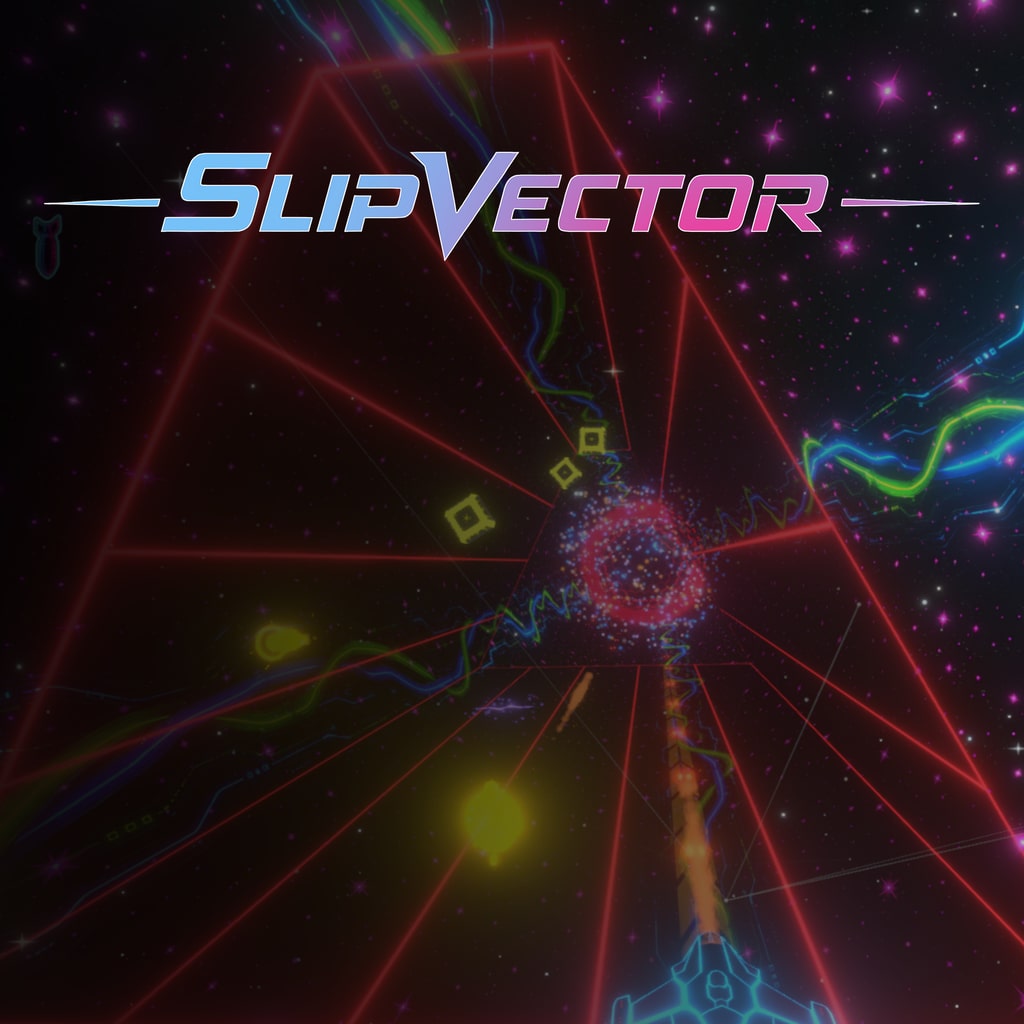
SlipVector immediately captures attention with its striking, retro-inspired presentation. Bright neon colours illuminate dark digital landscapes, creating a clean visual style that recalls classic vector graphics while still feeling modern enough to sit comfortably alongside contemporary indie releases.
The colourful system grids remain easy to read even during the busiest moments. Enemy attacks are clearly telegraphed, power-ups stand out naturally, and visual clutter rarely interferes with gameplay. In a genre where readability is crucial, this clarity is one of the game’s greatest strengths.
Performance is equally impressive. Frame rates remain consistently smooth, allowing the responsive controls to shine throughout even the most chaotic encounters. Given the game’s reliance on precise movement, that stability proves absolutely essential.
The soundtrack complements the visuals perfectly. Pulsing electronic music drives the action forward without becoming repetitive, while crisp sound effects provide satisfying feedback for every defeated enemy and collected upgrade. Together, the audio and visuals successfully recreate the energetic atmosphere of a classic arcade cabinet in the modern era.
Depth Through Mastery Rather Than Complexity
Players expecting extensive campaigns, elaborate progression trees, or dozens of gameplay modes may initially find SlipVector modest. Its focus remains firmly on refining a single gameplay loop rather than constantly introducing new mechanics.
However, that restraint ultimately becomes one of its greatest strengths. Every system exists for a reason, and very little feels unnecessary or artificially inflated to pad playtime.
The challenge gradually shifts from learning new mechanics to mastering existing ones. Better positioning, smarter resource management, quicker reactions, and cleaner movement become the real progression system.
That philosophy may not appeal to everyone, particularly players who prefer constant unlocks and narrative rewards, but arcade enthusiasts will almost certainly appreciate its confidence.
A Few Missing Pieces
Although the core gameplay remains consistently entertaining, SlipVector could benefit from slightly greater variety over extended sessions. Additional enemy behaviours, environmental hazards, or alternative objectives would help keep later runs feeling even fresher.
The minimalist presentation also keeps narrative elements extremely limited. While story is hardly essential in a game like this, a little more world-building around the Zanikore virus and digital setting could add extra personality.
Some players may also find the difficulty curve surprisingly steep. The opening moments are accessible enough, but later encounters demand genuine concentration and precision. Thankfully, repeated attempts steadily build confidence rather than causing frustration.
These shortcomings never undermine the fundamental quality of the gameplay, but they do leave room for future updates or sequels to expand on an already solid foundation.
Final Verdict
SlipVector is a confident celebration of classic arcade design. It strips away unnecessary distractions and focuses entirely on delivering responsive controls, satisfying movement, intense action, and the addictive pursuit of higher scores.
Its straightforward premise, vibrant presentation, and rewarding gameplay loop combine to create an experience that feels instantly familiar yet remains engaging enough to keep players returning long after their first successful run. Every improvement feels earned, every mistake becomes a lesson, and every completed stage encourages another attempt to do even better.
It may not match the content volume of larger modern releases, but quality has always mattered more than quantity in arcade games. SlipVector understands this better than most, offering an experience where pure gameplay remains king. For players who miss the simple joy of chasing a high score through skill rather than statistics, SlipVector proves that the spirit of the arcade is still very much alive.