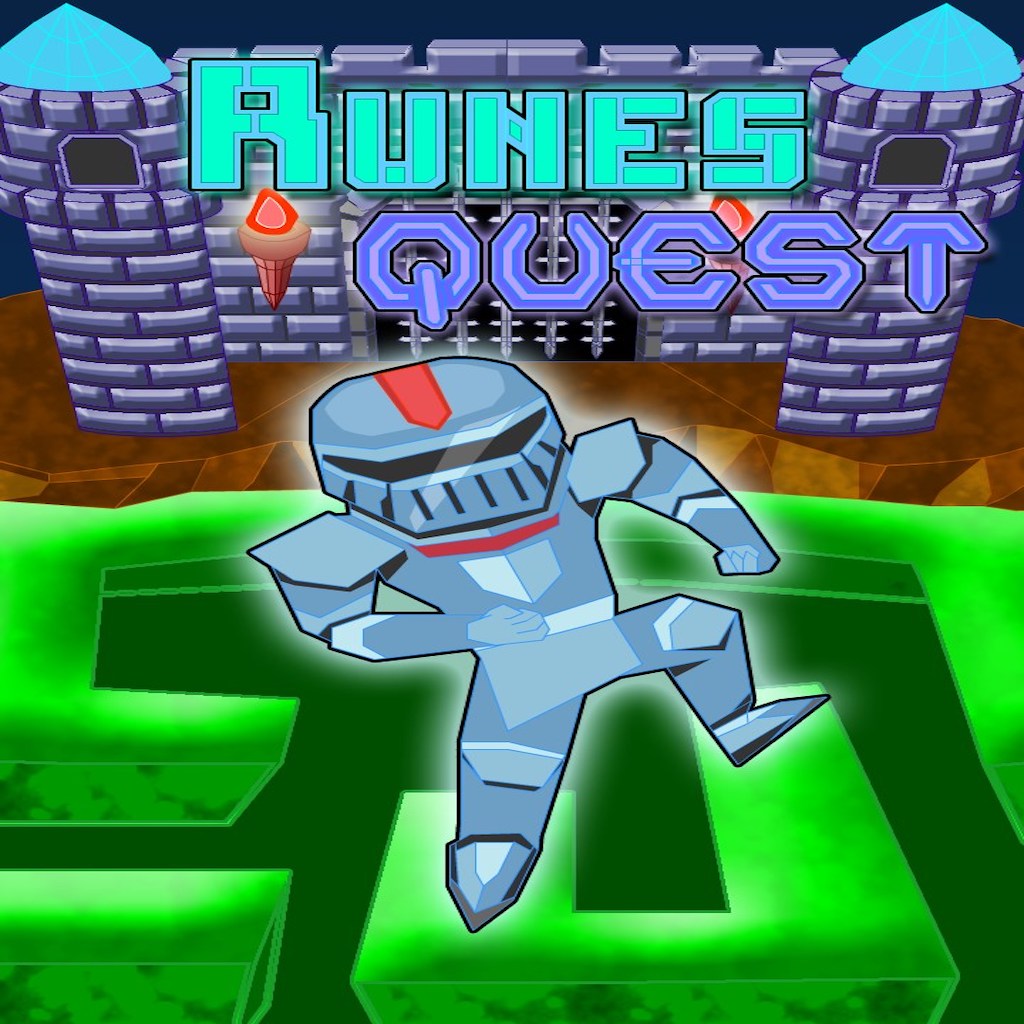
There is something wonderfully comforting about a good Sokoban puzzle. You look at a room, study the position of every box, button and obstacle, and realise the solution is probably right in front of you. The challenge is not finding the answer, but working out the exact sequence of moves required to reach it without making a mess of everything. Runes Quest understands that appeal and wraps the classic formula in a cute fantasy setting, sending a little knight on a journey through 30 increasingly demanding levels as he tries to find his way home.
Developed by Lovixsama and published by Xitilon, Runes Quest is very much a budget-friendly puzzle game, and it does not pretend to be anything more ambitious. There is no sprawling fantasy adventure waiting behind the next door, no elaborate character development and no epic story to get invested in. Instead, the focus is firmly on the puzzles themselves, with boxes, keys, buttons, grates, pits, traps and magical runes providing the tools you need to progress. Sometimes, there is something quite refreshing about a game that knows exactly what it wants to be.
A Knight With Somewhere To Go
The basic premise is charmingly straightforward. You control a brave little knight who has somehow found himself away from home, and the only way back is to navigate the puzzle rooms standing between him and his destination. The story is little more than a backdrop for the gameplay, but it provides just enough context to give your journey a purpose. You are not simply pushing boxes around because the game tells you to. You are helping this tiny armoured adventurer get home.
That simplicity works well because Sokoban has always been about the immediate problem in front of you. There is something satisfying about entering a new room and taking a few moments to assess the layout before making your first move. A button might open a grate, but standing on it could prevent you from reaching the key you need. A box might need to be pushed onto a particular spot, but getting it there could block another route entirely. These are small problems, but when everything clicks into place, they can be surprisingly satisfying.
Runes Quest also understands the importance of keeping its rules easy to grasp. You are not bombarded with pages of instructions before you can start playing. The game introduces its elements naturally, allowing you to learn what buttons, keys, boxes and runes do through experimentation. That makes it approachable for newcomers while still giving experienced puzzle fans enough familiar territory to settle into.
Classic Sokoban With A Fantasy Twist
At its heart, Runes Quest is unapologetically a Sokoban game. The grid-based movement is deliberate and methodical, and every step matters. Pushing a box in the wrong direction can leave you with an unsolvable puzzle, so the temptation to simply charge ahead needs to be resisted. It is the kind of game that rewards patience, observation and the willingness to pause and think.
That is where much of the enjoyment comes from. There is no need for lightning-fast reactions or complicated button combinations. Your greatest weapon is your brain, and the game gives you the time to use it. When you finally discover that one sequence of movements that makes everything fall into place, there is a satisfying little moment of triumph that never really gets old.
The introduction of additional mechanics helps prevent the experience from becoming nothing more than a collection of identical box-pushing rooms. Keys add another layer of planning, while pressure buttons and grates can force you to think about the order in which you tackle different parts of a level. Pits and traps introduce another reason to consider your movements carefully, and the runes add a little magical flavour to an otherwise very traditional puzzle structure.
None of these ideas completely reinvent the genre, but they do give Runes Quest enough variety to keep the journey moving. The best puzzles are those where several elements have to be considered together, rather than simply asking you to move a box from A to B. There is a pleasant feeling of gradually understanding how all the pieces of a level fit together.
Thirty Little Challenges
Thirty levels is a respectable number for a game of this scale. It gives the player a genuine sense of progression without making the experience feel like an endless collection of increasingly similar rooms. The difficulty curve is important in this sort of game, and Runes Quest generally benefits from letting its mechanics build gradually.
The early levels serve as a gentle introduction, giving you time to become comfortable with the controls and basic rules. As new elements are introduced, the puzzle rooms become more involved and require a little more planning. There is still a sense that the game wants you to succeed rather than punish you, which fits with its relaxed presentation.
There will inevitably be moments when you make a move, immediately realise you have made a terrible mistake, and wish you could rewind time. That is practically part of the Sokoban experience. While this can be frustrating, it also makes successful solutions feel more rewarding. The satisfaction comes from understanding why your previous attempt failed and finding a better way forward.
Light And Dark
Visually, Runes Quest keeps things deliberately cute and uncomplicated. The two biomes, light and dark, provide welcome variation and help break up what could otherwise become a rather monotonous collection of grid-based rooms. The pixel art has a pleasant retro quality, and the little knight gives the game much of its personality.
It is not going to win any awards for technical presentation, but that is not really the point. The artwork is clear, colourful and functional, making it easy to distinguish interactive objects from environmental decoration. In a puzzle game, that clarity is important because confusion about what you are looking at can quickly become frustrating for the wrong reasons.
The relaxing music is another nice touch. Rather than bombarding you with dramatic orchestral tracks every time you enter a room, the soundtrack provides a gentle backdrop that complements the game’s slower pace. It encourages you to sit back and think rather than rush through the levels, which feels exactly right for this sort of experience.
A Relaxed Puzzle Adventure
One of the things I appreciated most about Runes Quest is how uncomplicated it feels. Modern games can sometimes bury even the simplest concepts beneath progression systems, upgrade trees, challenges, currencies and endless distractions. Here, you have a knight, a puzzle room and a route home. That is pretty much it.
For casual players, that simplicity could be a real selling point. You can pick the game up, complete a few levels and put it down without feeling as though you have forgotten half the mechanics by the time you return. It works particularly well for short gaming sessions, and there is something satisfying about knowing you can make meaningful progress in relatively small chunks of time.
Achievement hunters will also find plenty to appreciate. The straightforward structure and accessible gameplay make Runes Quest an attractive proposition for players who enjoy adding another completed game to their collection. That may not be the most important consideration for everyone, but it is certainly part of the audience this sort of budget puzzle release naturally appeals to.
Where The Magic Runs Out
The biggest problem with Runes Quest is that its simplicity can occasionally work against it. While the additional mechanics add some variety, the underlying gameplay remains firmly rooted in a formula that has been around for decades. If you have played many Sokoban-style games, you may find there are few genuine surprises.
The presentation is also basic, though that is less of a criticism given its price and intended scale. There is a difference between a game being deliberately simple and a game feeling unfinished, and Runes Quest generally stays on the right side of that line. It has enough visual personality and mechanical variety to avoid feeling completely anonymous, even if it never develops a distinctive identity of its own.
I also found myself wishing there were a little more personality around the puzzles. The knight is a charming little character, and the fantasy setting has potential, but the game does not really explore it beyond providing a backdrop. A little more storytelling, perhaps some environmental touches or a few amusing character moments, could have made the journey feel more memorable.
That said, adding too much could just as easily have worked against the game’s strengths. Part of its appeal is that it does not waste your time. You are here to solve puzzles, and the game gets on with it.
The Final Move
Runes Quest is a modest game, and there is nothing wrong with modesty when the fundamentals are sound. It takes a familiar puzzle formula, gives it a cute fantasy presentation and provides 30 levels filled with boxes, keys, buttons, grates, traps and runes. It does not attempt to reinvent Sokoban, but it does offer a pleasant and accessible way to spend a few hours exercising the grey matter.
Its biggest strength is its accessibility. The rules are easy to understand, the presentation is welcoming and the relaxed music creates an atmosphere that makes it easy to settle into a puzzle-solving rhythm. There are no unnecessary complications getting in the way, and for players who simply want some straightforward brain-teasing, that can be surprisingly appealing.
The limitations are equally clear. Experienced puzzle fans may find the mechanics familiar and the overall experience somewhat lightweight, while those hoping for a deeper fantasy adventure will find very little story to sink their teeth into. The two visual biomes provide some variety, but they do not transform the fundamental experience.
Even so, I came away from Runes Quest with a smile. There is something satisfying about guiding that little knight through each room, carefully planning your moves and eventually watching the route home open up before you. It may not be a grand adventure, but it does not need to be. Sometimes, a small game with a simple idea is exactly what you need after a long day.