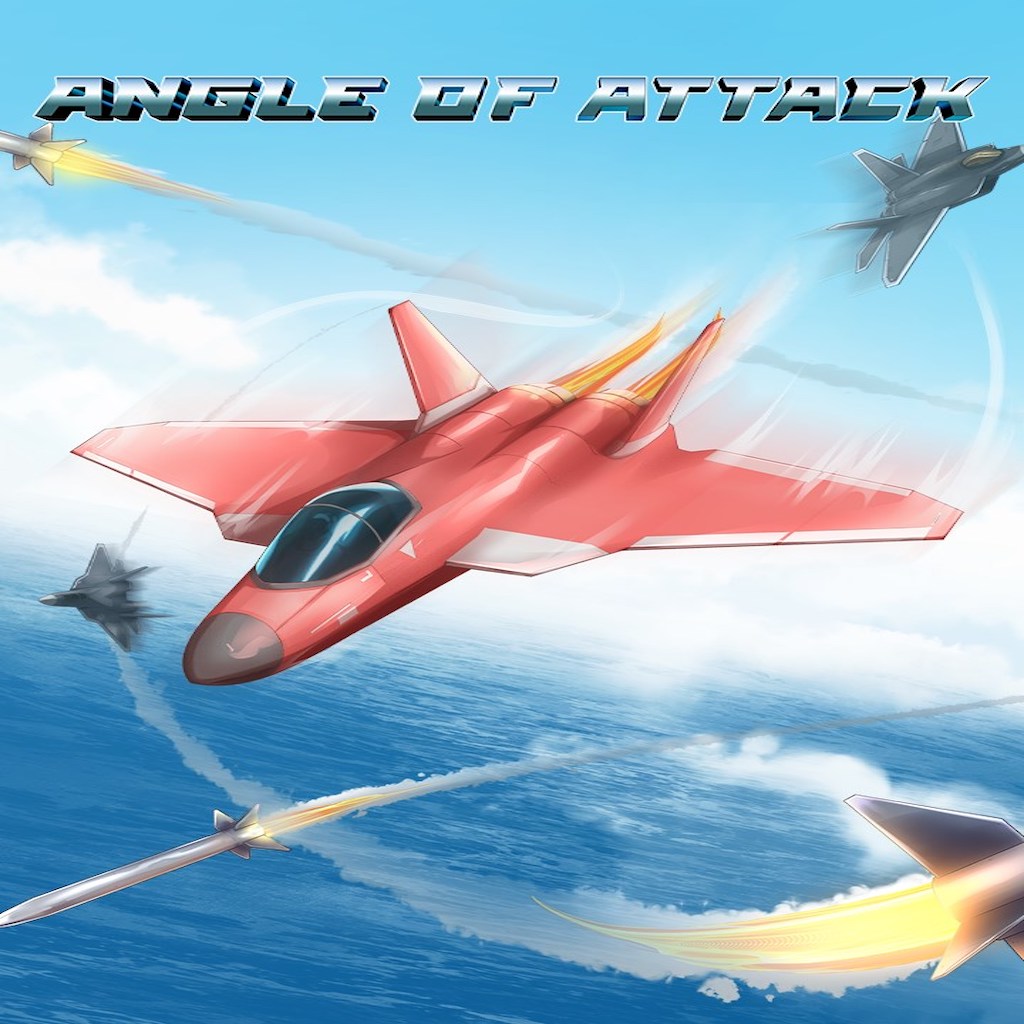
There is something undeniably appealing about climbing into a fighter jet, pointing the nose towards the horizon and immediately finding yourself in the middle of a dogfight. No lengthy briefing, no complicated skill trees and no twenty-hour campaign to work through before the action really starts. Angle Of Attack understands the appeal of the old arcade shooter and wastes very little time getting you into the cockpit. It is loud, colourful, frantic and occasionally unforgiving, but beneath its retro presentation sits a surprisingly enjoyable little aerial shooter that knows exactly what it wants to be.
Developed by 9Ratones and published by Ratalaika Games, Angle Of Attack puts you in the cockpit of a state-of-the-art fighter jet as you attempt to stop an invasion led by the ominously named Clever Foxes Clan. Across 30 missions, you will be asked to deal with enemy aircraft, ground installations, submarines, aircraft carriers, warheads and enormous air fortresses. It takes a deliberately old-school approach to arcade combat, with the emphasis firmly on reflexes, positioning and shooting rather than realism or complicated simulation.
Into The Cockpit
The premise is gloriously straightforward. The Clever Foxes Clan has launched a full-scale assault. Communications have been severed, and conventional forces are struggling to hold the line. That leaves your squadron with the unenviable task of taking to the skies and stopping the invasion, one mission at a time.
There is nothing particularly groundbreaking about the story, but that is not really a criticism here. Angle Of Attack is clearly inspired by an era when the plot was there primarily to give you a reason to blow things up. You are the pilot, the enemy is advancing, and there are targets that need destroying. Frankly, sometimes that is all the motivation required.
What matters is what happens once the mission begins. The game throws you straight into its colourful battlefields, with enemy units appearing across land, sea and air. There is a pleasing immediacy to it all. You are not spending the first ten minutes learning how to operate an aircraft. You are flying, shooting and dodging almost immediately.
Arcade At Heart
The 2D perspective is perhaps the most important part of Angle Of Attack’s identity. This is not a modern flight simulator, and there is no complicated cockpit instrumentation to distract you from the action. Instead, you get a streamlined arcade experience that emphasises movement, timing and keeping your aircraft alive.
That makes the game surprisingly easy to pick up. The controls are straightforward enough to grasp the basics quickly, but the real challenge comes from using them effectively as the screen fills with enemy fire. Dodging one attack is easy enough. Dodging several while lining up a target and avoiding collisions is another matter entirely.
There is a satisfying rhythm to the combat. You move into position, unleash your weapons, pull away from incoming fire and immediately start looking for your next target. It is not sophisticated, but it is fun, and that counts for a lot in an arcade shooter.
Thirty Missions Of Mayhem
With 30 missions making up the campaign, Angle Of Attack offers a reasonable amount of content for a game of this type. The variety comes from the objectives rather than a huge collection of complicated mechanics. One mission might have you intercepting warheads, while another asks you to destroy hardened ground installations or deal with enemy naval forces.
That variety helps keep the campaign moving. Fighting aircraft is obviously central to the experience, but being asked to attack targets on the ground and at sea gives the game a little more personality. Taking on a submarine or aircraft carrier feels different from chasing an enemy fighter, even though the underlying controls remain largely the same.
The larger set pieces are particularly enjoyable. There is something inherently satisfying about approaching a gigantic air fortress and watching it fill your screen. These moments provide the sense of scale that a relatively simple 2D shooter needs, giving you something to remember beyond simply clearing another group of enemies.
The missions can also become increasingly demanding as the campaign progresses. What begins as relatively straightforward target practice eventually requires you to pay much closer attention to where you are flying and what is happening around you. The game does not reinvent its mechanics as you progress, but it does become more demanding in how it expects you to use them.
Land, Sea And Sky
One of the game’s strengths is the variety of enemy units. With more than 30 enemy types across land, sea and air, there is enough variety to stop the battlefield from becoming completely predictable.
Enemy aircraft pose the most obvious threat, but ground installations can be just as troublesome when you are trying to maintain your position. Naval targets add another dimension, while warheads provide another reason to keep moving rather than simply concentrating on whichever enemy happens to be closest.
This variety is useful because it encourages you to look at the battlefield as a whole. You are not simply flying around looking for something to shoot. You need to think about what the mission is asking you to accomplish and which threats need to be dealt with first.
It is still very much an arcade shooter, though, so don’t expect the tactical complexity of a serious flight combat game. The variety is there to keep the action fresh rather than to transform Angle Of Attack into a military simulation.
Pixel Powered Warfare
Visually, Angle Of Attack embraces its retro ambitions wholeheartedly. The pixel art style gives the game a colourful, old-school appearance that suits its arcade roots. There is enough detail in the environments and enemy designs to make the battlefields interesting without sacrificing the clarity needed during fast-moving combat.
I particularly like that the game does not try to disguise its simplicity. There is a certain charm in seeing brightly coloured explosions, aircraft and enormous enemy structures rendered in a deliberately retro style. It gives the game a personality that a more generic modern presentation might have struggled to provide.
Of course, this approach will not appeal to everyone. Players expecting highly detailed aircraft models and photorealistic battlefields will find Angle Of Attack extremely basic. But that would be rather like criticising a classic arcade game for not being a flight simulator. The aesthetic is part of the package, and it suits what the developers are trying to achieve.
Finding The Right Difficulty
The three difficulty modes are a welcome addition. Arcade shooters can be tricky to balance because experienced players want something that tests their reflexes, while newcomers need a way into the action without being annihilated within seconds.
Having different difficulty options gives players a little freedom to choose how much punishment they are willing to take. The easier setting lets you enjoy the campaign and learn the mechanics, while higher difficulties offer a greater challenge for those who have mastered the basics.
It also adds replay value. Once you have completed the campaign, there is a clear reason to return and see how well you can perform at a higher difficulty. Whether that will be enough to keep players coming back for a long time is another question, but it is certainly better than a single fixed challenge.
The Arcade Sweet Spot
There is a particular charm to games like Angle Of Attack because they remind us that action does not always need to be complicated. Modern games can sometimes throw enormous numbers of systems at the player, while this one is perfectly happy to give you an aircraft and a list of targets to shoot.
That simplicity can be refreshing. You can sit down for a short session, complete a couple of missions, and walk away feeling as though you have actually accomplished something. There is no need to remember where you left a character quest or which upgrade path you were following.
The downside is that the simplicity also limits the game’s long-term appeal. Once you understand the controls and enemy patterns, there is not much beneath the surface. The missions provide variety, but the fundamental gameplay loop remains consistent from beginning to end. For arcade fans, that may be perfectly acceptable. For players looking for a deeper aerial combat experience, it will probably feel lightweight.
Where It Falls Short
The biggest problem with Angle Of Attack is that it does not quite have enough depth to elevate itself beyond its budget arcade roots. The basic combat is enjoyable, but there are relatively few systems to master beyond movement, aiming and target prioritisation.
There are also moments when the action can feel a little repetitive. Thirty missions sounds impressive on paper, but when the underlying mechanics remain largely unchanged, you can eventually start to feel like you have seen most of what the game has to offer. The different objectives and enemy types help, but they cannot completely mask the simplicity of the core formula.
That is not necessarily a fatal flaw. In fact, I suspect some players will actively appreciate the lack of unnecessary complexity. Angle Of Attack is never pretending to be anything other than a straightforward arcade shooter, and there is something admirable about that honesty.
It simply means that expectations need to be in the right place. This is a game to pick up, play and enjoy rather than one likely to occupy your thoughts for weeks.
A Quick Burst Of Arcade Fun
The achievement structure is also likely to appeal to completionists. The campaign offers a clear progression through its missions, and the straightforward mechanics make it accessible to anyone looking to add another completed title to their collection.
There is nothing wrong with a game being approachable. In fact, accessibility is one of Angle Of Attack’s greatest strengths. You understand what it wants from you almost immediately, so the game gets straight to the enjoyable part.
It also makes a welcome change of pace from more demanding games. After spending hours working through a complicated RPG or getting frustrated by a brutally difficult action title, there is something therapeutic about jumping into a fighter jet and simply blowing things up. Sometimes you don’t need an epic. Sometimes you just need twenty minutes of explosions.
Final Verdict
Angle Of Attack is a straightforward retro aerial shooter that succeeds largely because it understands the appeal of its own simplicity. The 2D combat is fast and accessible, the pixel art gives it plenty of nostalgic charm, and the 30 missions provide enough variety to keep the campaign moving.
The variety of enemy types and objectives is welcome, particularly when the game sends you after warheads, submarines, aircraft carriers and enormous air fortresses. Three difficulty settings also give players a reason to return once they have mastered the basics, while the uncomplicated controls ensure that anyone can climb into the cockpit without spending ages learning how to fly.
Its limitations are equally obvious. There is little here for players seeking a deep simulation or a highly sophisticated tactical shooter, and the relatively simple mechanics can become repetitive over time. The enemy behaviour and overall structure are firmly rooted in the budget arcade tradition, which means longevity will depend heavily on how much you enjoy chasing better performances.
For me, though, there is enough old-school charm here to make Angle Of Attack worth taking for a spin. It is not trying to change the aerial shooter genre, and it does not need to. It wants to deliver fast action, colourful explosions and a series of increasingly demanding missions, and it does that without unnecessary fuss.
There is a simple pleasure in watching an enemy fortress explode after several passes, narrowly avoiding a missile before banking immediately towards your next target. Angle Of Attack may be lightweight, but sometimes that is exactly what you want. Strap in, point the nose towards the enemy, and enjoy the ride.