Sometimes a game doesn’t need to reinvent the wheel. Sometimes you just want to sit down, switch your brain off for a little while, and shoot coloured marbles at other coloured marbles until everything disappears in a satisfying little chain reaction. Marble FX understands that simple pleasure completely. It is a deliberately minimalist match-three puzzle game inspired by arcade classics such as Zuma and Luxor, stripping the formula back to its essentials and concentrating almost entirely on the pleasure of making the right shot at the right moment.
Developed and published by Thomas Claus und Frank Menzel GbR, Marble FX arrives with little interest in unnecessary bells and whistles. There are no elaborate characters, sprawling storylines or overcomplicated systems competing for your attention. Instead, there is a central marble launcher, a winding track full of colourful spheres, and the increasingly urgent need to match three or more of the same colour before the advancing chain reaches its destination. It is a familiar formula, but there is a reason this particular style of puzzle game has endured for so long.
A Familiar Formula
If you’ve ever spent time with Zuma, you’ll know exactly what Marble FX is trying to achieve. You control a central emitter that fires coloured marbles into a moving chain, aiming to create groups of three or more matching colours. Successfully doing so removes those marbles from the track, while clever combinations can cause the remaining chain to collapse, creating opportunities for further matches.
It is an uncomplicated concept, but that doesn’t mean it is mindless. The further you progress, the more important it becomes to think about where your shot will land rather than simply firing at the first available colour. Sometimes the obvious match isn’t the best, particularly when you can create a larger chain reaction by waiting for the right opportunity. That small element of planning is what separates a satisfying puzzle game from something that quickly becomes little more than colourful target practice.
The controls are similarly straightforward, which is exactly what you want here. There is no lengthy tutorial demanding that you memorise a complicated control scheme before you’re allowed to have fun. You point, you fire and you react to the changing marble chain. It is the sort of game that can be picked up almost immediately, making it particularly well suited to short sessions.
Less Is More
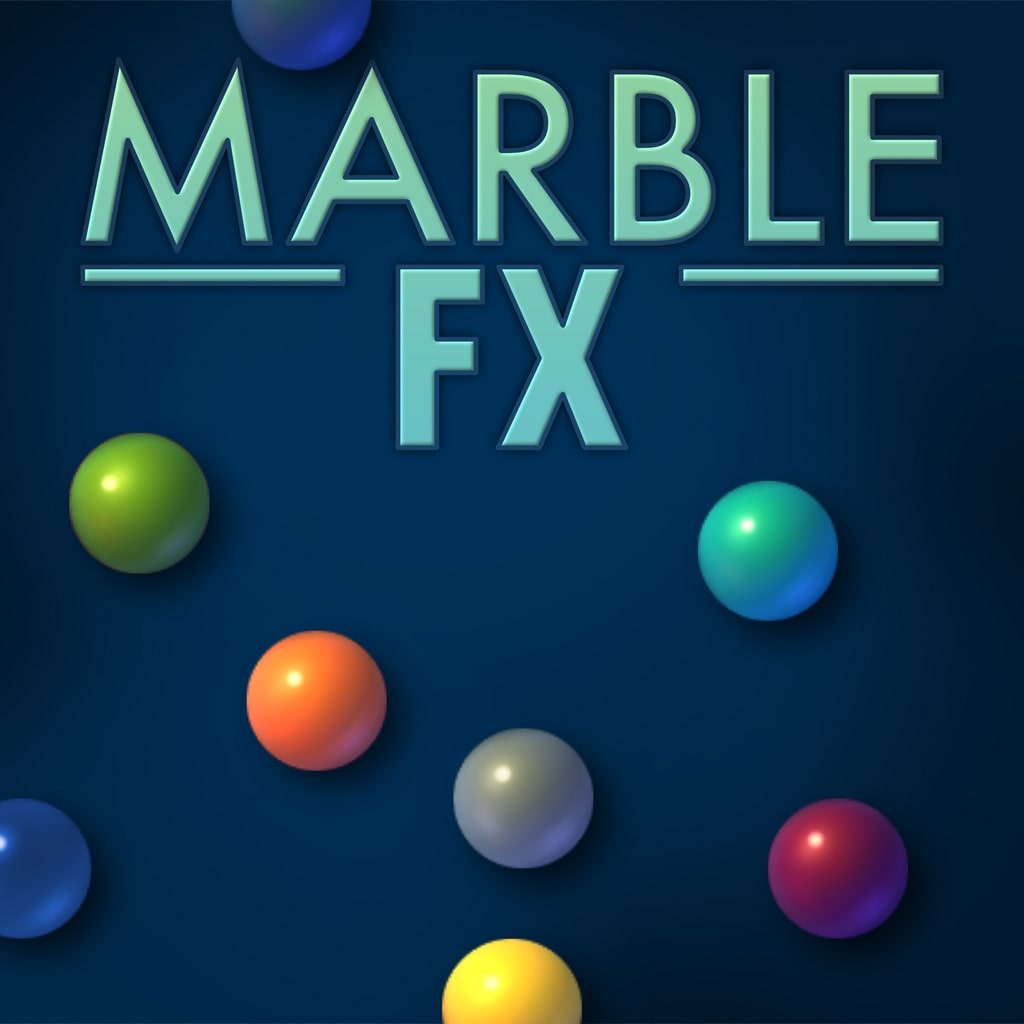
The most obvious characteristic of Marble FX is its minimalist presentation. The developers have clearly decided that the gameplay should be the star of the show, and almost everything surrounding it has been stripped back. The graphics are clean and modern, with the coloured marbles standing out clearly against the uncluttered environments.
Personally, I think this works rather well. Puzzle games live or die by clarity, and Marble FX makes it easy to understand what is happening on screen. You can immediately identify the colours, see the route of the approaching chain and concentrate on the shot you need to make. There are no distracting visual effects constantly vying for your attention, which makes the experience feel pleasantly focused.
The downside is that minimalism can easily become an excuse for a lack of content, and Marble FX occasionally wanders into that territory. There isn’t much here beyond the core gameplay, and players looking for a lavish arcade presentation with themed worlds, memorable characters and spectacular effects are likely to find the experience rather bare. It looks perfectly functional, but it doesn’t exactly dazzle.
That isn’t necessarily a criticism in itself. At a budget price of around €2.99/$2.99, expectations should be adjusted accordingly. The question isn’t whether Marble FX looks like a full-priced production, because it clearly doesn’t. The question is whether the gameplay is enjoyable enough to justify spending a few pounds on it, and for puzzle fans who enjoy this particular formula, there is certainly an argument that it is.
The Joy of a Good Chain Reaction
The best moments in Marble FX come when everything goes right. You line up a shot, create a match, and suddenly the chain shifts. Another set of marbles comes together, creating another match that triggers a collapse. Before you know it, you’ve set off a satisfying sequence that clears a substantial portion of the track.
That is the magic of the Zuma-style formula. It rewards both accuracy and anticipation, and there is a lovely sense of control when a carefully planned shot produces exactly the reaction you hoped for. Even after all these years, there is something immensely satisfying about watching a carefully constructed chain reaction unfold.
There is also constant pressure, knowing the marbles are moving towards the goal. You cannot spend forever considering your options. Eventually, you have to commit to a shot, and sometimes the safest option is more important than the most profitable. That balance between planning and panic gives the gameplay its rhythm.
It isn’t particularly difficult to understand, but mastering the flow of the game is another matter. As the speed and complexity increase, those previously comfortable decisions can suddenly become much more demanding. A misplaced marble can disrupt your plans, while a badly timed shot can leave you scrambling to prevent the chain from reaching the end.
Shuffle Mode
Where Marble FX attempts to add something of its own is in its Shuffle mode. Rather than simply presenting a fixed collection of handcrafted stages, this mode generates levels using a system that can adjust factors such as difficulty, wave length, track length, marble speed and the number of colours involved.
This is a clever idea because procedural generation can give a simple puzzle game considerably more longevity. Once you’ve played through a selection of predetermined levels, there is always the danger that the experience begins to feel predictable. Shuffle mode provides a way to create new challenges without requiring the developers to manually design every possible combination.
There is something appealing about not knowing exactly what you’re going to face. One generated level might give you a relatively forgiving track with a small selection of colours, while another can increase the speed and introduce more variety, forcing you to react much more quickly. The system isn’t revolutionary, but it is a welcome addition to an otherwise very straightforward package.
The problem is that procedural generation cannot completely replace handcrafted content. Randomly changing the parameters of a level can create variety, but it doesn’t necessarily create memorable challenges. There is a difference between a level that is difficult because it has been thoughtfully designed and one that is difficult because the numbers have been turned up. Marble FX occasionally brushes against that distinction.
A Game Designed for Short Sessions
One of the strongest aspects of Marble FX is its accessibility. It doesn’t demand that you dedicate an entire evening to it. You can play for a few minutes, clear a few waves and walk away, or settle in for a longer session if you find yourself chasing one more successful run.
That makes it particularly easy to recommend as a casual distraction. There is no complicated story to remember, no enormous map to explore and no extensive progression system that demands constant attention. You simply play the game, improve your reactions and try to beat whatever challenge is in front of you.
For trophy hunters, there is another attraction. The game offers relatively straightforward trophy progression, giving players another reason to work through its content. That won’t matter to everyone, naturally, but it does provide an additional layer of motivation for those who enjoy collecting achievements alongside their games.
However, the same simplicity that makes Marble FX accessible also limits its appeal. Once you’ve seen what the game has to offer, there isn’t much waiting beneath the surface. There are no elaborate power-ups, no dramatic boss encounters and no deeper puzzle mechanics waiting to completely change the experience.
Could It Have Been More?
This is where I found myself wishing Marble FX had taken a few more risks. The core mechanic works, and the Shuffle system is a nice touch, but there is a sense that the developers stopped just as the game had established its foundation. A handful of creative power-ups could have made a significant difference, while varied track designs, environmental themes or special challenges could have given the experience more personality.
Imagine, for example, having to deal with frozen marbles that require an extra hit, bombs that must be cleared before they reach the end, or temporary modifiers that change how your launcher behaves. Even a small selection of such mechanics could have added another layer of strategy without compromising the game’s minimalist philosophy.
As it stands, Marble FX is almost deliberately modest. It knows exactly what it is and doesn’t pretend to be something bigger. There is something admirable about that restraint, particularly in an era when even the simplest games can become overloaded with systems, currencies and unnecessary progression mechanics.
Final Verdict
Marble FX is a straightforward and enjoyable puzzle game that recognises the enduring appeal of the Zuma-style formula. Its clean presentation, accessible controls and satisfying chain reactions make it easy to pick up, while Shuffle mode adds welcome variety through procedurally generated challenges. At its low asking price, it offers a simple way to spend a few relaxing hours matching colourful marbles and keeping increasingly dangerous chains away from the goal.
The problem is that simplicity can only carry a game so far. Without more varied power-ups, richer level design or additional gameplay mechanics, Marble FX struggles to become genuinely memorable. The minimalist presentation is attractive in its own way, but it also reinforces the sense that this is a very small game built around one familiar idea.
Ultimately, whether that is enough will depend on what you’re looking for. If you want a quick, inexpensive puzzle game that you can pick up without reading a manual or learning a complicated system, Marble FX does exactly what it sets out to do. It doesn’t reinvent the genre, but it doesn’t need to. Sometimes there is still considerable pleasure in lining up three colourful marbles, pulling the trigger and watching the whole chain go pop.