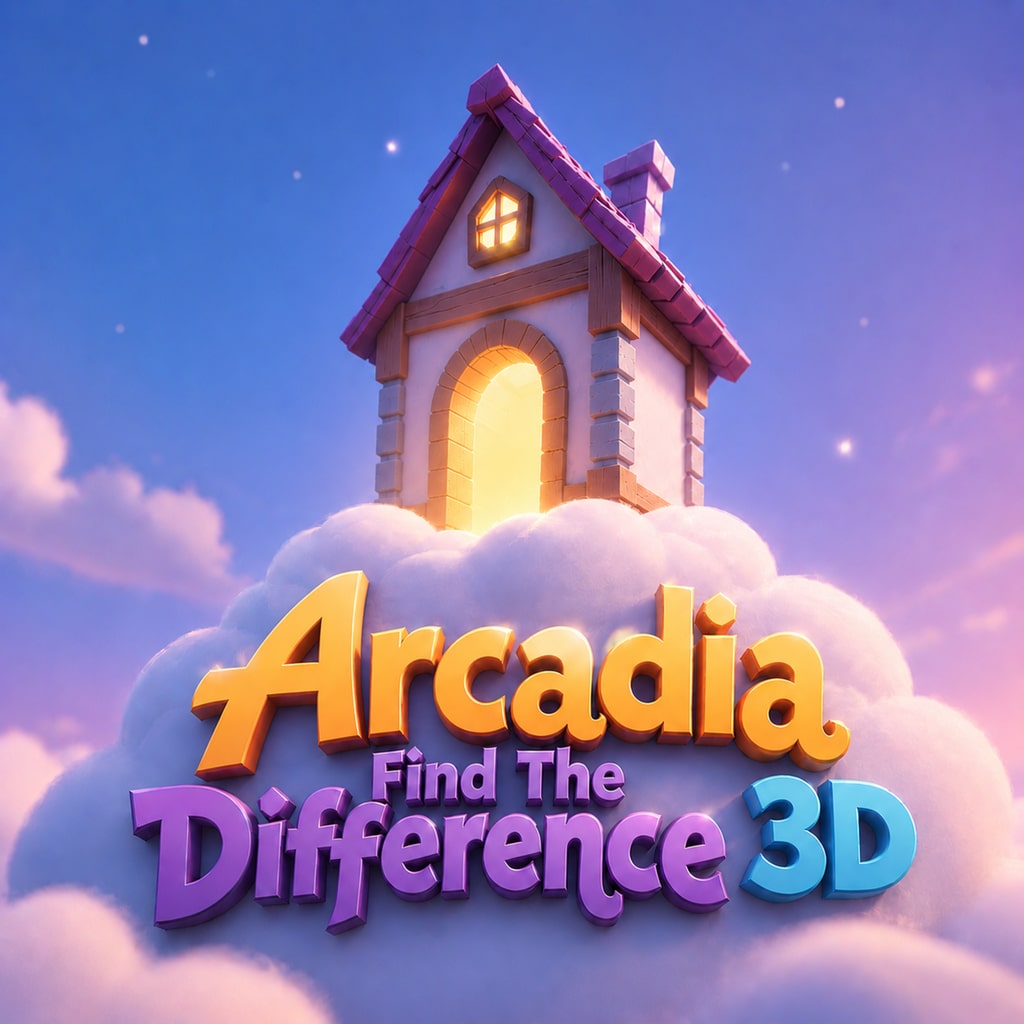
There is something wonderfully timeless about spot-the-difference games. They have entertained generations through newspapers, puzzle books, and mobile apps, offering the simple pleasure of slowing down and paying attention. In a world where so many games demand lightning-fast reactions and endless multitasking, there is still plenty to be said for an experience that simply asks you to stop, look, and appreciate the details. Arcadia: Find the Difference 3D takes that familiar concept and gently reimagines it by adding depth in every sense of the word.
Developed by Paper Plane Studio, Arcadia transforms the traditionally flat puzzle format into an inviting collection of beautifully crafted three-dimensional scenes. Rather than staring at two static images, players are encouraged to rotate detailed environments, inspect every corner, and uncover subtle differences that can only be spotted from the right angle. It sounds like a modest innovation on paper, but in practice it gives the classic formula an entirely new perspective.
More importantly, Arcadia knows exactly what it wants to be. It never chases artificial difficulty or frantic pacing. Instead, it creates an experience that feels welcoming, relaxing, and quietly rewarding from beginning to end.
A Fresh Perspective on a Familiar Formula
The biggest strength of Arcadia lies in how naturally its core mechanic supports moving into three dimensions. Every stage presents two nearly identical dioramas, each lovingly crafted with impressive attention to detail. Players are tasked with finding five differences, but unlike traditional puzzle games, discovering them often requires rotating the environment and viewing objects from completely different angles.
This simple addition transforms the experience. A missing object tucked behind a tree or a slightly altered decoration hidden around the back of a building suddenly becomes part of the puzzle rather than an afterthought. Every scene encourages genuine exploration rather than simply scanning left to right.
The environments themselves are genuinely charming. Whether wandering through cosy villages, fantasy-inspired landscapes, peaceful gardens, or whimsical interiors, every location feels handcrafted with care. Rather than rushing through levels, there is a surprising temptation to simply admire the artistry before searching for the hidden changes.
Relaxation Takes Centre Stage
One of Arcadia’s greatest achievements is its willingness to slow everything down. There are no countdown clocks hanging over your head, no harsh penalties for mistakes, and no pressure to complete puzzles within unrealistic time limits.
That design philosophy creates an atmosphere that feels almost therapeutic. You can rotate scenes at your own pace, inspect every tiny object, and gradually uncover each hidden detail without feeling rushed. In an industry that often equates challenge with constant pressure, Arcadia proves that thoughtful observation can be just as engaging.
The gentle soundtrack reinforces this calming mood beautifully. Soft ambient music quietly accompanies each puzzle without ever becoming repetitive or distracting. Combined with the clean user interface and colourful presentation, the entire experience feels carefully designed to help players unwind rather than compete. It becomes the sort of game that’s easy to lose an hour in without realising how much time has passed.
Variety Beyond Spotting Differences
Although spotting visual differences remains the central attraction, Arcadia wisely introduces additional activities to keep the formula from becoming repetitive. Mystery puzzles and a healthy selection of mini-games regularly interrupt the traditional gameplay loop, offering fresh objectives that encourage players to think in different ways.
These diversions never overstay their welcome. Instead, they provide short bursts of variety that prevent the experience from feeling too predictable across its fifty-plus handcrafted scenes. While some mini-games are naturally stronger than others, they collectively give Arcadia more personality than many puzzle games that rely entirely on one mechanic.
The progression system also adds welcome motivation. Completing levels rewards stars that can be invested in decorating your own room with unlockable furniture and cosmetic items. It’s a relatively simple feature, yet it provides a satisfying sense of progression without undermining the game’s relaxed nature.
Hidden Easter eggs further reward careful exploration by unlocking collectible three-dimensional figurines. Players who enjoy thoroughly examining every environment will likely discover these bonuses along the way.
Multiplayer Brings a Different Energy
Puzzle games are often solitary experiences, making Arcadia’s multiplayer options an unexpected but welcome addition. Local co-op works particularly well, allowing friends or family to examine scenes together while debating whether they’ve genuinely found a difference or are simply imagining things. It recreates the familiar experience of solving puzzle books together around a table, only now within detailed three-dimensional worlds.
Online multiplayer introduces a more competitive element, supporting matches with up to fifteen players. Suddenly, observation becomes a race rather than a leisurely pastime, giving the experience a different rhythm. It is a surprisingly enjoyable mode that gives Arcadia additional longevity once the single-player content has been completed. Neither multiplayer option feels like a gimmick. Instead, they broaden the appeal without compromising the relaxed identity that defines the core game.
Accessibility Done Right
Perhaps one of the most impressive aspects of Arcadia is its thoughtful approach to accessibility. Many spot-the-difference games rely heavily on colour variations, unintentionally excluding colour-blind players. Arcadia deliberately avoids this trap by ensuring differences are identified through texture, shape, placement, lighting, and object design rather than colour alone.
The dedicated colour-blind mode further improves visibility through enhanced contrast, making puzzles more comfortable for a wider audience. Rather than treating accessibility as an optional extra, Paper Plane Studio has clearly considered inclusivity throughout the game’s design. It is a small detail that deserves genuine praise because it allows far more players to enjoy the experience without unnecessary frustration.
Presentation
Visually, Arcadia consistently impresses. The handcrafted models possess a toy like charm that gives every scene warmth and personality without becoming overly complicated. Lighting is soft and inviting, textures remain clean, and every environment feels thoughtfully composed.
The rotating camera performs smoothly, allowing players to inspect objects from virtually any angle without awkward controls. Camera movement feels intuitive, making exploration enjoyable instead of cumbersome.
Performance also remains reliable throughout. Scene loading is quick, frame rates stay stable, and the interface remains pleasantly unobtrusive. Nothing distracts from the puzzles themselves, which is exactly how a game like this should function.
Audio complements the presentation perfectly. Gentle music and subtle environmental sounds establish a peaceful atmosphere that encourages careful observation rather than excitement. It never attempts to dominate the experience, instead quietly supporting the calm mood from beginning to end.
Small Frustrations
Arcadia’s commitment to relaxation occasionally has a minor downside. Some differences become exceptionally subtle, particularly in later stages. While this certainly increases the challenge, there are moments when careful searching begins to drift towards pixel hunting rather than satisfying deduction.
The mini-games, while welcome, vary slightly in quality. A handful feel more like pleasant diversions than meaningful additions, and players primarily interested in traditional spot-the-difference gameplay may occasionally wish for more of the core experience.
The room decoration system is enjoyable enough, but it never becomes as compelling as the puzzle-solving itself. It functions well as gentle progression rather than a deeply engaging secondary activity. These are relatively minor complaints, however, and none significantly undermine the overall experience.
Final Verdict
Arcadia: Find the Difference 3D succeeds because it understands the quiet pleasure of observation. Rather than reinventing puzzle games with complicated mechanics or artificial challenges, it gently expands a beloved classic by letting players explore beautifully crafted three-dimensional worlds from every angle.
Its relaxing pace, attractive presentation, thoughtful accessibility features, and surprisingly substantial content combine to create a puzzle game that feels welcoming to newcomers while remaining satisfying for experienced players. The addition of multiplayer, collectible secrets, and decorative progression gives the package even greater longevity without detracting from its wonderfully simple core idea.
There will always be players seeking bigger explosions, louder action, or more complex mechanics, but Arcadia reminds us that games do not always need to shout to capture our attention. Sometimes all they need is a beautifully crafted world, a handful of carefully hidden differences, and the patience to let curiosity guide the way. For anyone looking to escape the noise for a few quiet hours, Arcadia offers a delightful invitation to slow down and appreciate the little things.