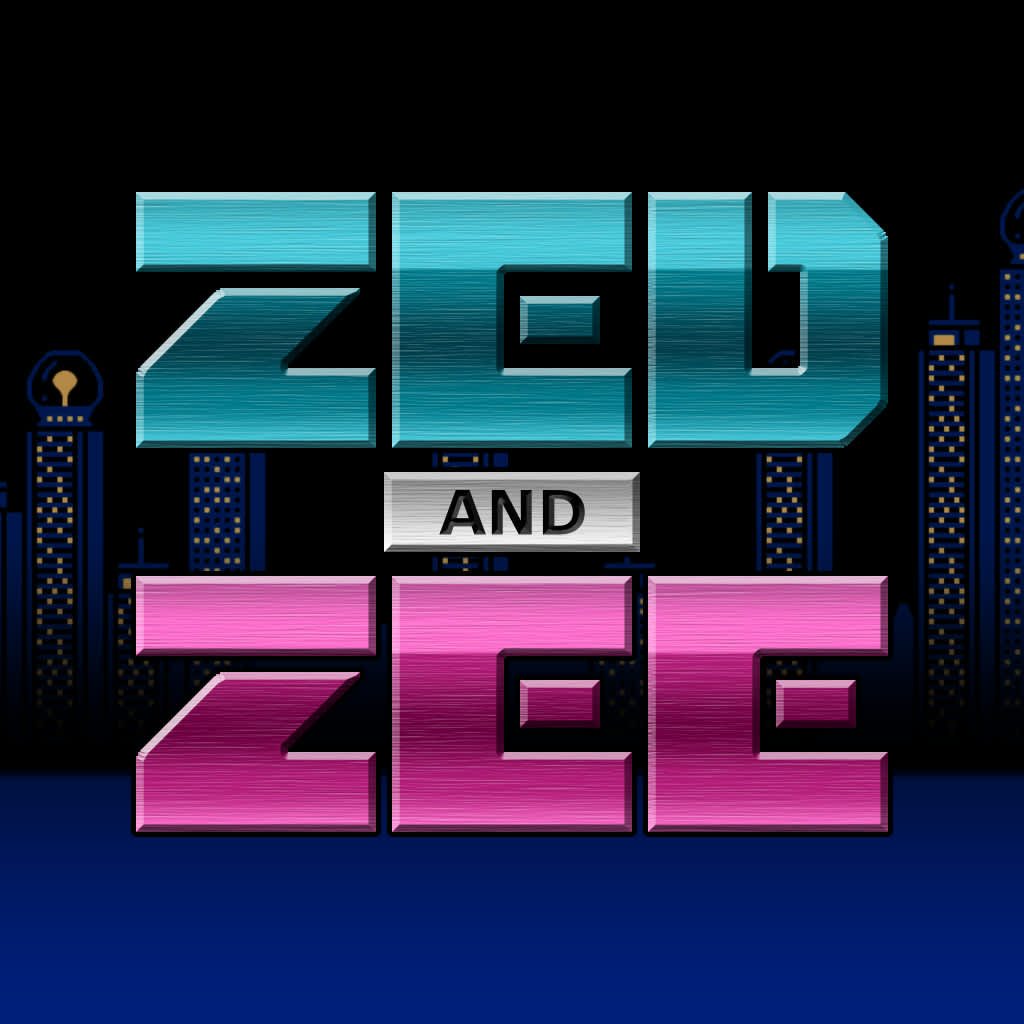
There is something wonderfully honest about an old-school platformer. It does not need a sprawling open world, a thousand collectibles, or a cinematic story that takes twenty hours to explain itself. Sometimes all you really need is a colourful character, a horde of enemies, a few dangerous jumps, and a villain who is absolutely convinced that world domination is a sensible career choice. Zed and Zee understands that beautifully, delivering a deliberately authentic 8-bit adventure that feels less like a modern game pretending to be retro and more like a forgotten cartridge that has somehow found its way into the present day.
The story is classic Saturday-morning cartoon material, and that is meant as a compliment. In the distant future of 20XX, brilliant roboticist Dr. Otto Matton creates Zed and Zee, two extraordinarily advanced humanoid robots intended to lead his army of super bots. Unfortunately for Matton, his creations discover that their ultimate purpose is to help conquer the world. Rather than accepting their programming, the pair rebel against their creator and set out to put an end to his plans. It is simple, silly, and wonderfully old-fashioned, giving the action a clear purpose without ever getting in the way of the game itself.
A Proper Blast From the Past
The first thing that stands out about Zed and Zee is its commitment to its 8-bit identity. There is no attempt to hide behind modern conveniences or to dress the game up as a retro experience while quietly behaving like something else underneath. It is presented as a genuine 8-bit game designed for 8-bit console hardware, and that authenticity gives the whole experience a particular charm. The chunky sprites, limited visual language and straightforward presentation immediately transport you to an era when games had to communicate personality with remarkably little.
That simplicity works particularly well because Zed and Zee never tries to make its adventure more complicated than it needs to be. You run, jump and stomp your way through six distinct worlds, each with its own visual identity and collection of mechanical threats. From the city of Mechtropolis to the hazardous Wired Woods and the scorching Infernal Factory, there is enough variety to prevent the journey from feeling like one continuous stretch of identical platforms. It is the kind of progression that feels familiar almost immediately, yet that familiarity is part of the appeal.
There is also a lovely sense of scale to the adventure. Six worlds might sound modest compared with contemporary platformers, but in an experience built around arcade-style action, it is enough to create a satisfying journey without becoming bloated. Each area has its own hazards and enemies to learn, while the presence of a boss at the end provides that wonderfully traditional punctuation mark. You know there is something unpleasant waiting at the end of the road, and reaching it becomes part of the motivation to keep moving.
Run, Jump and Try Not to Get Flattened
At its heart, Zed and Zee is built around the simplest platforming vocabulary imaginable. Move, jump and stomp. There is something refreshing about that approach because it leaves little room for excuses when you make a mistake. When a jump goes wrong, you generally know why, and when you successfully navigate a tricky section, the satisfaction comes from your own timing rather than an elaborate progression system doing the work for you.
The enemy design helps keep that straightforward formula lively. Plasma tanks, flying luchador masks and unpredictable robo frogs all sound like they escaped from the kind of wonderfully strange enemy catalogue that defined the 8-bit era. They are not necessarily complicated opponents, but they do their job by making you think about where you are standing and when you should move. A platform that looks perfectly safe can suddenly become considerably less inviting when something starts flying towards your head.
The six worlds also provide an opportunity for the game to change the rhythm of its challenges. Mechtropolis gives the adventure that classic futuristic city backdrop, while Wired Woods introduces the sort of environmental hazards you expect from a forest designed by someone with a worrying obsession with machinery. Then there is the Infernal Factory, where the temperature goes up and the surroundings become considerably less forgiving. These changes may be familiar platforming territory, but the familiarity feels comfortable rather than stale.
The Joy of Playing Together
One of Zed and Zee’s strongest features is its cooperative multiplayer. You can tackle the main adventure alone, but bringing another player along gives the game an entirely different energy. Old-school platformers have always been excellent candidates for sofa co-op, largely because the inevitable mistakes, close calls and moments of success become shared experiences rather than solitary victories.
There is something particularly appealing about working through Dr. Matton’s robotic army with a friend. Cooperation can turn an otherwise straightforward platforming challenge into a comedy of errors, especially when one player makes a jump that the other immediately fails. Those are often the moments that stick with you, and they are exactly the sort of memories that made multiplayer games of this style so enjoyable in the first place.
The Battle Mode is another nice addition because it allows the relationship between the two players to become considerably less cooperative. When you have finished saving the world and fancy settling the question of who is actually the better robot, you can face each other directly. It is a small feature, but one that adds another reason to keep the game around once the main adventure has been completed.
Six Worlds, Six Challenges
Boss encounters are another area where Zed and Zee understand the appeal of classic arcade design. Each world culminates in a confrontation with one of Dr. Matton’s enormous Super Robots, providing a final test after the platforming challenges that came before. These encounters are important because they give each section a sense of purpose. You are not simply moving from one colourful backdrop to another; you are working towards another showdown.
The bosses also fit the game’s overall personality. There is a sense that everything has been built around the idea of exaggerated robotic spectacle, without losing sight of the fact that this is fundamentally an old-school action game. You are expected to watch, react and learn rather than simply absorb damage and rely on increasingly powerful abilities. That approach can make the tougher encounters feel surprisingly satisfying when you finally figure them out.
Naturally, the retro philosophy means Zed and Zee is not always interested in holding your hand. There are moments when patience and repetition become necessary, particularly if you are determined to make it through without constantly repeating sections. That will either be part of the appeal or a potential source of frustration, depending on how much affection you have for classic platformers. For me, it works because the game never pretends to be something it is not.
Keeping the Cartridge Alive
The password system is another charming reminder of the game’s inspiration. Modern games have become so accustomed to automatic saving that the humble password can feel almost prehistoric, yet there is something strangely satisfying about a system that tells you exactly where you are in an adventure. It fits the overall design philosophy perfectly and reinforces the feeling that you are playing something from another era.
Of course, modern players may initially find the limitations more noticeable than those who grew up with this style of game. There is less room for convenience, and the experience is deliberately stripped back. Yet that is precisely why Zed and Zee works as a retro project. It does not spend all its time apologising for the limitations of its chosen format. Instead, it embraces them and builds its identity around them.
A Pixelated Personality
Visually, Zed and Zee is colourful and cheerful without needing elaborate graphical effects. The character designs have the sort of immediate readability that was essential during the 8-bit era, while the different worlds provide enough visual variety to keep things interesting. The robots, environmental hazards and bosses all have a playful personality that prevents the futuristic setting from becoming overly serious.
There is also a certain warmth to authentic pixel art that modern attempts to recreate the aesthetic sometimes struggle to capture. When every pixel has a job to do, character animation and enemy design become more important. Zed and Zee benefits from that economy. It does not need a mountain of visual detail to tell you what something is or what it is about to do.
The same philosophy extends to the overall presentation. Everything feels focused on delivering an arcade adventure rather than overwhelming the player with menus, statistics and systems. That makes it particularly easy to pick up and play, whether you are approaching it as a solo adventure or bringing someone else along for the ride.
Verdict
Zed and Zee is a charming love letter to an era when platformers were wonderfully uncomplicated. Its story of rebellious robots fighting back against a mad inventor is gloriously familiar, but the real appeal lies in how faithfully the game captures the spirit of classic 8-bit action. Six colourful worlds, a selection of wonderfully oddball enemies, challenging bosses, cooperative play and a competitive Battle Mode give the package enough variety to keep the adventure moving.
It is not trying to reinvent the platformer, and honestly, it does not need to. There is considerable pleasure in a game that knows exactly what it wants to be and commits to that idea wholeheartedly. The occasional difficulty spike and deliberately old-fashioned design will not suit everyone, particularly players accustomed to modern platformers being considerably more forgiving, but for anyone with an affection for authentic retro gaming, there is plenty here to enjoy.
Most importantly, Zed and Zee has personality. It feels colourful, playful and genuinely enthusiastic about the hardware and era it is celebrating. Whether you tackle Dr. Matton’s army alone, recruit a friend for some cooperative chaos, or turn on each other in Battle Mode, there is a pleasing simplicity to the whole experience. In a gaming landscape that can sometimes take itself far too seriously, Zed and Zee is a reminder that all you really need sometimes is a couple of rebellious robots, a mad scientist and a whole lot of jumping.