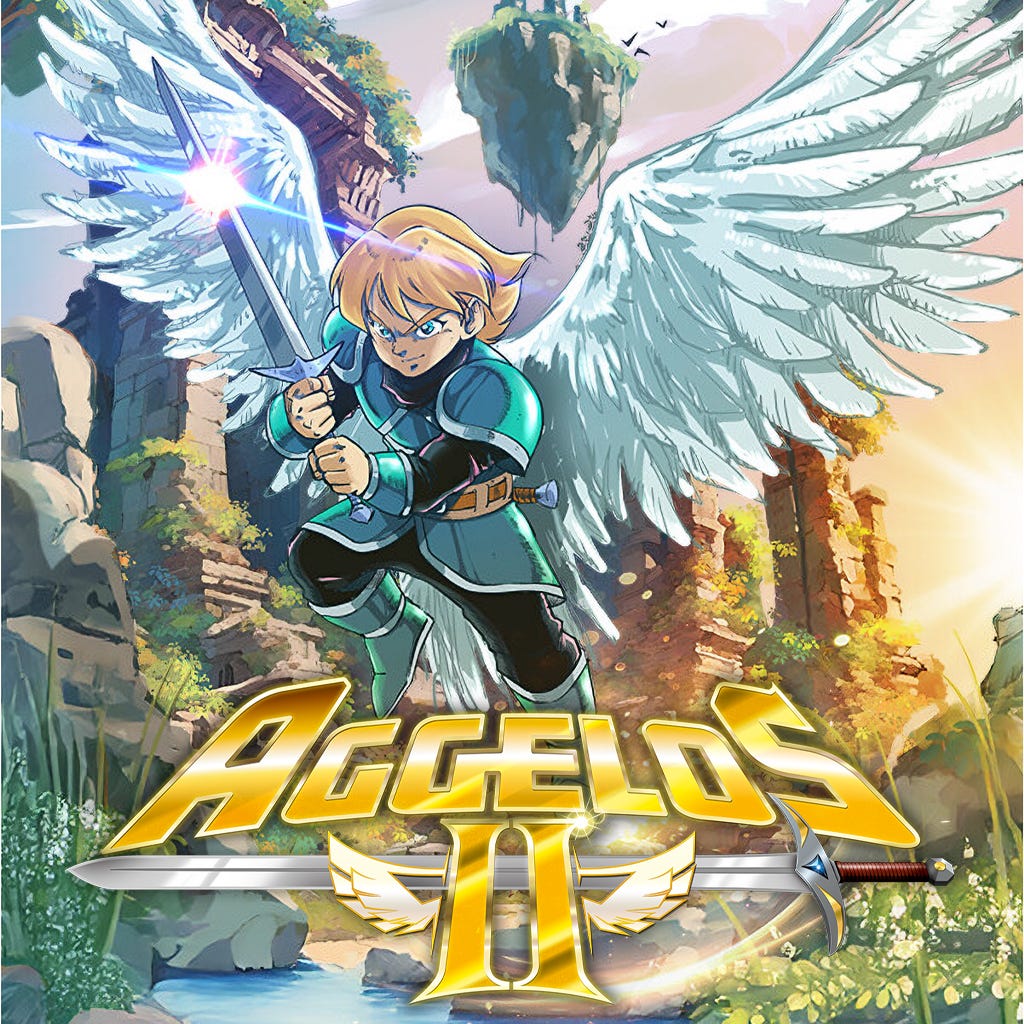
There is something wonderfully satisfying about a game that knows exactly which era it wants to evoke. Aggelos 2 wears its 16-bit influences proudly, but this is far more than a nostalgia trip dressed up in pixel art. Developed by Wonderboy Bobi and published by PQube, it builds on the foundations of its predecessor and throws them into a much larger, faster and more ambitious adventure. The result is an action platformer that understands why the classics were so addictive in the first place, while adding enough modern ideas to forge its own identity rather than simply copying the past.
From the opening moments, Aggelos 2 makes it clear that this is a game about movement, combat and discovery. You take control of an Aggelos, an elite angelic warrior summoned to the Kingdom of Lumen as the forces of darkness close in. What initially sounds like a straightforward battle between good and evil soon becomes considerably more interesting, as your character is forced to embrace a demonic form to survive. That conflict between light and darkness becomes the beating heart of the adventure, influencing everything from combat and exploration to puzzles and progression.
Welcome to Lumen
The Kingdom of Lumen is in serious trouble. The Gods are under siege, the Army of Darkness is advancing, and your arrival could hardly have come at a worse time. However, rather than simply marching towards the nearest villain and swinging a sword until something explodes, you are gradually drawn into a much larger conflict involving two overlapping versions of the same world.
This duality gives the setting an intriguing quality. The light and dark realms are not merely two separate places you visit. They exist alongside one another, and understanding how they interact is essential to making progress. A route blocked in one realm may be perfectly accessible in the other, while an obstacle or enemy encountered in one version of the world can completely change how you approach the other.
It is an idea that feels immediately familiar to anyone who grew up with classic Metroidvanias, but Aggelos 2 makes good use of it rather than treating the two worlds as a gimmick. There is a real sense of discovery in figuring out why a particular passage exists, where a newly acquired ability can be used, and how the two realities fit together. The map gradually becomes less of a collection of locations and more of a puzzle in itself.
Light Meets Darkness
The most interesting aspect of Aggelos 2 is undoubtedly its dual combat system. Your angelic form is slower and more disciplined, encouraging careful positioning and defensive play, while the demonic form is considerably more aggressive and agile. Switching between the two isn’t simply about picking whichever character looks cooler. You need to understand what each form can do and recognise when the situation demands a change.
That difference becomes particularly important during some of the game’s more chaotic encounters. Enemy projectiles can be handled according to your current alignment, meaning a fight can quickly become a test of timing and awareness rather than simply an exercise in button-mashing. One moment you might be carefully picking apart an enemy formation, only to switch forms and suddenly turn the encounter into a frantic assault.
The combat has a pleasing sense of weight despite its speed. Sword strikes feel responsive, ranged attacks give you options when getting close would be dangerous, and the increasingly powerful abilities you unlock provide a welcome sense of progression. There is a definite rhythm to the fighting, and once everything clicks, moving between forms while attacking feels wonderfully fluid.
A World Built for Exploration
If combat gives Aggelos 2 its adrenaline, exploration provides its soul. Lumen is packed with secrets, hidden routes, upgrades and areas deliberately inaccessible until you acquire the right ability. This is classic Metroidvania territory, but the design is dense enough that simply remembering where you have been can become part of the challenge.
New abilities gradually transform the way you see the world. Flight opens up previously unreachable areas, wall grabs let you approach familiar locations from new angles, and dashes give you access to routes that initially seemed impossible. There is a satisfying moment when you acquire a new ability and immediately remember three or four places where you could probably use it.
That is one reason backtracking never feels entirely like a chore. You are not simply retracing your footsteps because the game needs you to find another key. You are returning because you now have the tools to understand the environment differently. Hidden rooms, health upgrades, magical improvements and other secrets reward players who are willing to poke around rather than simply following the obvious route.
Puzzles That Make You Think
The puzzles are another welcome part of the experience. They rarely feel like separate minigames dropped into the adventure, instead making use of the world’s mechanics and your growing collection of abilities. Some require you to memorise routes, manipulate mechanisms or carefully navigate traps, while others encourage you to consider how the two realms interact.
There is a lovely feeling when one of these puzzles finally makes sense. Aggelos 2 does not always make its expectations clear, which can occasionally result in a little head-scratching, but solving something yourself is much more satisfying than being led by the hand. It respects the player’s ability to experiment.
The best puzzles also reinforce the game’s central theme. Light and darkness are not simply narrative concepts. They are tools, obstacles and solutions, and learning to think in terms of both worlds becomes an important part of becoming proficient at the game.
Bosses Worth Remembering
With 13 major bosses spread across the two realms, Aggelos 2 has no shortage of big encounters. These fights are among the clearest demonstrations of how far the series has come, as enemies hurl increasingly elaborate attacks at you and demand that you master your movement and abilities.
The encounters escalate in a satisfying way. Early bosses give you room to learn, while later battles become much more demanding tests of reflexes and pattern recognition. Some fights can feel brutally unforgiving when you first encounter them, but there is usually a sense that defeat stems from your own mistake rather than the game simply deciding you should lose.
The projectile-heavy nature of some encounters also gives Aggelos 2 a slight bullet-hell flavour. Watching the screen fill with danger while trying to determine which attacks can be countered by your current form creates wonderfully tense moments. It is the sort of pressure that can have you muttering “one more try” long after you intended to stop playing.
Gorgeous 16 Bit Nostalgia
Visually, Aggelos 2 is a significant step forward. The move from the original game’s 8-bit presentation to a much richer 16-bit aesthetic suits the sequel’s scale perfectly. Characters are expressive, enemies are packed with personality, and environments are colourful enough to make each region feel distinct.
There is a real appreciation for classic pixel art here without it feeling overly constrained by nostalgia. Animations are smooth, environments are richly detailed, and the various forms and attacks are easy to distinguish even when the action becomes hectic. It looks like the kind of game you might have discovered on a 90s console, except someone has given the artists considerably more pixels to play with.
The soundtrack complements that presentation beautifully. The energetic, chiptune-inspired music captures the adventurous spirit of old-school action platformers while still providing enough atmosphere for the darker areas. It is suitably heroic when you’re charging into battle and more wistful when you’re exploring the quieter corners of Lumen.
A Few Rough Edges
Aaggellos 2 is not flawless, and the developers have already had to address a number of technical issues. The day-one patch tackles problems ranging from invisible and missing colliders to graphical glitches, animation issues and save-related quirks. There are also some platform-specific concerns, including minor lag in particularly busy areas on the Nintendo Switch.
The important thing is that these issues appear to be the sort of problems that can be corrected rather than fundamental flaws in the design. They are worth mentioning because a game built around precision platforming and combat cannot afford too many technical hiccups. Even a small collision issue can be frustrating when you are attempting a difficult sequence.
Thankfully, beneath those rough edges is a very strong game. The responsiveness of the movement, the quality of the combat and the density of the world are what ultimately define the experience, and those elements are considerably more impressive than the occasional blemish.
Final Verdict
Aggelos 2 is exactly the sort of sequel retro fans should be happy to see. It takes the spirit of the original and expands it into a much bigger adventure without losing sight of what made the first game appealing. The move to 16-bit visuals is gorgeous, the light-and-dark mechanics add genuine depth to both combat and exploration, and the sprawling world provides plenty of reasons to keep searching long after the main path has been discovered.
What I particularly like is that Aggelos 2 never feels embarrassed about being old school. It wants you to explore without a constant stream of markers telling you where to go. It wants you to learn enemy patterns, remember locations, and occasionally get stuck before experiencing that satisfying moment when everything suddenly falls into place. Most importantly, it wants you to earn your victories.
There are a few technical imperfections that stop it from reaching the very highest score, and some players may find the difficulty spikes a little harsh. Yet those complaints are relatively minor when compared with the sheer amount of personality packed into the adventure. Between the satisfying swordplay, rapid form-switching, clever puzzles, sprawling maps, and excellent boss encounters, there is plenty here for fans of classic action platformers to sink their teeth into.
Aagelos 2 feels like a genuine celebration of the genre rather than a museum piece. It evokes the joy of discovering a hidden passage, the frustration of finally reaching a boss, and the satisfaction of defeating something that seemed impossible ten attempts earlier. It may look like a game from another era, but beneath those beautiful pixels lies an adventure that knows exactly how to keep a modern player hooked.