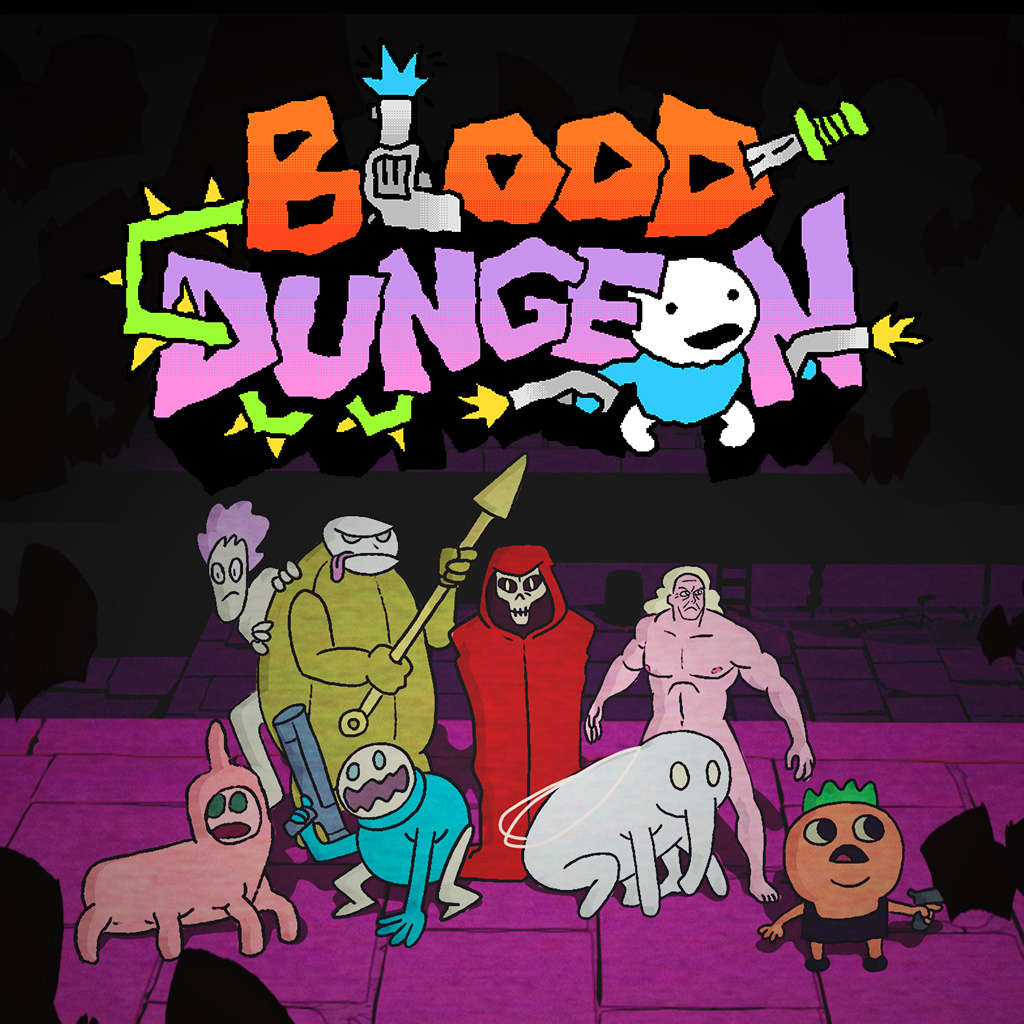
There is a particular kind of game that seems determined to make you panic, laugh and swear at the screen all at once. Blood Dungeon is very much one of those games. Developed and published by Messhof, the studio behind the wonderfully competitive Nidhogg, this chaotic survival adventure takes the increasingly familiar bullet-hell formula and throws it into a two-dimensional platforming blender. Instead of simply wandering around an arena while your character automatically turns everything nearby into a pile of corpses, you are constantly moving, climbing, jumping and scrambling for your life as an absurd number of monsters try to make you regret every decision that brought you into the dungeon.
It is a brilliantly simple idea, but the execution gives it a personality all of its own. Blood Dungeon understands that movement can be just as important as combat, and that surviving for another minute should feel like an achievement. Your attacks largely take care of themselves, leaving you to concentrate on positioning, parkour and split-second decisions as the dungeon becomes increasingly crowded. The result is frantic, messy and occasionally ridiculous, but there is a real method hiding beneath all that chaos.
Welcome to the Dungeon
The premise is wonderfully simple. You enter a dungeon, gather blood and power-ups, survive for as long as possible, and collect bones that can eventually be spent at the Bone Shop. There is no complicated narrative getting in the way, because Blood Dungeon knows exactly what you came here to do. You are here to run, fight, upgrade, and see just how long you can keep your character alive before the dungeon inevitably wins.
What makes that loop work is the vertical structure of the arenas. Instead of an open space where you can simply circle a crowd of enemies, you have multiple levels, platforms, walls, chains, ladders, and hazards to contend with. You are constantly thinking about where you can move next, where the enemies are gathering, and whether that tempting blood orb is actually worth risking your neck for.
It gives the gameplay an almost dance-like quality. You might leap over a monster, scramble up a wall, drop through a gap, and immediately find yourself trapped between two more enemies. There is rarely a moment when you can completely switch off, and while that might sound exhausting, the sheer speed of the game makes it incredibly addictive.
Run For Your Life
Movement is unquestionably the star of Blood Dungeon. Dashing, wall-jumping, climbing and scrambling across the environment are not merely useful abilities that occasionally come into play. They are the foundation of survival. If you stop moving for too long, the dungeon will quickly remind you why that was a terrible idea.
This makes the game feel markedly different from many other survival shooters. Your character’s attacks happen automatically, so there is no need to worry about constantly aiming or manually pulling the trigger. Instead, your attention is fixed on movement and positioning, which means every platform becomes a potential escape route and every wall can save your life.
The best moments come when you find yourself in a seemingly impossible situation and somehow escape. A swarm is closing in from below, something nasty is flying towards your face, and a spike trap is waiting on the other side of the platform. Somehow you manage to wall-jump, scramble across a chain and squeeze through a tiny gap before the enemies catch up. It is the kind of nonsense that would look completely ridiculous in another game but feels absolutely brilliant here.
A Cast With Character
There are nine playable characters to unlock, and they are more than simple cosmetic alternatives. Each has distinct traits, weapons and movement characteristics, so choosing a character can fundamentally change how you approach a run.
Leggy, for example, brings web-based mobility to the mix, while Bug can glide through areas that would be considerably more awkward for another character. Skinja has its own strengths when navigating tight spaces, and experimenting with the cast gradually reveals how much variety is hidden within what initially appears to be a straightforward survival game.
This is particularly important for replayability. Once you become comfortable with one character, switching to another can make familiar arenas feel surprisingly different. You suddenly reconsider routes, escape options and which upgrades are worth pursuing, giving the game a lovely sense of discovery even after you have already spent hours with it.
Build Your Own Monster
The automated combat system might sound restrictive on paper, but it actually gives Blood Dungeon more room to experiment. With your attention focused on movement, the upgrade system becomes the primary way you shape your character’s development during a run.
There are more than 100 weapons and upgrades to discover, allowing you to create wonderfully ridiculous combinations. Blood orbs and chests offer opportunities to strengthen your character, enhance existing abilities and develop a build that can cope with increasingly ridiculous numbers of enemies.
This is where the game’s roguelite elements become particularly addictive. A run might start relatively calmly, but after a few carefully chosen upgrades you can suddenly find yourself surrounded by a storm of automated attacks. Another run might yield a more defensive build that prioritises survival and mobility. The fact that each run can develop differently gives you plenty of incentive to experiment rather than simply repeating the same strategy every time.
The Monsters Keep Coming
The sheer variety of enemies is another impressive aspect of Blood Dungeon. With more than 100 enemy types, the game offers plenty of ways to make your life unpleasant. Flying creatures, bouncing horrors and enormous monsters each pose different problems, forcing you to keep an eye on what is happening rather than blindly following the same movement pattern.
The difficulty also stems from how these enemies interact with the environment. An enemy by itself may not be especially threatening, but add another dozen monsters, a few platforms, some spikes and a badly timed jump, and suddenly you have a genuine survival problem.
There is something almost comical about the visual spectacle as well. The screen can become absolutely packed with creatures and effects, yet the pixel art remains surprisingly readable. You can still generally tell where your character is and where the immediate danger lies, which is essential in a game where hesitation can result in a very quick death.
Bones, Quests and More Reasons to Return
Dying is not simply the end of the story. The bones you collect can be taken back to the Bone Shop, where they can be used to strengthen your characters and unlock additional options. This persistent progression gives every run value, even when things go horribly wrong.
There are more than 100 quests to complete, adding another layer of long-term objectives. These quests can unlock upgrades, arenas, skins and other rewards, so there is always something else to chase. You are not simply trying to survive longer for the sake of a high score. You are gradually opening up more of the game.
The six unlockable survival arenas also help with longevity. Once you have started learning the rhythms of one environment, moving into another can force you to rethink everything. The variety gives Blood Dungeon a surprisingly substantial amount of content for something that is so easy to pick up and play.
Pixel Art Meets Drum And Bass
Visually, Blood Dungeon is wonderfully scruffy in all the right ways. The pixel art has plenty of personality, with strange creatures, expressive animations, and environments that look like they have been designed specifically to make your day considerably worse. There is a pleasing retro quality to everything without the game feeling like it is simply trying to imitate an old console.
The animation deserves particular praise. With so much happening on screen, it would have been easy for the visuals to become an unreadable mess, but the game generally manages to maintain a good sense of clarity. Enemies have distinctive designs, and attacks have enough visual identity that you can usually understand what is happening even when the screen is completely packed.
Then there is the soundtrack, which is frankly excellent. Thomas Hoey’s dynamic dungeon drum and bass music is a perfect fit for the game’s frantic pace. As the action intensifies, the music helps push you into that slightly manic state where you are moving almost instinctively, trying to stay one step ahead of the swarm.
A Beautiful Kind of Chaos
Blood Dungeon is not going to appeal to everyone. If you prefer carefully paced adventures, deliberate combat, or games where you have plenty of time to consider your next move, this is likely to feel like someone has plugged your controller directly into a lightning storm. There is very little downtime, and later runs can become genuinely overwhelming.
For everyone else, however, there is something wonderfully pure about it. The controls are easy to understand, the progression is satisfying, and the movement gives the game an identity that sets it apart from the growing number of bullet-hell titles appearing across the industry.
Most importantly, it feels like a game designed to be replayed. You die, learn something, spend your bones, unlock something new, and jump straight back in. Eventually, you realise that what initially felt impossible has become manageable, and then the game introduces another character, another arena, or another enemy that makes you rethink everything again.
Final Verdict
Blood Dungeon is a gloriously chaotic little monster. It takes the familiar survival formula and injects it with enough platforming, parkour and personality to feel surprisingly fresh. The movement is fantastic, the character variety gives you plenty of reasons to experiment, and the enormous selection of upgrades means that no two runs need to feel quite the same.
What really makes it special, though, is how everything works together. The automated combat frees you to concentrate on movement, the vertical arenas turn positioning into a constant challenge, and the upgrade system gives you just enough power to believe that maybe this time you can survive. Then the dungeon throws another hundred monsters at you and laughs at your optimism.
There are moments when the sheer amount of chaos can become overwhelming, and players who are not fond of roguelite repetition may eventually find the loop familiar. Yet the sheer quality of the movement and the variety of the systems make returning for another run remarkably easy. Add in the excellent drum and bass soundtrack, and you have a game that can make even failure feel entertaining.
Messhof has created something that feels distinctly its own. Blood Dungeon may be drenched in blood, monsters and pixelated mayhem, but beneath the gore is a beautifully constructed survival game that rewards instinct, experimentation and a willingness to keep moving.