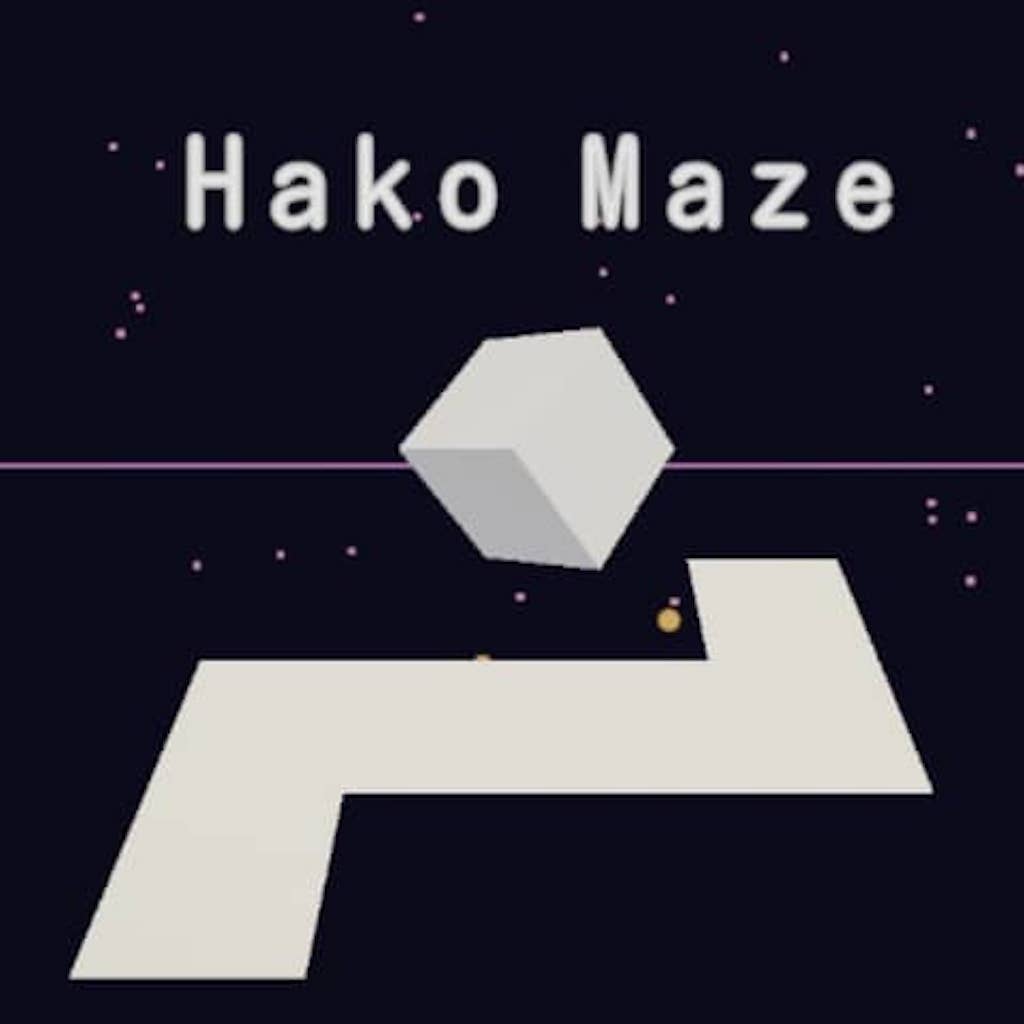
There is something wonderfully satisfying about a puzzle that makes you stop and stare before you even make your first move. Hako Maze is one of those games. Developed and published by Hako Maze Workshop, this quietly clever spatial puzzler takes the simple idea of guiding a rolling ball through a maze and turns it into a test of perspective, mental rotation and three-dimensional thinking. What initially looks like a straightforward cube quickly becomes considerably more demanding once you realise that the path visible on one face is only part of the puzzle.
Set within a mysterious digital void left behind by an apparently forgotten civilisation, Hako Maze has a wonderfully understated premise. Floating cubes drift through cyberspace, each containing an intricate security system that must be breached before the strange artefact hidden inside can be awakened. There are no armies to defeat, no complicated inventory systems and no elaborate narrative getting in the way. Instead, the game puts one thing front and centre: your brain.
A Simple Idea With A Clever Twist
The brilliance of Hako Maze lies in how quickly it establishes its central concept. You are presented with a cube covered in maze pathways, and your job is to guide a small sphere towards the goal. That sounds simple enough, especially when you first look at the maze from a single angle. The problem is that the ball is not restricted to one surface, and once it reaches an edge, it can roll onto another face of the cube.
Suddenly, what appeared to be a conventional two-dimensional maze becomes a three-dimensional navigation problem. You need to understand where each surface connects, how the pathways continue around the edges, and whether the route you have identified actually works once the cube’s geometry comes into play. It is the sort of concept that can make you feel incredibly clever one moment and completely lost the next.
That is where Hako Maze finds its appeal. It does not need flashy gimmicks to make its puzzles engaging because the geometry itself is the gimmick. The more you play, the more naturally you begin to think of the cube as a complete object rather than six separate surfaces.
Thinking In Three Dimensions
The game’s emphasis on spatial reasoning is immediately apparent, particularly when it starts asking you to interpret two-dimensional layouts as three-dimensional structures. This is where Hako Maze can be surprisingly demanding. You are effectively asked to unfold the cube in your mind, understand how the faces connect, and then mentally fold everything back together before committing to a route.
It is a skill that becomes easier with practice, but the learning process is part of what makes the game rewarding. Early puzzles give you room to grasp the rules without overwhelming you, while later challenges gradually demand a much stronger awareness of direction and perspective. Eventually, you stop thinking purely about where the ball is and start considering where it will be several moves from now.
There is a lovely sense of discovery when that mental picture finally clicks. You might stare at a seemingly impossible arrangement for several minutes, only to realise that a route on the opposite side of the cube connects perfectly with the path in front of you. That moment of understanding is the real reward, and Hako Maze understands that better than many puzzle games.
Rolling Into Trouble
Controlling the ball itself is deliberately straightforward. The challenge comes from deciding where you want it to go, rather than wrestling with an overly complicated control system. As the ball moves across the cube’s surfaces, perspective shifts and the relationships between the faces become increasingly important.
That means mistakes are often caused by your own assumptions. You may think you have found the perfect route, only to discover that an edge connects differently than expected, or that a blocked passage forces you to reconsider the entire plan. There is a refreshing honesty to this design, because the game rarely asks you to perform a complicated sequence of button presses. It asks whether you actually understand the space in front of you.
The introduction of barriers, one-way passages and electronic hazards adds another layer to the problem. These obstacles do not completely change the formula, but they force you to look beyond the most obvious route. A path that appears shorter may be useless, while a longer journey around several faces can turn out to be the only viable solution.
The Joy Of Getting It Wrong
One of the things I enjoyed most about Hako Maze is that failure rarely feels punishing. When you get a route wrong, the natural response is not frustration so much as curiosity. You start wondering where your mental map went astray and whether there was a connection you missed.
That makes the game feel like a genuine mental exercise rather than a test designed to make you feel foolish. There is always another way to look at the problem, and because the central mechanics remain consistent, you can apply what you learned from one puzzle to the next. It creates a gentle learning curve in which your own improvement becomes one of the game’s most rewarding progression systems.
The increasing complexity also helps prevent the core concept from becoming stale. Once you have become comfortable with basic cube navigation, more intricate structures demand greater foresight. The game does not need to constantly introduce new mechanics because the existing ones have enough depth to keep challenging you.
A Digital World With A Quiet Atmosphere
Visually, Hako Maze adopts an appropriately minimalist approach. The digital void provides a clean backdrop for the floating geometric structures, while glowing lines and futuristic interface elements lend the whole experience the feel of a forgotten piece of advanced technology.
That simplicity works in the game’s favour. With a puzzle so heavily based on geometry and visualisation, clutter would only get in the way. The pathways remain clear, the cube edges are easy to follow, and the glowing details help distinguish the different elements without overwhelming the player.
There is also something strangely relaxing about the presentation. Hako Maze does not bombard you with flashy effects or constant distractions. Instead, the ambient electronic soundtrack creates a quiet space in which you can concentrate. The subtle sounds accompanying the ball’s movement provide just enough feedback to make every successful step feel satisfying.
A Puzzle Game That Makes You Think
What makes Hako Maze stand out is its confidence in its central idea. It does not need a huge collection of unrelated mechanics because spatial reasoning is more than enough to carry the experience. The cube itself becomes the puzzle, and each new configuration asks you to look at something familiar from a slightly different perspective.
That makes it particularly appealing to anyone who enjoys games that exercise the brain without relying on conventional trivia or word puzzles. There is a genuine mathematical quality to working through the levels, but the experience never feels like sitting down for a maths lesson. You are simply trying to get a little ball from one point to another, and somewhere along the way you realise you have been quietly training your ability to visualise three-dimensional space.
It is also the sort of game that works beautifully in short sessions. You can solve a handful of puzzles, put it down and return later without needing to remember a complicated story or progression system. Equally, once a particularly difficult puzzle gets inside your head, there is a strong temptation to keep going until you finally crack it.
The Verdict
Hako Maze is a smart, focused and refreshingly uncomplicated puzzle game that gets impressive mileage from a single idea. Guiding a ball across the shifting surfaces of a cube sounds almost ridiculously simple, yet the combination of 2D layouts, 3D navigation and mental rotation creates a challenge that genuinely tests your spatial awareness.
Its minimalist presentation complements the gameplay beautifully, while the gradual increase in complexity ensures the central mechanics remain rewarding rather than repetitive. There are moments when the mental gymnastics can be demanding, and players who prefer more immediately accessible puzzle formats may find the later challenges require considerable patience. For those willing to slow down and think, however, there is plenty to enjoy.
Most importantly, Hako Maze respects the intelligence of its player. It does not need explosions, elaborate rewards or endless distractions to keep you interested. It gives you a cube, a ball and a problem, then leaves you alone to work it out. Sometimes that is all a great puzzle game really needs.