
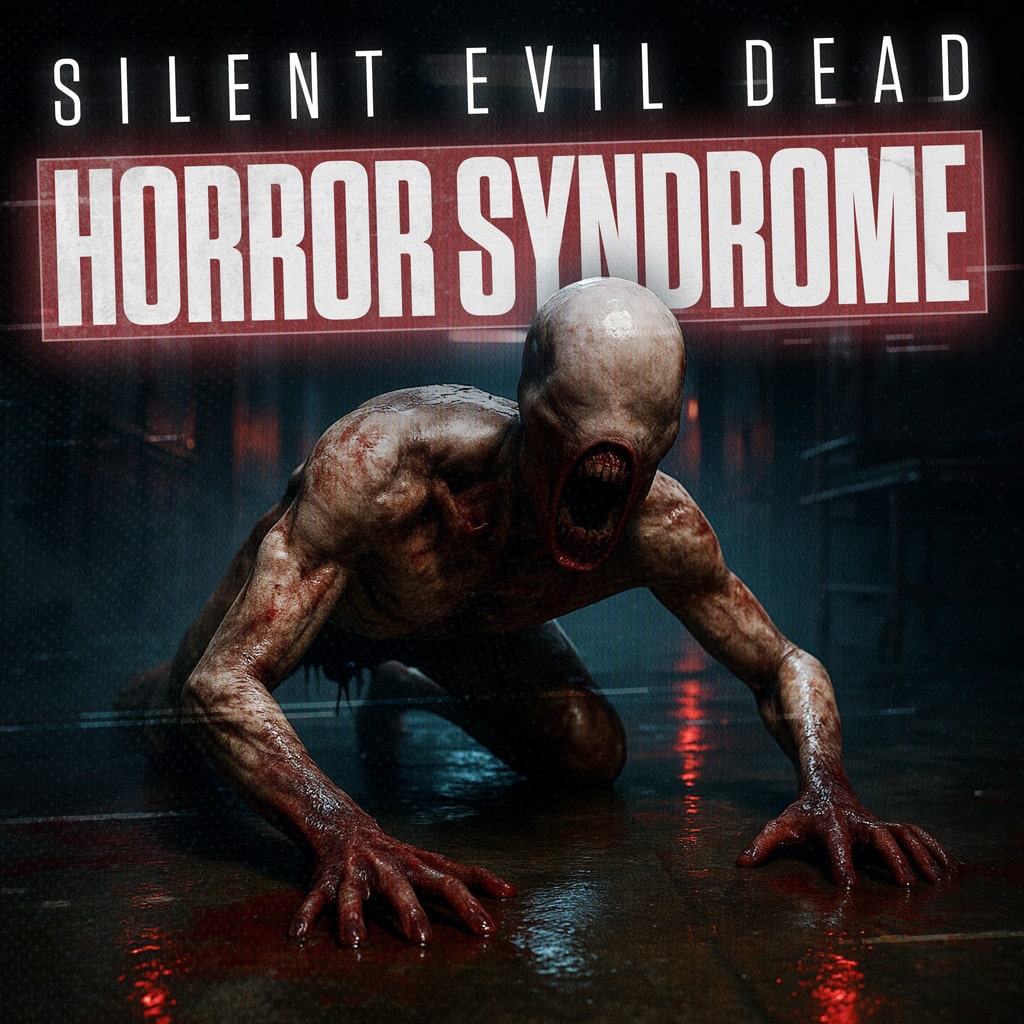
There are horror games that carefully build dread, and then there are horror games that try to overwhelm you with it from the first corridor onward. Silent Evil Dead Horror Syndrome, released on April 16, 2026 for PlayStation 4 (with PS5 compatibility), firmly belongs to the latter category. Developed and published by Lu Ming, it is a survival horror title that leans heavily into familiar genre ingredients: ruined laboratories, grotesque experiments, scarce resources, and a protagonist forced into constant improvisation.
At its best, it delivers a tense, resource-driven experience that recalls older survival horror traditions. At its worst, it feels like a collage of ideas from better-executed inspirations, stitched together with uneven pacing and inconsistent mechanical depth.
Story & Setting
The game is set in the aftermath of catastrophic experiments that have left a facility, and its surrounding infrastructure, in ruins. Whatever occurred here has transformed both the environment and its inhabitants into something unstable, violent, and deeply unnatural. You are one of the few remaining survivors, navigating a collapsed research complex where every corridor feels like a warning rather than a path forward.
The narrative is delivered through environmental storytelling, scattered logs, and fragmented discoveries. Rather than focusing on character-driven dialogue, the game emphasises implication. You are meant to piece together what happened through observation rather than exposition.
The central mystery revolves around a series of experiments that went catastrophically wrong, resulting in biological mutations and psychological breakdowns across the facility. While the premise is serviceable, it rarely rises above genre familiarity. Long-time horror players will recognise its beats almost immediately: unethical science, containment failure, and an eventual descent into monstrosity.
What gives the setting some identity is its tone. There is a persistent sense of decay not just in the environment, but in the logic of the world itself. Doors lead to impossible spaces, corridors feel artificially extended, and lighting often suggests movement where none exists. It is a world designed to unsettle through instability rather than revelation.
Gameplay & Core Survival Systems
The defining mechanical feature of Silent Evil Dead Horror Syndrome is the protagonist’s mechanical prosthetic arm. This tool serves multiple functions: combat weapon, environmental interaction device, and utility tool for survival. It is a strong concept that helps distinguish the game from more conventional survival horror titles.
In practice, the arm is versatile but not always finely tuned. Combat uses it for close-range strikes and contextual interactions, while exploration relies on it for manipulating the environment, triggering mechanisms, or overcoming obstacles. The idea of a single integrated toolset is appealing, and when it works, it gives the game a sense of cohesion.
However, combat encounters can feel uneven. Enemy responsiveness and hit detection occasionally lack precision, leading to moments where survival feels dictated more by system inconsistency than player decision-making. This is especially noticeable in tight spaces, where camera control and enemy positioning can clash.
Resource Management & Crafting
Resource scarcity is a core pillar of the experience. Ammunition, healing items, and crafting materials are all limited, forcing players to make constant decisions about what to prioritise. Crafting plays an important role, allowing you to convert environmental resources into weapons, ammunition, and medkits.
This system reinforces tension effectively. Every encounter carries weight because recovery is not guaranteed. However, the crafting interface and progression loop can feel somewhat repetitive over time. Once optimal resource routes are identified, tension diminishes slightly, especially in mid-game sections.
The balance between scarcity and survival is mostly effective, but not always consistent. Some sections feel punishing to the point of frustration, while others provide unexpected surplus, disrupting the intended rhythm.
Enemies & Combat Design
Enemy variety is one of the game’s stronger elements. Players face disfigured zombies, twisted goblin-like creatures, and large mutated entities that serve as occasional set-piece threats. These designs lean heavily into grotesque experimentation aesthetics, reinforcing the narrative context of failed scientific ambition.
Encounters are designed to maintain pressure rather than offer fairness. Enemies often appear in confined spaces or under low visibility, forcing reliance on sound and environmental awareness. This works well in building tension, though repetition in encounter patterns becomes noticeable over time.
Boss encounters are present but irregular in quality. Some provide memorable escalation moments that test resource management and positioning, while others feel mechanically simplistic compared to standard enemies.
Exploration & Level Design
Exploration is structured around interconnected areas that gradually reveal more of the facility’s history. Progression is gated through keys, environmental puzzles, and occasional backtracking. This design is familiar to the survival horror genre and is executed competently, if not innovatively.
The strongest aspect of exploration is atmosphere. Lighting, sound design, and environmental decay combine to create a consistently oppressive mood. Even safe areas feel temporary, as though the world itself is unstable.
However, navigation can occasionally feel unclear. Objectives are not always communicated with precision, leading to moments of uncertainty where progress depends more on trial and error than deduction.
Atmosphere & Presentation
Atmosphere is arguably where Silent Evil Dead Horror Syndrome succeeds most consistently. The game commits fully to darkness as both a visual and thematic tool. Shadows are dense, visibility is frequently restricted, and sound plays a crucial role in orientation.
Audio design is effective, particularly in environmental cues such as distant movement, mechanical groaning, and distorted ambient noise. These elements help maintain tension even during quieter sections.
Visually, the game is functional rather than striking. Environments are appropriately grim and decayed, but asset repetition and texture limitations occasionally break immersion. On PS4 hardware, performance remains stable but visually restrained, with PS5 compatibility offering only modest improvements.
Pacing & Structure
The game’s pacing is uneven. Early sections do a strong job of establishing tension and resource pressure, but mid-game repetition slows momentum. Later areas regain intensity, particularly when enemy density increases and resource scarcity becomes more pronounced.
Narrative pacing mirrors this inconsistency. Key story revelations are spaced irregularly, sometimes arriving too late to significantly alter player perception of earlier events.
Final Verdict
Silent Evil Dead Horror Syndrome is a competent but uneven survival horror experience that succeeds in atmosphere and core tension, but struggles with consistency in execution. Its mechanical prosthetic arm is a strong central idea, and its resource-driven gameplay can generate genuine moments of stress and satisfaction.
However, technical rough edges, uneven pacing, and familiar narrative territory prevent it from reaching higher impact. It is a game that understands survival horror fundamentals but rarely elevates them beyond expectation.
For genre enthusiasts, there is enough here to justify a playthrough, particularly for those who value atmosphere over innovation. For everyone else, it may feel like a familiar nightmare that never fully evolves into something memorable.










[…] 4 and PlayStation 5, including Car Dealer Garage Simulator 2026, Wash Cleaner Simulator, Silent Evil Dead Horror Syndrome, Ragdoll Playground Sandbox, Longboard Skate Downhill Simulator and Parkour Simulator […]