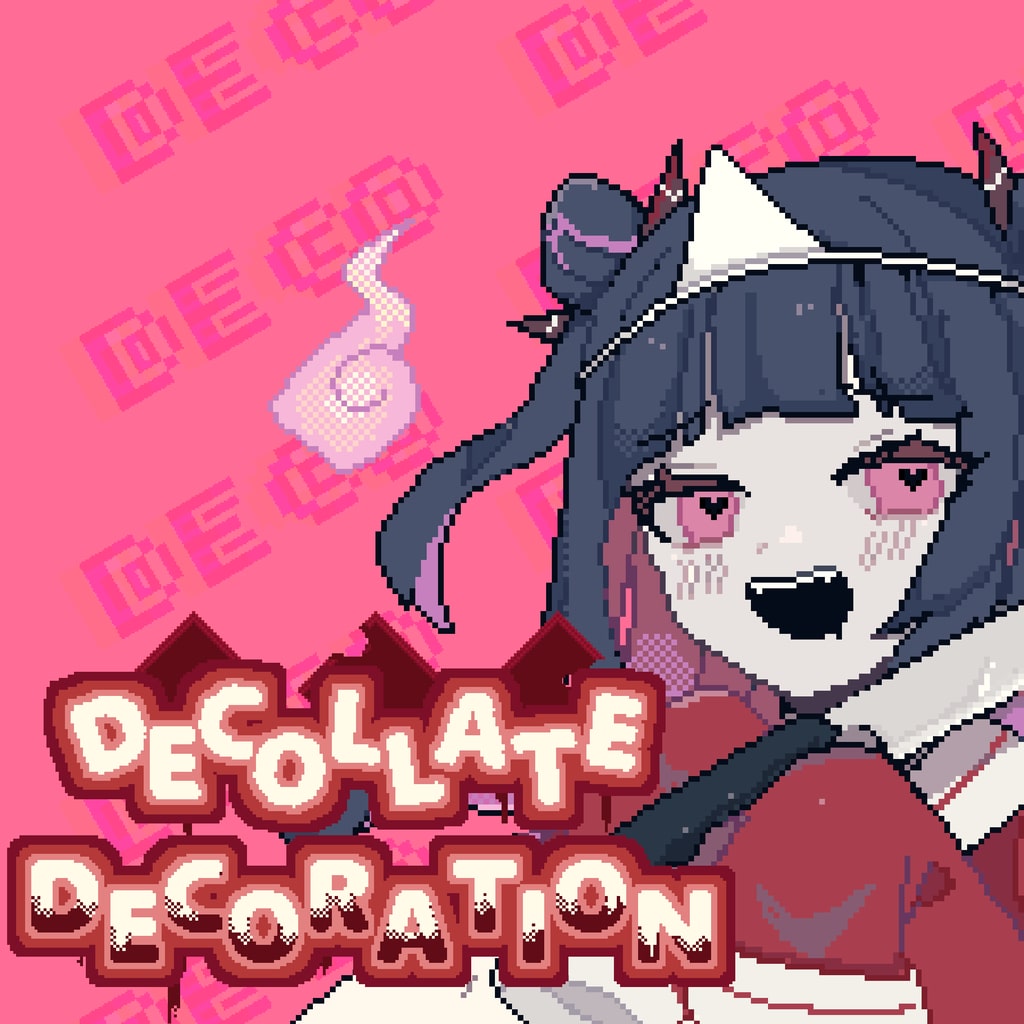
There is a particular kind of indie visual novel that thrives on discomfort rather than comfort, where romance and horror are not opposites but overlapping lenses through which obsession is examined. Decollate Decoration, developed by KANEKODO and published by KEMCO, is very much one of those experiences.
Originally released on PC (Steam) in January 2026, before arriving on consoles including PlayStation 5, PlayStation 4, Xbox Series X|S, Xbox One, and Nintendo Switch in April 2026, it presents itself as a compact but emotionally dense pixel-art visual novel adventure. On the surface, it is a short branching narrative about love beyond death. Underneath, it is something far more unsettling: a story about possession disguised as devotion.
Story & Premise
You begin as an ordinary girl who dies unexpectedly and awakens as a ghost. There is no dramatic twist to your life, no moral stain that justifies your fate. By all accounts, you should be at peace. Yet peace is not what lingers in your mind.
Instead, there is attachment.
Your lover remains alive, unaware of your presence, unable to perceive you in any meaningful way. And rather than accept separation, you begin to question whether “moving on” is truly the correct outcome. What follows is a descent into increasingly intrusive attempts to remain part of his life, regardless of consent, awareness, or consequence.
The narrative is intentionally uncomfortable. It asks a question that slowly becomes more disturbing as it progresses: if love survives death, does that justify control?
There is no single moral framing imposed on the player. Instead, the game allows interpretation to emerge through action. Each route reveals a different emotional angle, from tragic longing to outright possessiveness, and the tone shifts accordingly.
It is not a love story in the traditional sense. It is a story about refusal.
Gameplay Structure & Mechanics
Mechanically, Decollate Decoration is a hybrid visual novel with light point-and-click and command selection elements. Interaction is minimal but deliberate. Rather than controlling physical movement, the player influences outcomes through presence and interference.
As a ghost, you cannot communicate directly with your lover. Instead, you must experiment with indirect methods: moving objects, triggering poltergeist activity, influencing dreams, or applying subtle curses. Each method alters how he behaves, reacts, or interprets his environment.
Because the protagonist lacks meaningful physical agency, the gameplay becomes about inference and psychological manipulation. You are constantly testing cause and effect, trying to determine how far influence can stretch without being understood.
This creates an interesting dynamic. Rather than solving puzzles in a traditional sense, you are essentially solving emotional equations: how much interference leads to recognition, and how much leads to rejection or fear.
Each playthrough is short, lasting roughly 15 minutes, but structured around branching outcomes. There are six endings in total, and each route reframes prior choices in subtle ways. Some endings feel like resolution. Others feel like escalation. A few feel like collapse.
Narrative Themes & Emotional Design
The most striking aspect of Decollate Decoration is its willingness to explore emotional discomfort without softening it. The protagonist is not framed as purely sympathetic or villainous. Instead, she exists in a morally ambiguous space where love, grief, and control overlap.
The game gradually shifts the player’s perception of their own actions. What begins as harmless attempts to “stay close” slowly transforms into increasingly invasive behaviour. Dream manipulation becomes emotional coercion. Poltergeist activity becomes disruption. Curiosity becomes intrusion.
There is no single moment where the game tells you this is wrong. Instead, it allows consequences to accumulate naturally, forcing reflection after the fact.
This restraint is effective, though at times it can feel understated to a fault. Certain narrative beats could benefit from stronger framing, particularly in later routes where emotional stakes become more extreme but presentation remains deliberately subdued.
Replay Structure & Endings
Replayability is central to the experience. The six endings are not simply variations of a single conclusion but distinct emotional interpretations of the same premise. Some lean toward acceptance and release. Others double down on obsession. A few blur the line entirely, suggesting outcomes that are neither peaceful nor catastrophic.
The short runtime encourages experimentation. Replaying routes feels less like repetition and more like reframing, as small changes in behaviour lead to noticeably different emotional outcomes.
Additional content such as a prologue, epilogue side stories, an ending list, and unlockable illustrations adds incentive for completionists. These extras expand context but do not fundamentally alter the core narrative.
Presentation & Atmosphere
Visually, the game adopts a restrained pixel-art style that suits its tone. Environments are simple but evocative, often focusing more on mood than detail. Domestic spaces feel empty in a way that reflects absence rather than minimalism.
Character sprites are expressive within their limitations, relying on subtle animation changes to convey emotional shifts. The ghostly presence of the protagonist is often represented through environmental distortion rather than explicit visualisation, reinforcing her liminal state.
Sound design is similarly understated. Ambient audio dominates, with minimal musical intrusion. When music does appear, it tends to be melancholic or unsettling rather than melodic. Silence is used effectively, particularly during moments of emotional tension.
Writing & Pacing
The writing is concise, sometimes almost sparse. Dialogue is deliberately restrained, relying on implication rather than exposition. This works well for the game’s short structure, but it can also make certain emotional transitions feel abrupt.
Because each route is only around 15 minutes, pacing is necessarily compressed. This allows for multiple interpretations but limits deeper character development. The result is a narrative that feels emotionally suggestive rather than fully explored.
That said, this ambiguity is likely intentional. The game is less interested in providing answers than in presenting emotional contradictions and allowing players to sit with them.
Themes of Control & Devotion
At its core, Decollate Decoration is about the tension between love and autonomy. It explores what happens when emotional attachment persists beyond physical existence, and whether persistence itself becomes a form of violation.
The ghost protagonist’s actions raise uncomfortable questions. Is she protecting her relationship, or refusing to let go? Is her behaviour driven by love, or fear of absence? The game never resolves this tension cleanly, which is where much of its impact lies.
Unlike traditional romantic narratives, there is no guaranteed “good ending” in the emotional sense. Even the most peaceful outcomes carry a sense of unresolved distance.
Final Verdict
Decollate Decoration is a short but emotionally loaded visual novel that succeeds more through tone and implication than mechanical complexity. Its branching structure encourages exploration, while its themes of love, loss, and obsession linger long after individual routes conclude.
It is not a comfortable experience. It is intentionally reflective, sometimes unsettling, and deliberately ambiguous in its moral framing. While its brevity limits character depth and its minimal presentation may not appeal to all players, its thematic cohesion is strong.
This is a game that asks difficult questions without offering easy interpretations, and that restraint gives it a quiet but persistent impact.