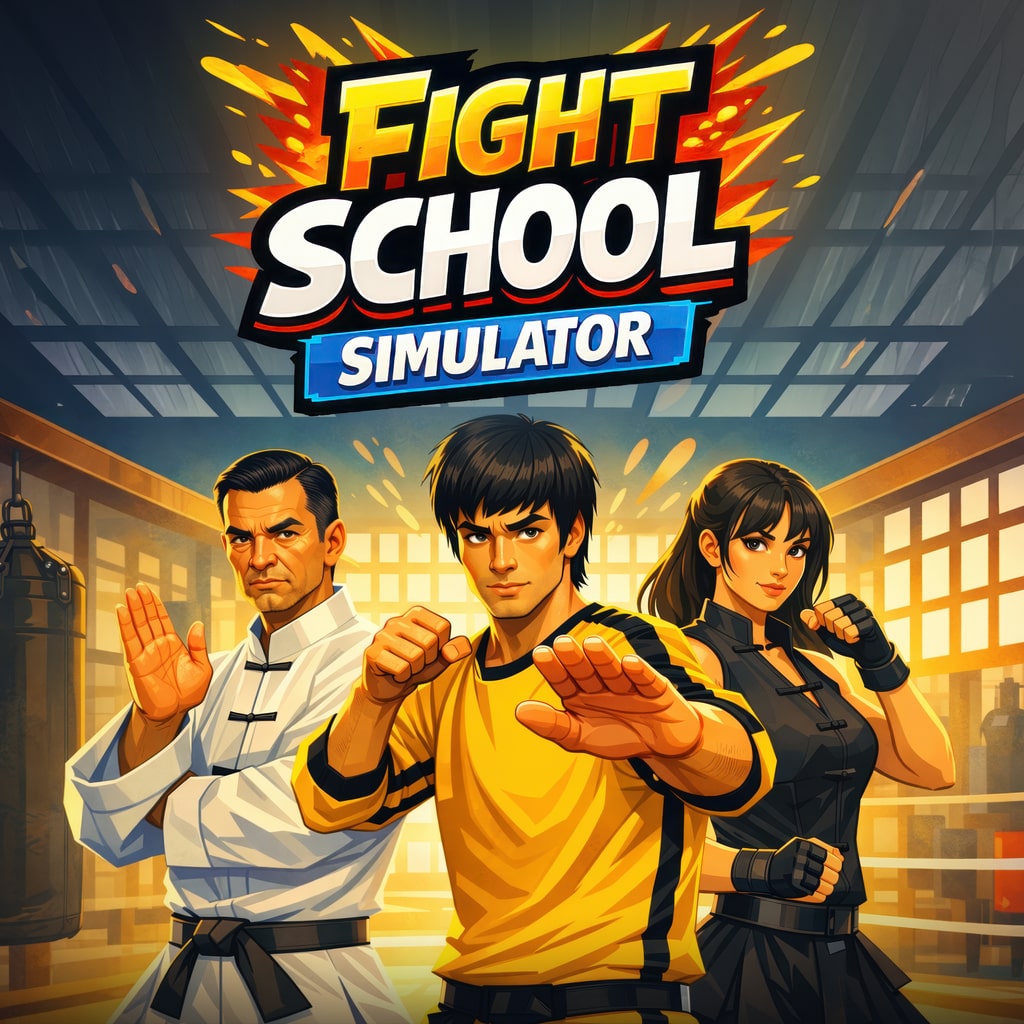
There are few things more satisfying than the fantasy of starting with absolutely nothing and slowly building something to be proud of. In Fight School Simulator, that something is a martial arts school, and your route to greatness involves equal parts training, business management and punching people who probably deserve it. It is an unusual combination, but then again, running a dojo has never seemed like a particularly ordinary career choice.
The premise is straightforward enough. You inherit a struggling martial arts school and set about turning it into a respected dojo capable of standing alongside the best in town. That means cleaning things up, buying equipment, attracting students, learning new techniques and dealing with rival schools who are not especially keen on watching you succeed. Then there is the small matter of the local Mafia and thieves, because apparently running a martial arts school isn’t stressful enough without becoming the city’s unofficial defender.
Fight School Simulator is very much a game of two halves. One side asks you to think like a business owner and teacher, while the other puts you directly into the action through first-person street fights. Neither side is especially complicated on its own, but bringing them together creates an entertaining little simulation that is at its best when your carefully trained students and hard work begin to pay off.
From Run Down Dojo To Martial Arts Empire
The early stages capture the appeal of rebuilding something from scratch quite well. Your dojo needs attention, and there’s a satisfying sense of progress in clearing away the mess, putting equipment in place and gradually turning an uninspiring space into somewhere that actually looks like a martial arts school.
You can customise your dojo with a variety of training equipment and decorations, allowing you to arrange the available space around your students’ needs. Punching bags, wooden dummies and other training equipment aren’t simply there to make the place look authentic. They form part of the training process and help turn your dojo into a functioning school rather than an empty room with a few mats thrown across the floor.
The construction side isn’t going to compete with the most elaborate management games, but that isn’t necessarily a problem. Fight School Simulator keeps things relatively accessible, which means you can concentrate on the bigger picture rather than spending hours worrying about whether your punching bags are positioned at precisely the correct angle.
Building Your Fighting Family
Students are the real heart of the dojo. Attracting new recruits is one thing, but turning them into capable martial artists is where the game really starts to get interesting. Applicants come in different tiers, and deciding which students deserve your time and resources gives the management side some welcome decision-making.
You can develop fighters towards different specialities, including Kick Masters, Punch Specialists, or more balanced fighters. That creates a nice sense of individuality because you’re not simply filling the dojo with identical characters and watching their numbers increase. The students become the people you are investing in, and there is a genuine sense of satisfaction when someone who started out as an unimpressive beginner eventually becomes one of your most reliable fighters.
Uniform colours and logos also give you the chance to put your own stamp on the school. These touches may seem relatively minor, but they contribute to the feeling that you are actually running an organisation. Your dojo gradually starts to feel like your dojo, rather than another generic building in another generic simulation.
And yes, your grasshoppers are there to help keep things running smoothly. They are a wonderfully odd little addition that fits the game’s slightly eccentric personality. Fight School Simulator doesn’t take itself so seriously that it forgets to have a bit of fun.
Learning From The Masters
Your progression is closely tied to the school’s development. By completing tasks from the Grand Master, you can learn new martial arts techniques and improve your abilities through a series of mini-games. It is a nice way to break up the management routine while giving you something tangible to work towards.
The most important point is that these techniques aren’t just for show. Once you’ve learned new moves, you can pass them on to your students and make them stronger. This creates one of the game’s more satisfying loops. You learn, you teach, your students improve, and eventually you get to see the results when those students step into combat.
There is a slightly old-fashioned charm to this progression. You aren’t simply unlocking another statistic from a menu. There is a sense that knowledge is being passed from one generation of martial artists to the next. It isn’t especially deep, but it fits the fantasy of becoming a master surprisingly well.
When The Dojo Gets A Visit
Naturally, success attracts attention, and not all of it is welcome. Four rival schools are waiting to make your life difficult, with raids forcing you to defend your territory and counterattacks letting you take the fight back to them.
This is where the two halves of Fight School Simulator begin to overlap properly. The students you’ve been training aren’t just decorative members of your dojo. They become part of your response when rival schools come calling, giving your management decisions genuine consequences.
There is also an element of strategy and diplomacy in your relationship with rivals. It isn’t simply a case of charging into every confrontation with your fists raised. Knowing when to strengthen your school, when to train your students and when to take the fight elsewhere gives the progression a little more structure.
The rival system could certainly be deeper, but it provides a useful sense of opposition. Without it, building and training could become a repetitive cycle with little urgency. Having other schools breathing down your neck gives your ambitions some teeth.
Taking To The Streets
Then there are the first-person fights, perhaps the most immediately entertaining part of the experience. When you’re not managing the dojo, you can take matters into your own hands and confront enemies with light attacks, heavy kicks and parries.
The combat isn’t sophisticated enough to be mistaken for a dedicated martial arts fighting game, but it doesn’t need to be. It provides a change of pace from the management elements and gives you a direct way to interact with the world you’ve been building.
There is something particularly satisfying about moving from quietly arranging training equipment to suddenly finding yourself in a street brawl. It is an unusual transition, but it gives Fight School Simulator a personality that many conventional management games simply don’t have.
Combat is also tied into the wider progression, since your martial arts skills can be used when defending the dojo or taking the fight to rival schools. That connection helps prevent the action from feeling like a completely separate mini-game bolted onto the side of the simulation.
Saving The City One Punch At A Time
If rival schools weren’t enough trouble, the city also has a Mafia problem. Thieves and criminals are causing trouble, giving you dozens of side missions to tackle away from the dojo.
These missions add variety and help make the city feel like more than a backdrop for your school. There is a slightly ridiculous superhero quality to the idea of a martial arts teacher leaving their dojo to sort out local criminals, but it fits the game’s deliberately quirky tone.
The side content also gives you another reason to keep improving. Every new technique and every stronger student contributes to making your organisation more capable, while completing missions helps build your school’s reputation. It creates a useful sense that everything you’re doing is ultimately feeding into the same larger goal.
Rough Around The Edges
It would be impossible to discuss Fight School Simulator without acknowledging its modest presentation. The low-poly environments, straightforward character models and occasional visual quirks make it clear this is an indie project working within its limitations.
There are moments when the animations don’t quite look as polished as they could, and the environments can feel functional rather than beautifully crafted. Lighting and character interactions aren’t always perfect either. If you’re coming to this expecting the production values of a major-studio simulation, you’re likely to be disappointed.
Personally, though, I think there is something quite likeable about the roughness. Fight School Simulator has the feel of a game built around an idea rather than a huge production budget. Its ambition is considerably greater than its polish, but that ambition is also what makes it interesting.
The audio follows a similar philosophy. Environmental sounds are relatively simple, while punches and other impacts carry enough weight to make combat feel lively. Music changes during rival encounters, signalling when the relatively peaceful business of running a dojo has suddenly become more serious.
Where The Formula Works Best
The best moments come when all these systems connect. You recruit a student, train them, teach them techniques you’ve learned yourself, improve your dojo, and eventually send them into a confrontation. Suddenly, the hours spent managing equipment and working on training don’t feel like background tasks. They have led somewhere.
That sense of cause and effect is what keeps Fight School Simulator moving forward. There is always another improvement to make, another student to develop, or another rival to deal with. Even when individual activities become repetitive, the broader progression gives you a reason to keep going.
It is also a game that understands the appeal of watching something grow. Your dojo starts modestly, but over time it becomes busier, stronger, and more recognisable. You can look around and see the results of your decisions, and that is often enough to keep the management side engaging.
The Verdict
Fight School Simulator is a strange game, but I mean that as a compliment. Combining dojo management, student development, martial arts training and first-person street fighting could easily have resulted in a confused mess. Instead, while some of its systems are undeniably basic and the presentation shows its indie roots, there is a surprisingly enjoyable rhythm to building your school and watching it develop.
The combat isn’t going to satisfy anyone looking for a serious martial arts simulator, and the management mechanics lack the depth of the genre’s heavyweights. The visual presentation is also modest, and some rough edges are difficult to ignore. Yet focusing too heavily on those shortcomings would miss what makes the game enjoyable in the first place.
There is charm in taking an empty, struggling dojo and turning it into a respected martial arts school. There is satisfaction in seeing students improve, amusement in dealing with the game’s eccentric touches, and genuine excitement when your carefully prepared fighters finally have to prove themselves. The Mafia missions and rival schools add enough chaos to keep the experience from becoming too comfortable.
Most importantly, Fight School Simulator has an identity. It knows that managing a dojo and throwing punches are two very different activities, then cheerfully decides that you should do both. The result isn’t perfect, but it is entertaining, occasionally surprisingly satisfying, and just unusual enough to stand out from the crowd.
You may not become the greatest martial artist in gaming history, but watching your little dojo grow from a struggling school into a genuine force in the city is a rewarding journey. Sometimes that’s all a good simulator needs to offer.