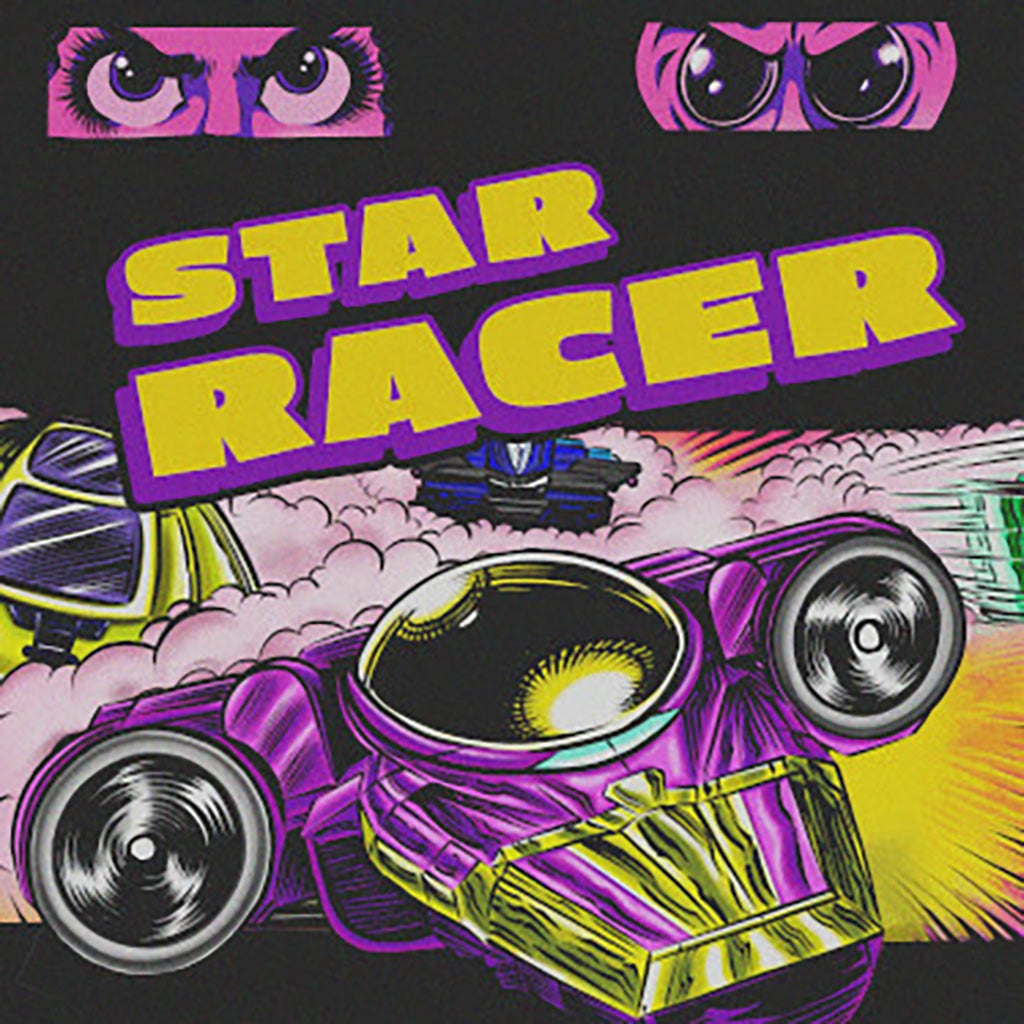
There is something wonderfully uncomplicated about Star Racer. It revisits the futuristic racing games that once made us grip a controller a little tighter, lean into corners and wonder how our thumbs could possibly move any faster, then brings that feeling into the modern era without burying it beneath unnecessary complexity. This is a game that knows exactly what it wants to be. Fast, colourful, explosive and just a little bit ridiculous, Star Racer is an affectionate love letter to the era when futuristic racing meant screaming around a track at impossible speeds while praying that the next bend did not send you flying into a wall.
The influence of games such as F-Zero is immediately apparent, particularly in the way the tracks stretch away beneath your vehicle, with that wonderfully artificial sense of depth associated with the old Mode 7 era. Yet Star Racer is not content to simply recreate a classic formula. It throws in weapons, aerial gliding, energy management, dynamic events and an impressively versatile course editor. The result is a racer that feels nostalgic without becoming trapped in the past.
Feel The Speed
Speed is obviously the most important ingredient in any futuristic racer, and Star Racer gets that right from the moment you hit the accelerator. Your vehicle tears around the circuit with an energy that makes even a relatively straightforward lap feel exciting. There is a lovely sense of momentum as you approach a corner, judge your line, drift through it, and immediately start looking for the next opportunity to gain a few precious seconds.
The tracks themselves are designed to keep you busy. Jumps launch you into the air, shortcuts tempt you away from the safest route, and hazards punish anyone who becomes complacent. There is a constant temptation to push just a little harder, particularly when another racer is breathing down your neck. Sometimes that gamble pays off beautifully, while other times it results in an explosion and the sort of mistake that leaves you staring at the screen, wondering why you thought that was a good idea.
That balance between control and chaos is one of the game’s strongest qualities. Star Racer is accessible enough to pick up quickly, but mastering a track requires considerably more than simply holding down the accelerator. Learning where to brake, when to drift, and which shortcuts are genuinely worth taking gives the racing a satisfying sense of progression.
Racing With Firepower
Of course, this is not a peaceful Sunday drive through the stars. Star Racer is a combat racer, and weapons add another layer of tension to every race. Explosive pickups can be used against your rivals, turning an apparently comfortable lead into something considerably less secure.
There is a particular joy in watching an opponent disappear in a burst of explosions just as they are about to overtake you. It is equally satisfying when you use the environment and your own speed to escape an incoming attack. The combat never completely overwhelms the racing, which is important because the game would quickly become frustrating if every race simply turned into a chaotic weapons contest.
The result is a nice middle ground. You still need to know the track, but you also need to pay attention to what everyone else is doing. A perfect racing line means very little if another competitor has a weapon waiting for you around the next corner.
Managing Your Energy
One of the more interesting mechanics is how your energy reserve must be managed. The same resource can be used to boost your vehicle’s speed or restore its defensive capabilities, creating a small but meaningful decision every time you find yourself running low.
Do you spend that energy chasing down the racer ahead, knowing you may be more vulnerable afterwards? Or do you save it to repair your defences, giving yourself a better chance of surviving the next barrage of attacks? Neither choice is always correct, and that uncertainty adds welcome strategy to what could otherwise have been a fairly straightforward arcade racer.
This mechanic becomes more important as the competition gets tougher. Early races let you focus primarily on staying on the track, but later events demand greater awareness of your resources. Suddenly, that boost you wasted half a lap ago becomes something you wish you still had.
Taking To The Skies
The ability to leave the track and glide through the air is another feature that gives Star Racer its own identity. Ramps can launch you away from the surface, turning a high-speed corner into an opportunity to take a shortcut or attack another competitor from above.
These moments feel particularly good because they break up the rhythm of conventional racing. One second you are drifting around a bend, and the next you are airborne, looking down at the circuit while lining yourself up for the landing. There is an almost arcade-like joy to it, and the game rarely lets you forget that it wants you to have fun.
Aerial combat adds another dimension, too. Being able to use weapons while gliding means the skies are not simply a brief transition between sections of track. They can become miniature battles in their own right, particularly when several racers launch into the same section together.
Event Races Keep Things Fresh
When you think you have a handle on what Star Racer is doing, the Event Races start throwing curveballs. These challenges introduce unusual rules and objectives that prevent the experience from becoming nothing more than a series of conventional races.
Lava-flooded circuits, target-destroying challenges, and encounters with boss characters all provide distinct reasons to approach the game differently. The Break the Targets events are particularly effective because they temporarily shift your priorities away from pure speed and towards precision.
That variety is important because racing games can become repetitive surprisingly quickly. By introducing different objectives, Star Racer gives you a reason to keep exploring rather than simply chasing first place over and over again. Some events are more successful than others, but the willingness to experiment deserves credit.
Build Your Own Racing Nightmare
The course editor may ultimately prove to be one of Star Racer’s most valuable features. Once you have exhausted the standard selection of tracks, the ability to create your own circuits opens the door to practically endless experimentation.
There is something deeply satisfying about designing a track specifically to torment your friends. You can create challenging layouts, incorporate jumps and hazards, experiment with shortcuts, and then throw your creation into the mix to see whether anyone else can complete it. Better still, the community sharing element means you are not restricted to the circuits you build yourself.
This transforms Star Racer from a game with a fixed collection of races into something that can continue evolving through player creativity. The quality of community creations will naturally vary, but that is part of the fun. Somewhere out there is likely to be a beautifully designed circuit you would never have thought to create yourself.
Four Friends, One Winner
Local multiplayer is another area where Star Racer feels designed with old-school gaming sessions in mind. Up to four players can compete in split-screen, and there is something timeless about gathering a few friends around the same screen to see who is actually the best racer.
Of course, friendships can become surprisingly fragile when weapons are involved. Someone will inevitably take a shortcut, someone else will claim they were deliberately targeted, and somebody will almost certainly blame the controller after crashing into the same wall for the third time.
That is precisely why local multiplayer suits this game so well. Star Racer does not need to reinvent multiplayer racing. It simply understands that fast races, ridiculous accidents, and a little bit of friendly rivalry can provide an enormous amount of entertainment.
A Retro Future
Visually, Star Racer wears its influences proudly. The combination of low-polygon vehicles and pixel-inspired environments creates a distinctive aesthetic that feels like a lost futuristic racer from another timeline. It is not trying to compete with photorealistic racing games, nor should it.
Visual clarity is one of its strengths. At the speeds involved, you need to recognise corners, hazards and track boundaries quickly. The bright environments and clearly defined obstacles ensure the action remains readable, even when everything is moving at ridiculous speed.
The soundtrack completes the package nicely. Synthwave and chiptune influences provide the appropriate pulse, while explosions, weapon effects and the hum of the vehicles add weight to the racing. It all combines to create an atmosphere that feels nostalgic and energetic.
When The Speed Becomes Too Much
Star Racer is not entirely immune to the problems that come with its enthusiasm. Later races can occasionally become overly reliant on hazards, with several dangers appearing in quick succession and making some events feel more chaotic than challenging. There are moments when victory seems to depend as much on avoiding an unfortunate sequence of events as on your actual racing ability.
That can be frustrating, particularly when you have spent an entire race driving beautifully only to lose everything because of one badly timed hazard. Thankfully, these moments do not define the experience. For the most part, Star Racer manages to keep its chaos entertaining rather than exhausting.
The important thing is that the underlying racing remains enjoyable. When a game gets its basic handling right, a few rough edges are much easier to forgive, and Star Racer has a solid foundation beneath all those explosions.
The Verdict
Star Racer is the sort of game that reminds you why futuristic racing was so much fun in the first place. It does not need a complicated explanation or a hundred systems fighting for your attention. It gives you a fast vehicle, a ridiculous track, a few weapons, and the chance to make someone else regret ever trying to overtake you.
The 3D arena racing provides a strong foundation, but it is the combination of aerial gliding, energy management, Event Races, and the course editor that gives the game its own personality. Add four-player local multiplayer and community-created tracks, and there is plenty here for both solo racers and groups of friends.
It is not perfect. The later difficulty spikes can occasionally feel unfair, particularly when hazards arrive with alarming frequency, and some races can descend into chaos rather than rewarding precision. Yet even when Star Racer frustrates, it rarely stops being fun.
More importantly, this is a game made with genuine affection for its influences. You can feel that affection in the visuals, hear it in the soundtrack, and see it in the way the developers have embraced player-created content. Star Racer is not trying to convince you that it is the next generation of racing. It simply wants to give you that old feeling of picking up a controller, seeing the starting lights disappear, and thinking, “Right, let’s go.” For fans of classic futuristic racers, that is a pretty compelling invitation.