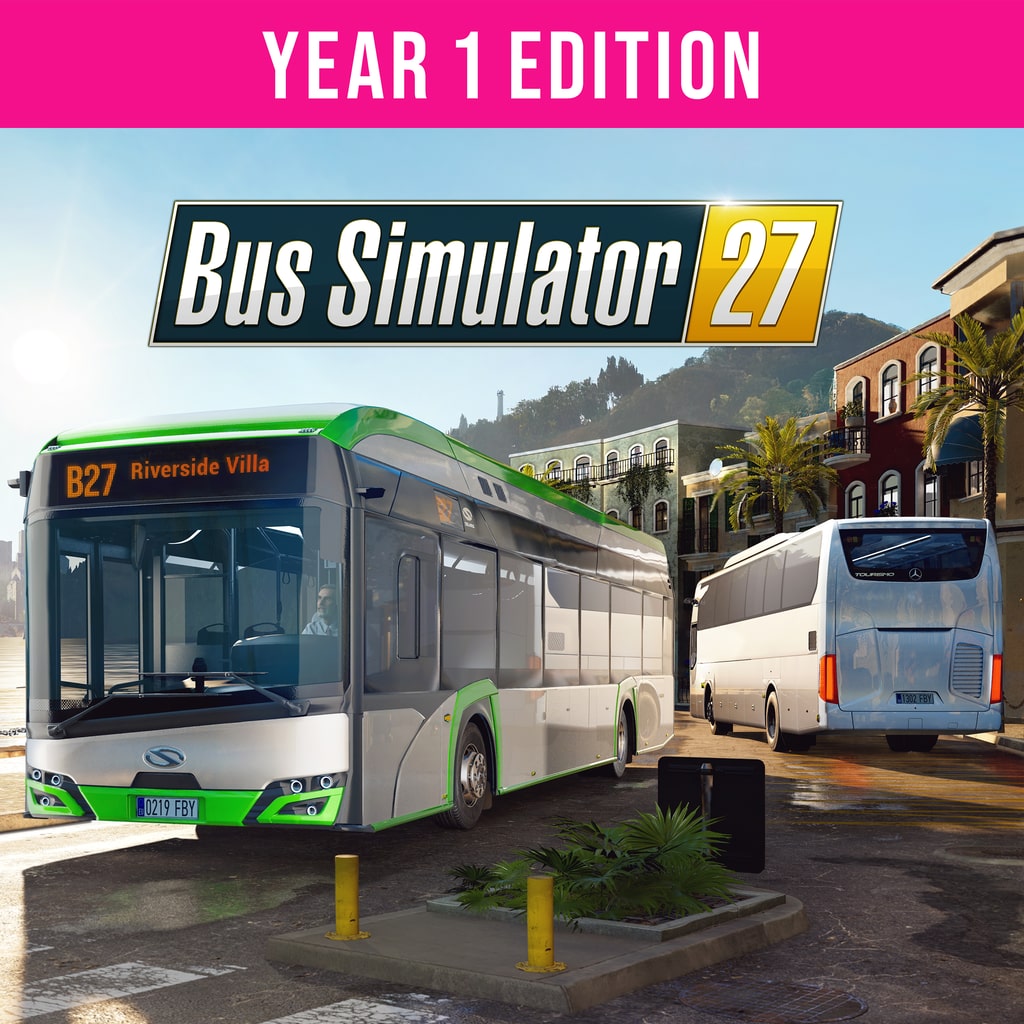
There are few games quite as capable of turning something as ordinary as catching the bus into an oddly satisfying pastime as the Bus Simulator series. What sounds mundane on paper can become strangely compelling once you are behind the wheel, watching passengers climb aboard, checking your mirrors, keeping to a timetable and trying to avoid turning a perfectly respectable journey into a traffic-jammed disaster. Bus Simulator 27 takes that familiar formula and gives it considerably more room to breathe. With a new development team, Unreal Engine 5 and a greater emphasis on long-distance travel, this is a much broader interpretation of the series.
The Year 1 Edition is particularly interesting because it packages the main game with its first wave of additional content. Alongside the full experience, buyers receive the Year 1 Season Pass, covering a Mercedes-Benz Intouro Bus DLC, a FlixBus Coach Expansion, two additional bus packs and two cosmetic packs. It is clearly aimed at players who already know they are going to spend a lot of time behind the wheel, and there is something reassuring about having the first year of additional content bundled together from the outset.
More importantly, though, the base experience has enough ambition of its own to make the journey worthwhile. This is not simply another collection of city routes with slightly shinier buses. Bus Simulator 27 wants you to think about public transport on a much larger scale.
The Road Gets Longer
The most significant addition is long-distance coach travel. Previous entries have understandably focused on urban routes, where the challenge lies in navigating busy streets, stopping frequently and keeping passengers moving. Here, the world opens up and the journey itself becomes part of the experience.
There is something genuinely relaxing about leaving the city behind and watching the scenery change as you head towards another destination. Highways replace narrow urban streets, the number of stops decreases, and suddenly you have time to settle into the rhythm of driving. That does not mean the game becomes passive, though. Passenger comfort, route planning and the demands of longer journeys introduce their own considerations.
The difference in pace is perhaps the most welcome part. One minute you can be squeezing a large vehicle through a busy downtown junction, the next you are cruising along a coastal highway with nothing but the road ahead. It gives Bus Simulator 27 a stronger sense of scale and makes the bus itself feel like more than simply a means of getting from one waypoint to another.
A Fleet Worth Building
There is also an impressive selection of vehicles to get behind the wheel of. More than 45 officially licensed buses are available across a wide range of manufacturers, with city buses, articulated models, electric vehicles, double deckers and coaches all contributing to the fleet.
That variety matters because different buses naturally change how you approach the road. A compact city vehicle feels very different from a long articulated bus, while a coach designed for longer journeys has its own character. Learning each vehicle’s dimensions and getting comfortable with their handling becomes part of the appeal.
The licensed manufacturers also add a pleasing sense of authenticity. Fans of real-world public transport will no doubt enjoy recognising familiar names, while even players who could not tell one bus from another will appreciate the additional personality they bring to the fleet. There is something satisfying about building up a collection and eventually having a vehicle for practically every occasion.
The Year 1 Edition adds even more incentive to collect, with additional buses and future content included through the Season Pass. The Mercedes-Benz Intouro is particularly well suited to the game’s expanded long-distance focus, while the FlixBus expansion should appeal to anyone who enjoys the idea of operating something closer to a genuine coach network.
Felicia Bay Awaits
The setting is another major part of the experience. Felicia Bay offers a large open world inspired by the Iberian Peninsula, blending dense urban areas with rural roads, coastal scenery and longer stretches of highway.
This variety gives routes a welcome sense of place. A bus journey feels different depending on where you are driving, and the contrast between city traffic and open countryside helps prevent the map from becoming visually repetitive. There is a certain pleasure in discovering a new road or realising that a route takes you somewhere you have not explored before.
Weather also plays its part. Rain can turn familiar roads into something considerably more challenging, particularly when combined with heavy traffic or night-time driving. It is not merely there for visual effect. Changing conditions help create those little moments of tension when you suddenly become much more aware of your speed, braking distance and surroundings.
That is where the move to Unreal Engine 5 begins to make sense. It is not just about making the buses look prettier. Lighting, reflections, weather and environmental detail all contribute to making the world feel more convincing.
The Quiet Satisfaction Of Driving
The best thing about Bus Simulator 27 is still the driving. There is a particular rhythm to a good route that other driving games rarely capture. You pull into a stop, open the doors, wait for passengers, check the road, and move off again, all while keeping one eye on the timetable.
It sounds repetitive because it is repetitive. Yet that repetition is precisely why the game works. There is something oddly satisfying about becoming familiar with a route and gradually improving your performance. You begin to anticipate junctions, understand where traffic tends to build up, and learn exactly how much room your bus needs.
It is not about constantly chasing excitement. Sometimes the pleasure comes from completing an entire journey without making a mistake. When you arrive at your destination on time, with satisfied passengers and an intact bus, the game gives you that quiet sense of accomplishment that simulation games do so well.
Building A Transport Empire
The management side adds another layer for those who want more than simply driving. You are not merely taking passengers from one stop to another. You are gradually building a fleet and expanding your operation.
Route creation and timetable management become increasingly important as your network grows. You need to consider which vehicles are best suited to certain journeys and how your services fit together. The more responsibility you take on, the more the game starts to feel like a transport management experience rather than simply a driving simulator.
That progression is particularly important because it gives your time behind the wheel a purpose. You are not just completing another route for the sake of it. You are working towards something larger, and that sense of development encourages you to keep playing.
Four Drivers, One Network
Cooperative multiplayer is another welcome feature, allowing up to four players to work together. It sounds like a novelty until you imagine what a shared transport network could look like.
One player can handle a busy city route while another takes a coach onto the motorway. Someone else can cover the afternoon rush while another driver tackles a longer journey. It creates the potential for a surprisingly social simulation experience, particularly if everyone is willing to take the job seriously.
Of course, there is also enormous potential for chaos. A friend who decides to ignore every traffic rule imaginable is likely to make the whole operation considerably less efficient. But that is part of the charm. Simulation games can sometimes become overly serious, and having other players around gives Bus Simulator 27 an opportunity to be both relaxing and entertaining.
A Beautiful Bus Ride
The Unreal Engine 5 presentation is one of the game’s most noticeable improvements. Buses benefit from detailed interiors and dashboards, while wet roads and shifting lighting can make familiar environments look dramatically different.
Night driving, in particular, has a distinct atmosphere. Headlights reflect off wet surfaces, street lighting illuminates the road ahead, and the bus interior takes on a warmer, quieter feel. It is not going to compete with the biggest open-world driving games in sheer visual spectacle, but it does not need to.
The audio helps sell the experience too. Engine noise, air brakes, ticket machines and passenger chatter create the familiar soundtrack of public transport. These little details matter more than you might expect. After enough time behind the wheel, the sounds become part of the routine, helping transform the game from a collection of mechanics into a convincing simulation.
There are occasional technical rough edges, particularly when traffic becomes dense, and AI vehicles can sometimes make questionable decisions. These moments can pull you out of the simulation, but they are generally exceptions rather than the rule.
What The Year 1 Edition Adds
The Year 1 Edition makes the most sense for players who already know they are going to commit to Bus Simulator 27. The main game provides the foundation, while the Season Pass promises to keep expanding the fleet and cosmetic options throughout 2026 and 2027.
Including the Mercedes-Benz Intouro Bus DLC, FlixBus Coach Expansion, two bus packs and two cosmetic packs gives the package a clear advantage over buying each piece individually. The more than 16 per cent saving also makes the bundle considerably easier to recommend to dedicated simulation fans.
The free Deluxe Pack for pre-orders adds another incentive for those buying before launch, although that offer is naturally time-limited. The bigger point is that the Year 1 Edition feels designed for the long haul. It is not simply trying to sell you a game and leave you there. It is positioning itself as the starting point for an expanding transport simulator.
The Verdict
Bus Simulator 27: Year 1 Edition is an impressive step forward for the series, recognising that bigger does not necessarily mean more complicated. The addition of long-distance coach travel gives the game a new rhythm, while the huge vehicle roster and expansive Felicia Bay map provide plenty of opportunities to settle into a route and simply enjoy the drive.
The Unreal Engine 5 presentation adds atmosphere rather than merely visual polish, particularly when weather and lighting combine to make a familiar road look completely different. The management elements give your driving a sense of purpose, while four-player multiplayer could provide some memorable evenings for friends willing to embrace the simulation’s slower pace.
It is not without faults. Traffic AI can occasionally behave strangely, dense areas can put some pressure on performance, and the deliberate nature of the simulation will inevitably test the patience of anyone looking for constant action. This is a game where a successful twenty-minute journey can be more rewarding than a spectacular five-minute one.
For the right audience, that is exactly the appeal. Bus Simulator 27 does not try to make driving a bus glamorous. Instead, it finds satisfaction in the little details and gradually builds them into something much larger. The Year 1 Edition strengthens that proposition with a substantial package of additional content and a Season Pass designed to keep the fleet growing.
There is something strangely comforting about a game that asks you to slow down, pay attention and get everyone where they need to go. In a gaming landscape obsessed with explosions and enormous set pieces, Bus Simulator 27 finds its excitement in a timetable, a wet motorway and a bus full of passengers waiting to reach their destination. And honestly, sometimes that is all the excitement you need.