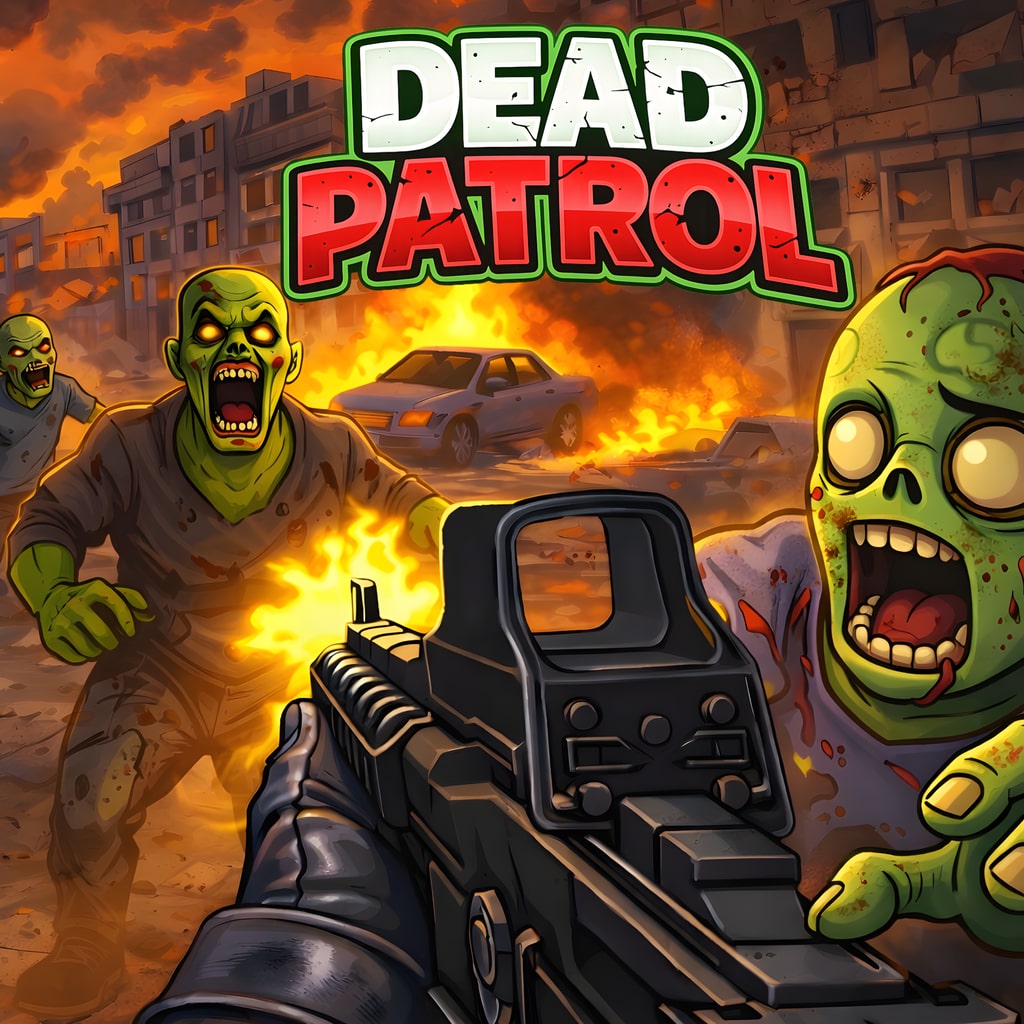
There’s a certain confidence in simplicity, and Dead Patrol embodies that philosophy on its blood-soaked sleeve. Released on April 5, 2026, by y-zo studio, this urban zombie shooter doesn’t pretend to reinvent the genre. Instead, it emphasises immediacy—tight combat loops, relentless pacing, and a stripped-back structure that prioritises action above all else.
In a landscape crowded with survival horror hybrids, open-world sandboxes, and narrative-heavy undead epics, Dead Patrol feels almost defiant in its approach. This isn’t about crafting, base-building, or emotional storytelling. It’s about stepping into a ruined city, pulling the trigger, and surviving the next wave.
The question is: does that purity of vision translate into something compelling—or does it leave the experience feeling thin?
A City on the Brink
Dead Patrol quickly establishes the setting. Civilisation has fallen, the streets are overrun, and you are one of the last defenders: an elite patrol officer assigned to reclaim sectors of a ruined city.
There’s no deep lore to explore or branching storylines to follow. The storytelling is sparse, conveyed through brief mission briefings and environmental clues. Burnt-out vehicles, barricaded shops, and blood-stained alleyways carry most of the narrative.
While some players might find the lack of story depth unsatisfying, it’s arguable that it fits the game’s tone. Dead Patrol focuses less on why the apocalypse occurred and more on how you survive in its aftermath.
Still, it’s difficult to overlook the missed opportunity. A stronger narrative structure—or even more characterisation for your protagonist—could have enhanced the experience beyond its mechanical nature.
Combat First, Everything Else Second
At its heart, Dead Patrol is all about combat—and to its credit, this is where the game is at its strongest.
Gunplay is quick, responsive, and satisfyingly heavy. Weapons deliver a punch, and there’s a clear sense of impact when mowing down waves of the undead. The focus on smooth weapon switching encourages adaptability, pushing you to cycle between firearms based on the situation.
Shotguns feel devastating at close range, assault rifles provide reliable mid-range control, and heavier weaponry offers crowd-clearing power when things get chaotic. There’s a rhythm to combat that becomes increasingly engaging as enemy numbers grow.
Movement is just as crucial. The game promotes constant repositioning—standing still can be a death sentence. Dodging through tight spaces, exploiting environmental choke points, and managing distance become second nature as you learn the flow of each encounter.
This creates a satisfying loop: move, shoot, switch, survive.
However, the “straightforward and brutal” approach is both a strength and a limitation. While the combat feels great, it seldom evolves. Enemy types, though varied enough to keep you alert early on, don’t introduce enough new mechanics to significantly change your strategy in later stages.
The Weight of the DualSense
On PlayStation 5, Dead Patrol makes excellent use of the DualSense controller—and it’s one of the game’s standout features.
Adaptive triggers provide resistance for different weapon types, giving each firearm a unique tactile feel. There’s a satisfying tension when firing heavier weapons, while lighter guns respond more quickly and responsively.
Haptic feedback further boosts immersion. You’ll feel the recoil of gunfire, the gentle rumble of distant chaos, and the impact of nearby threats. It’s not revolutionary, but it’s implemented thoughtfully enough to enhance the overall experience.
On PlayStation 4, the core gameplay remains intact but naturally lacks this added layer of immersion. It’s still perfectly playable—but the PS5 version is clearly the best way to experience the game.
Mission Structure and Replayability
The game is organised around sector-based missions, each tasking you with clearing zones of the undead and reclaiming territory.
These missions are simple: survive waves, eliminate targets, and advance. There’s a distinct arcade-like vibe here, with an emphasis on performance, efficiency, and survival time.
This design suits short, intense gaming sessions. Dead Patrol is at its best when played in bursts—jumping into a mission or two, aiming for better performance, and gradually honing your skills.
However, the repetition becomes more apparent during longer play sessions. Without meaningful variation in objectives or mission structure, the experience can start to feel cyclical. You’re basically doing the same thing in slightly different environments, repeatedly.
There’s potential for replayability through score-chasing and mastery, but players seeking a deeper progression system or evolving gameplay loop may find it lacking.
Visuals and Atmosphere
Visually, Dead Patrol offers a gritty, functional portrayal of a city in collapse.
The environments are appropriately bleak, filled with debris, flickering lights, and signs of recent संघर्ष. There’s a consistent tone throughout, even if it lacks variety. Urban streets, deserted buildings, and narrow corridors dominate the landscape.
Enemy design is adequate, if not particularly memorable. The undead appear in various forms, but they seldom stand out visually. While they may lack individuality, they compensate with sheer numbers.
Performance remains stable on both PS5 and PS4, with smooth frame rates that are vital for a game heavily dependent on responsiveness. There are occasional rough edges—minor animation quirks and visual inconsistencies—but nothing that significantly detracts from the experience.
Brutal Simplicity—For Better or Worse
What ultimately defines Dead Patrol is its dedication to simplicity.
There’s no excess here. No unnecessary systems, no complicated mechanics—just pure, unadulterated action. For some players, that’s exactly what they seek. A game that respects their time, provides immediate thrills, and avoids overcomplication.
However, that same simplicity can also feel restrictive. Without deeper systems, more robust progression, or a wider variety of content, the experience risks becoming repetitive.
It’s a game that knows its identity—but doesn’t quite push beyond it.
Final Thoughts
Dead Patrol is a capable, sharply focused action shooter that delivers exactly what it promises: fast-paced, brutal combat in a collapsing urban environment.
For players who enjoy arcade-style shooters and brief, intense gameplay loops, there’s plenty to enjoy here. The gunplay is satisfying, the controls respond well, and the DualSense features add a welcome layer of immersion on PS5.
However, its lack of depth, limited variety, and minimal narrative ambition stop it from standing out in a crowded genre. It’s a solid base—but one that feels like it could have been developed further.
Ultimately, Dead Patrol is a game best enjoyed in short bursts—a quick rush of adrenaline rather than a long-term obsession.