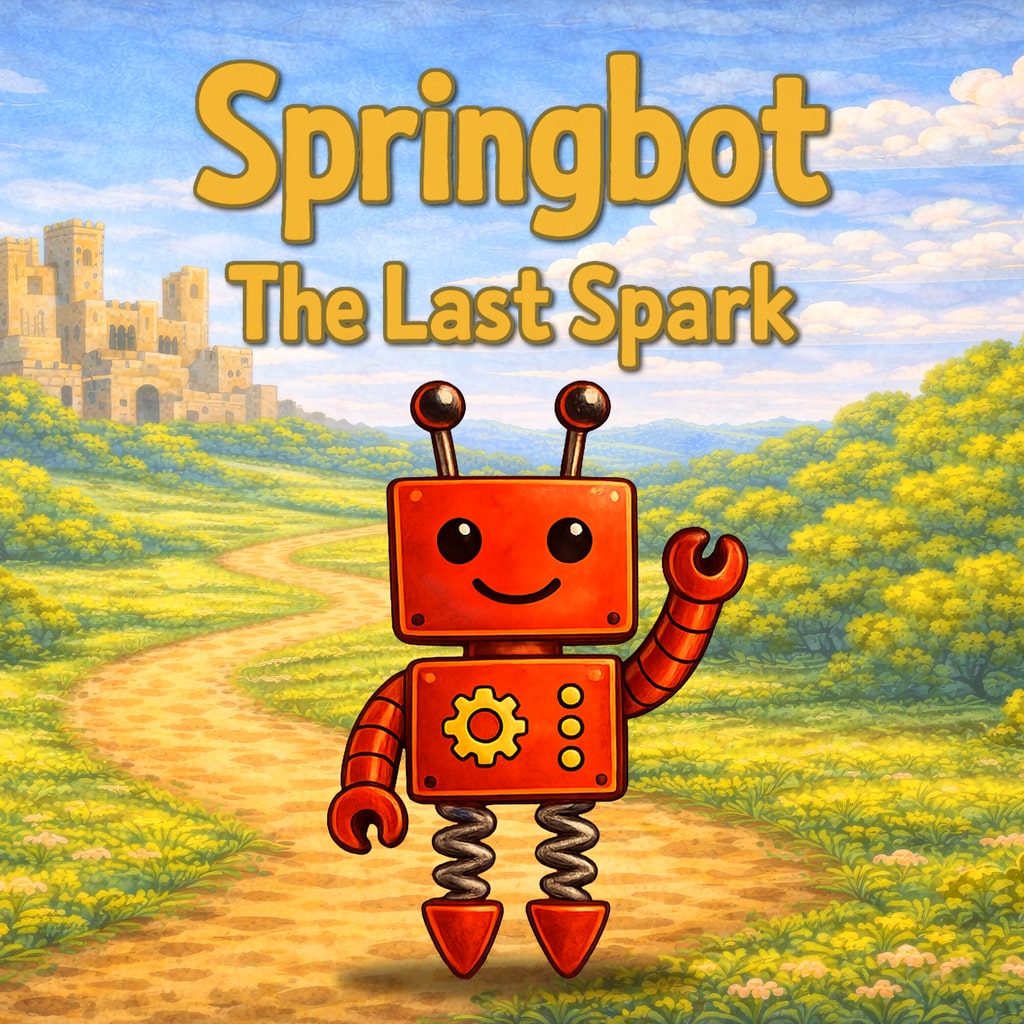
There is something wonderfully refreshing about a game that knows exactly what it wants to be. In an era when many platformers chase sprawling open worlds, endless upgrade trees, and increasingly complex systems, Springbot: The Last Spark takes a much simpler approach. It embraces the spirit of classic side-scrolling adventures and focuses on what has always mattered most in the genre: responsive movement, clever level design, and pure fun.
Developed by SMV Games and Eastasiasoft, this colourful platforming adventure arrives with no grand ambitions to reinvent the wheel. Instead, it aims to polish familiar ideas until they shine. The result is a charming, family-friendly experience that feels like a love letter to the platformers many of us grew up with. From the moment the adventure begins, it becomes clear that Springbot’s greatest strength is its sincerity. This is not a game trying to overwhelm players with spectacle. It simply wants to put a smile on your face, and for the most part, it succeeds.
One Little Robot Against a Silent World
The story is deliberately straightforward, and that simplicity works in its favour. A mysterious event has left an entire robotic civilisation powerless and frozen in place. Only one tiny hero remains active. Armed with the mysterious Last Spark, Springbot sets out to restore energy to his world and bring his robotic companions back from their dormant state.
The premise provides enough motivation to keep the journey moving without distracting from the gameplay. There are no lengthy cutscenes or convoluted lore dumps. Instead, the narrative quietly supports the adventure in the background, keeping the focus on exploration and platforming.
Despite the minimalist storytelling, Springbot himself possesses a surprising amount of personality. His animations are expressive, his movements are energetic, and his determination becomes increasingly endearing as the adventure progresses. It is difficult not to root for the little robot as he bounces through forests, caverns, cliffs, and mechanical ruins in search of the gems needed to save his world.
Built Around Movement
The defining feature of Springbot: The Last Spark is its unique movement system. Rather than relying on traditional jumps, Springbot traverses the world using spring-loaded robotic legs that let him bounce, leap, and launch himself across each stage. Thankfully, the controls feel excellent. Every jump is responsive and predictable, which is essential in a platformer built around momentum. A satisfying rhythm emerges as players learn to chain jumps together, clear hazards, and discover hidden pathways.
The game strikes an effective balance between accessibility and mastery. Newcomers can comfortably work their way through most stages, while more experienced players will find opportunities to optimise routes, shave seconds off completion times, and uncover every hidden collectible. Movement simply feels good, and that carries the experience a long way. There were numerous occasions when I replayed levels not because I needed to, but because traversing the environments was enjoyable in its own right.
Maze-Like Worlds Filled With Secrets
While platforming forms the foundation, exploration plays an equally important role throughout the adventure. Across 35 unique levels, players are encouraged to search every corner for hidden gems, coins, and secrets. Many stages function as miniature labyrinths, with alternate routes and concealed areas rewarding curious players who take the time to investigate.
Environmental puzzles add welcome variety to the formula. Pushing crates to create makeshift platforms, activating switches, and navigating obstacle-filled areas prevent the gameplay from becoming repetitive too quickly. These puzzles rarely become particularly difficult, but they offer enough variety to keep progression engaging.
Collectible hunting proves especially satisfying because levels are designed with replayability in mind. Returning to earlier stages, armed with greater familiarity, often reveals shortcuts or hidden areas that may have been overlooked during an initial playthrough. This creates a pleasant sense of discovery throughout the adventure, encouraging exploration without ever feeling overwhelming.
Colourful Charm at Every Turn
Visually, Springbot: The Last Spark is delightful. Its bright, cheerful art style immediately evokes classic platforming adventures while benefiting from a modern high-definition presentation. Environments burst with colour, character models are expressive, and the visual clarity ensures hazards remain easy to read even during more demanding platforming sections. The world itself feels welcoming. Forests glow with vibrant greens, cavern systems feature rich lighting effects, and cliffside environments provide impressive verticality that complements Springbot’s bouncing abilities perfectly.
There is a consistent sense of optimism throughout the presentation. Even when navigating dangerous traps or hostile mechanical creatures, the game maintains a light-hearted tone that makes it suitable for players of all ages.
Performance is equally impressive. Throughout my time with the game, movement remained smooth and responsive, with a stable frame rate helping every jump feel precise. In a genre where timing is everything, that technical consistency makes a significant difference.
Simple Combat, Effective Design
Combat is deliberately uncomplicated. Most enemies can be defeated by jumping on their heads, echoing the traditions of platforming classics from decades past. While some players may wish for more combat depth, the simplicity suits the overall design philosophy.
The focus remains firmly on movement and exploration rather than combat encounters. Enemies function more as environmental obstacles than genuine threats, requiring players to carefully manage positioning and timing rather than engage in lengthy battles. This approach keeps the pacing brisk. Levels flow naturally from one challenge to the next without becoming bogged down by unnecessary complexity. The game understands its strengths and wisely chooses not to overcomplicate matters.
Co-op Fun and Glitchy Challenges
One of the welcome additions is the inclusion of local co-op play. Sharing the adventure with a friend adds an extra layer of enjoyment, particularly when tackling puzzle sections that require teamwork and coordination. The co-op implementation feels natural rather than tacked on, offering genuine opportunities for collaborative problem-solving throughout the campaign.
Meanwhile, players seeking additional challenge can dive into Glitch Mode. This alternative mode significantly raises the difficulty by introducing unusual modifiers and environmental disruptions. Altered gravity, visual distortions, and more aggressive hazards transform familiar stages into entirely new tests of skill. While casual players may be content with the standard campaign, Glitch Mode offers a worthwhile challenge for platforming veterans looking to push their abilities further.
Familiarity Holds It Back
If there is one area where Springbot: The Last Spark occasionally stumbles, it is in maintaining variety across its middle sections. Although the environments change visually, some objectives begin to repeat. Pushing crates, locating keys, and uncovering hidden paths remain enjoyable, but the formula can feel a little too familiar after several hours.
This never becomes a major problem, largely because the excellent movement system continues to carry the experience. Still, a few additional gameplay twists or unique mechanics introduced later in the adventure could have elevated the overall package further. Fortunately, the game’s relatively concise length prevents repetition from becoming a serious issue.
Final Verdict
Springbot: The Last Spark proves that a platformer does not need revolutionary ideas to be memorable. What it lacks in innovation, it more than makes up for with polish, charm, and genuinely enjoyable gameplay.
Its responsive controls, colourful presentation, satisfying exploration, and cheerful personality combine to create an adventure that feels welcoming from start to finish. While some objectives become repetitive over time, the sheer joy of bouncing through its imaginative levels keeps the experience from losing momentum. This is the kind of game that understands the timeless appeal of classic platforming and delivers it with confidence. It may not redefine the genre, but it absolutely reminds us why we fell in love with it in the first place.