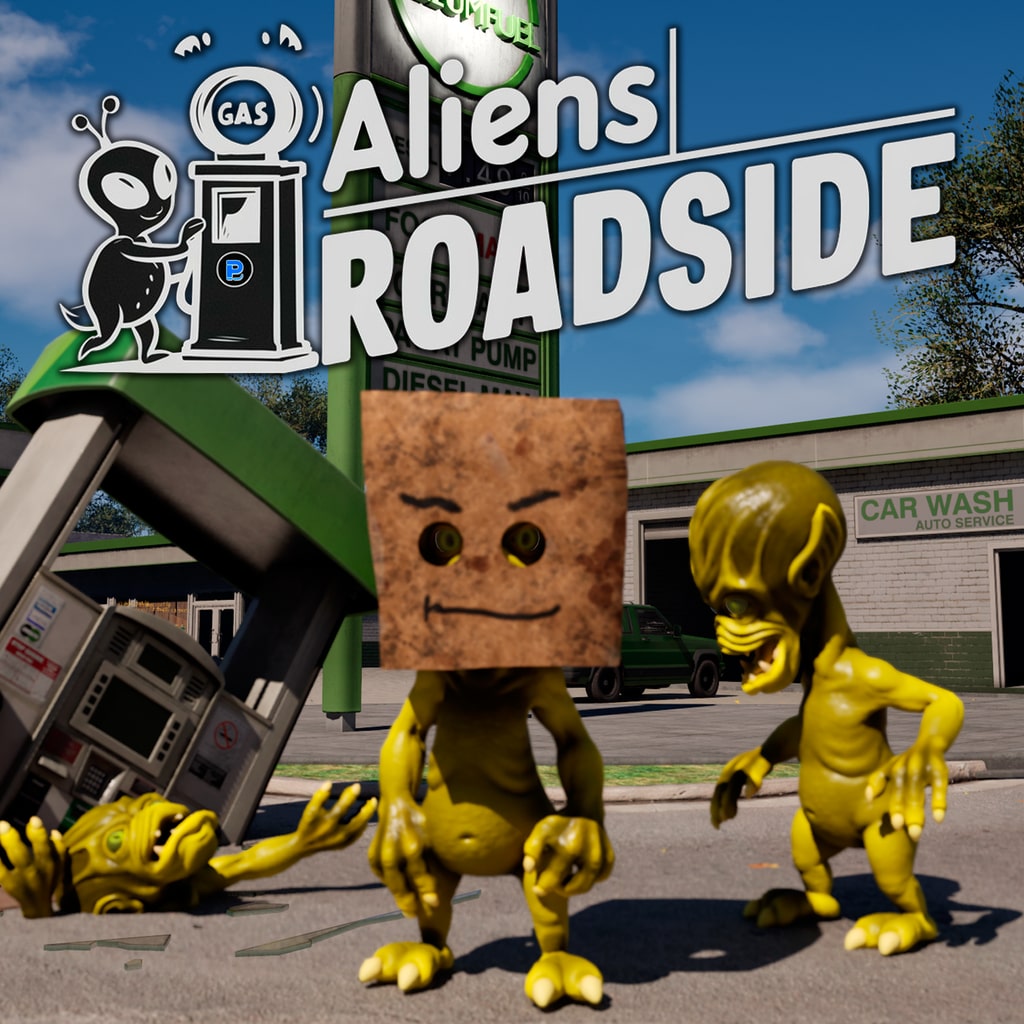
There’s a very specific type of indie game pitch that instantly raises an eyebrow—and Aliens Roadside certainly fits that description. A third-person adventure where you play as an alien stranded on Earth, compelled to run a roadside gas station to earn enough money for a comically large pizza order just to get home? It’s the kind of premise that sounds like a joke… until you realise developer Jes Games is playing it almost entirely straight.
Released on 6 April 2026 for PlayStation 5, Aliens Roadside combines simulation, light management, and quirky storytelling into something that sits somewhere between Gas Station Simulator and a low-budget sci-fi comedy. It’s odd, often charming, occasionally frustrating—and ultimately a fascinating example of ambition exceeding execution.
A Premise That Carries the Experience
Let’s clear one thing up: the concept does a lot of the heavy lifting here.
You play as a stranded alien trying to blend in among humans while rebuilding a dilapidated gas station on the outskirts of a sleepy town. The goal? Earn enough money to place an outrageously large pizza order that somehow doubles as your ticket off Earth.
It’s ridiculous—and pleasantly so. There’s a subtle humour in everything, from the alien’s slightly odd behaviour to the deadpan way the game treats its own absurdity. Customers rarely question your peculiarness, and your character’s “pretending to be human” adds a gentle layer of awkward comedy to otherwise mundane tasks.
Narratively, though, don’t expect anything particularly profound. The story acts more as a framing device than a driving force. There are hints of world-building and the occasional amusing interaction, but Aliens Roadside is much more focused on its gameplay loop than on telling a compelling story.
From Ruin to Roadside Empire
At its core, Aliens Roadside is a management-lite simulation game seen from a third-person perspective.
You start with a run-down petrol station: broken pumps, dusty shelves, and a general impression that no one has visited in years. From there, the gameplay loop develops in a familiar yet satisfying manner.
- Clean up debris and repair equipment
- Serve customers at the pumps
- Stock shelves with snacks and essentials
- Expand into additional services like a diner and car wash
- Reinvest profits into upgrades and efficiency improvements
There is a clear sense of progression, and the early hours are particularly engaging. Watching your shabby station gradually transform into a busy roadside stop is genuinely satisfying, especially as new systems unlock and your responsibilities expand.
Adding a diner and car wash helps break up the routine. Preparing food, managing orders, and keeping vehicles clean adds variety—even if these systems remain fairly simple on a mechanical level.
However, the game rarely develops beyond its initial ideas. Once you’ve unlocked most of the upgrades, the loop becomes repetitive. There is little in the way of late-game complexity or meaningful variation, and the absence of deeper management systems can make it feel shallow after extended gameplay.
Hands-On… Perhaps Too Hands-On
One of Aliens Roadside’s notable features is its insistence on keeping you actively involved in every task. Unlike more traditional management sims where you eventually automate processes or delegate responsibilities, here you’re handling almost everything yourself. Pumping fuel, scanning items, cleaning floors — it’s all manual, all the time.
Initially, this creates a sense of immersion. You feel like you’re genuinely running the station, juggling multiple responsibilities as customers arrive in waves. There’s a certain satisfaction in efficiently managing a busy rush.
However, over time, this design choice can become a double-edged sword.
Without meaningful automation or staff management systems, the game may become draining rather than engaging. Repetition quickly sets in, and the lack of tools to streamline your workflow means you’re often stuck performing the same tasks long after they’ve lost their novelty.
It’s a missed opportunity — especially given how well the game sets itself up for deeper management mechanics.
A World That Feels… Slightly Off
Visually, Aliens Roadside falls squarely into the “functional but unremarkable” category.
The small-town setting has a certain charm, with quiet roads, passing cars, and a relaxed atmosphere that aligns with the game’s tone. There’s a pleasant simplicity to the environment, even if it lacks detail or variety.
Character models, however, are noticeably rough. Animations can feel stiff, and interactions sometimes lack polish. Customers, in particular, seem a bit lifeless, more like moving objectives than believable people.
Ironically, this slightly uncanny presentation almost works in the game’s favour. Since you’re playing as an alien trying to pass as human, the oddity of the world and its inhabitants enhances the overall vibe—intended or not.
Performance on PS5 is generally stable, with smooth frame rates and minimal loading times. While it doesn’t push the hardware significantly, it at least avoids technical distractions.
Quirky Charm vs Mechanical Repetition
What ultimately defines Aliens Roadside is the tension between its personality and its systems.
On one hand, it’s undeniably charming. The premise is unique, the tone is light-hearted, and there’s a consistent sense of humour running through the experience. It’s the kind of game that’s easy to like, even when it’s not doing anything particularly groundbreaking.
On the other hand, its gameplay systems struggle to sustain long-term engagement. The lack of depth, combined with repetitive tasks and limited progression, means the experience can start to feel like a grind rather than a journey.
There are glimpses of something more here—a deeper simulation, a richer narrative, a more dynamic world—but they’re never fully realised.
Final Thoughts
Aliens Roadside is a game that hinges on its concept but is held back by its execution.
For a few hours, it’s genuinely enjoyable. Building your station, juggling tasks, and embracing the absurdity of your alien predicament creates a satisfying and often amusing experience. It’s easy to lose yourself in the early-game loop, especially if you enjoy hands-on simulation titles.
However, as the hours pass, the flaws become more apparent. Repetition sets in, systems fail to develop, and the lack of meaningful progression makes the experience less engaging.
Nevertheless, there’s something charming about it. Aliens Roadside may not fully realise its potential, but it offers a quirky, relaxing slice of simulation gameplay that’s easy to get immersed in—even if it struggles to maintain your attention over time.