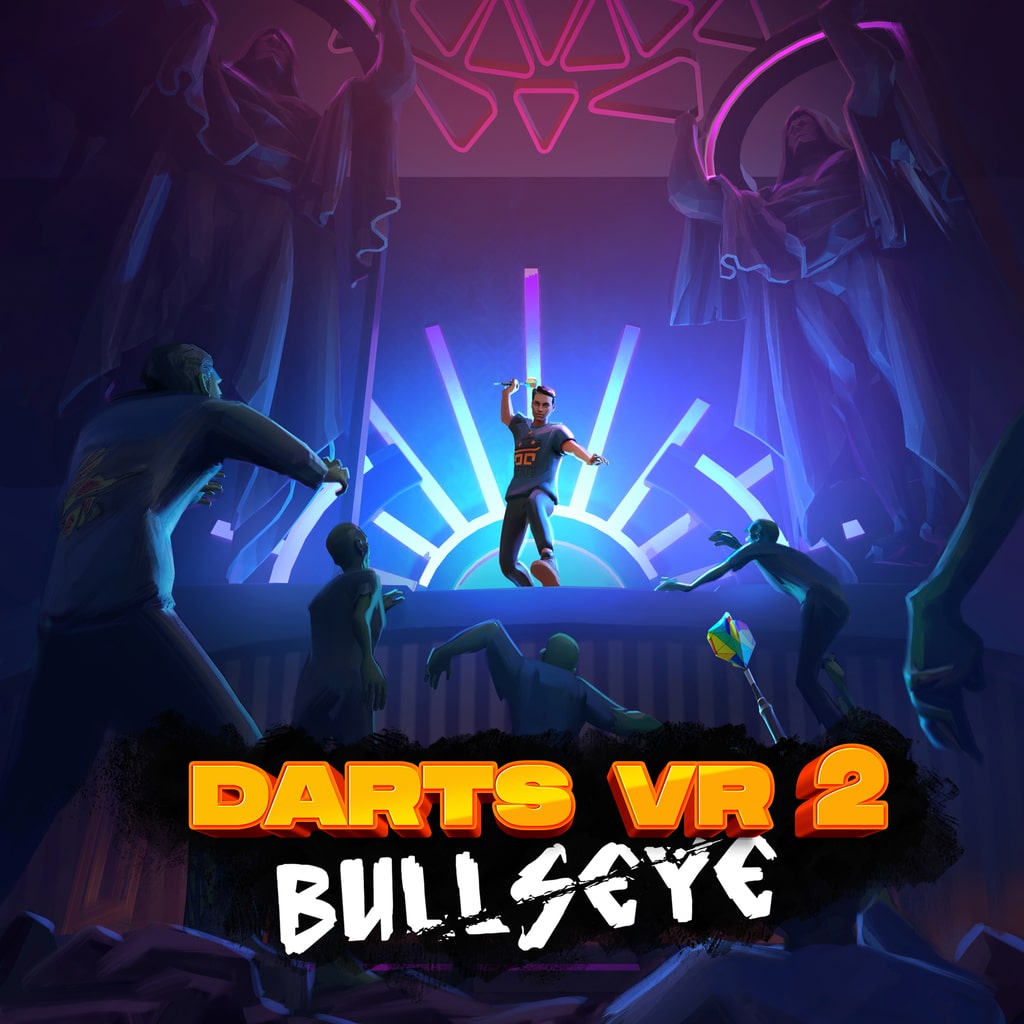
Sports sims in VR often occupy a strange space. They can either become deeply immersive recreations of real-world precision, or drift into gimmick territory in an attempt to broaden appeal. Darts VR2: BullsEye, developed by Gamitronics and published by Evolution Publishing, largely manages to balance both ambitions—delivering a surprisingly grounded darts simulation while also experimenting with arcade-style modes that push the concept far beyond the pub game it is based on.
Released simultaneously across PlayStation VR2, Meta Quest, and PCVR on April 9, 2026, this sequel to 2017’s Darts VR arrives with a clear goal: to refine the physics, expand the content, and modernise the experience for contemporary VR audiences.
For the most part, it succeeds—though not without some uneven design choices.
A Sharper Throw: Physics and Core Gameplay
At the heart of BullsEye is its reworked physics engine, arguably the most important improvement over its predecessor. Dart throwing in VR lives and dies by feel, and the developers have clearly prioritised consistency and precision.
The throwing motion feels more grounded than before. Wrist flicks, arm angle, and release timing all play a meaningful role in accuracy. There is a noticeable weight to the darts, making each throw feel deliberate rather than floaty or automated. When everything clicks, landing a tight triple 20 or a decisive bullseye feels genuinely satisfying.
On PSVR2, haptic feedback further enhances this sensation, subtly reinforcing impact and release timing. It’s not overly aggressive, but it adds enough tactile response to deepen immersion.
The physics are not perfect, however. Occasional inconsistencies can appear when throwing quickly or under pressure, particularly in competitive multiplayer scenarios where latency or minor tracking deviations can affect precision. While these moments are rare, they are noticeable enough to occasionally break the illusion of total control.
Still, compared to the original Darts VR, this sequel represents a significant step forward in mechanical reliability.
Traditional Modes: 501, Around the World, and Beyond
For purists, BullsEye offers a strong selection of traditional darts formats. The inclusion of 501, Cricket-style variants, and Around the World ensures the core experience remains faithful to the sport.
Matches are well-paced, with AI opponents scaling in difficulty in a way that feels gradual rather than abrupt. Lower-tier opponents provide a relaxed entry point, while higher-tier competitors demonstrate more consistent accuracy and strategic finishing.
Around the World, in particular, benefits from VR implementation. Physically tracking segments around the dartboard adds a layer of spatial awareness that feels more engaging than simply selecting targets on a flat screen.
However, despite the solid implementation, these traditional modes can feel slightly conservative compared to the game’s more experimental offerings. While they are well-executed, they rarely evolve beyond standard darts rulesets.
Arcade Experiments: Killstreak and Rhythm Chaos
Where BullsEye differentiates itself most clearly is in its arcade-inspired modes. The standout is the “Killstreak” mode, a high-pressure challenge that turns darts into a survival-style scoring gauntlet. Players must maintain accuracy under escalating conditions, with mistakes quickly breaking momentum.
Here, the game shifts from simulation into something more abstract and chaotic. Killstreak is less about perfect darts strategy and more about maintaining composure under pressure, blending timing, precision, and escalating stakes.
Even more unconventional is the inclusion of a “Zombies” mode, where darts are used as a weapon against incoming waves of undead. While mechanically simple, it introduces a surprising layer of absurdity that contrasts sharply with the otherwise grounded core gameplay. It is undeniably gimmicky, but also entertaining in short bursts.
The rhythm-based reinterpretations of “Around the World” and Killstreak further push this experimental direction. Timing throws to a beat introduces a new skill layer that feels closer to rhythm games than to sports simulation. While this won’t appeal to purists, it demonstrates a willingness to explore what VR darts can become beyond its real-world counterpart.
These modes are inconsistent in tone, but they do succeed in expanding the game’s longevity and variety.
Multiplayer and Social Play
One of BullsEye’s strongest features is its robust multiplayer suite. Supporting up to 16 players in online matches, with league structures and voice chat integration, the game positions itself as a serious social VR experience.
Matches with larger player counts create a lively, pub-like atmosphere that suits the sport well. The ability to spectate, chat, and participate in ongoing leagues adds longevity and community potential.
However, the pacing of large multiplayer sessions can occasionally feel uneven. Waiting between turns, especially in full lobbies, may slow engagement for some players. While this mirrors real-world darts pacing, it can feel slightly drawn out in VR, where expectations for immediacy are higher.
Still, as a social platform, BullsEye does a commendable job of capturing the communal aspect of darts.
Presentation and Immersion
Visually, the game prioritises functional clarity over stylised flair. Dartboards are cleanly rendered, environments are simple yet atmospheric, and pub-style settings provide just enough visual context without overwhelming the player.
On VR2, lighting and spatial depth are well handled, giving environments a convincing sense of scale. The focus remains firmly on the board at all times, helping maintain concentration during play.
Sound design is understated yet effective. The satisfying thunk of a dart hitting wood, ambient pub chatter in multiplayer lobbies, and subtle crowd reactions all contribute to immersion without becoming distracting.
It is not a visually ambitious title, but it does not need to be. Clarity and precision are clearly the priorities.
Where It Falls Short
Despite its improvements, BullsEye is not without flaws. The most notable issue is an inconsistent tone. The game swings between serious simulation and arcade absurdity, often lacking cohesion. While this variety may appeal to some, others may find it undermines the core experience’s identity.
Additionally, although the physics are improved, they are not entirely flawless. Occasional inconsistencies in dart trajectory or tracking precision can lead to frustration in competitive play.
The UI, while functional, also lacks refinement in places, particularly in multiplayer navigation and mode selection.
Finally, while arcade modes are fun, they sometimes feel like separate mini-games rather than fully integrated systems within the broader darts experience.
Final Thoughts
Darts VR2: BullsEye is a confident, significantly improved sequel that modernises VR darts while expanding its scope beyond pure simulation. Its refined physics and robust multiplayer support make it one of the more compelling sports VR titles at launch.
However, its identity is somewhat fragmented. The contrast between realistic darts simulation and chaotic arcade modes results in a game that is varied but not always cohesive.
Despite this, its core mechanics are strong enough to carry the experience, and its social features give it lasting appeal beyond solo play.