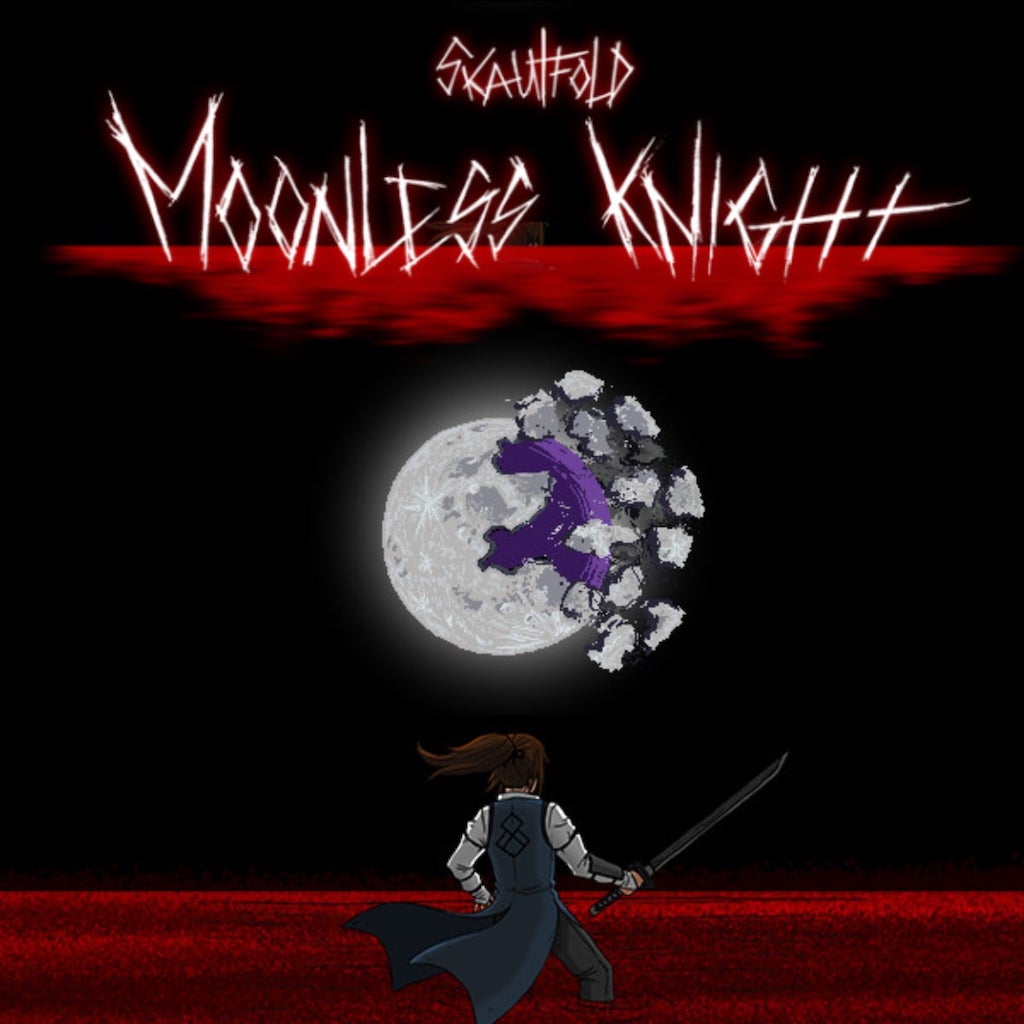
The Skautfold series has always thrived on evolution. Each entry reinvents its structure just enough to keep returning players slightly off balance, while maintaining the Lovecraftian identity and mechanical precision that define Steve Gal’s work under Pugware. With Skautfold: Moonless Knight, originally released on PC in 2020 and arriving on consoles in 2026 via Red Art Games, the series once again shifts form—this time blending semi-open exploration with the refined “Guard” combat system first introduced in Usurper.
Set in an alternate 1900s Japan where the moon itself has been torn open, unleashing eldritch horrors upon the world, Moonless Knight positions itself as both a continuation and a convergence point for the entire Skautfold narrative arc. It is ambitious, dense, and mechanically demanding, yet surprisingly approachable for newcomers despite its long-running lore.
The result is a game that feels like the culmination of everything the series has been building towards—both narratively and mechanically.
A Broken Moon Over the Dawn Empire
The premise alone sets an immediate tone of unease. You play as Gray, the Second Knight of the Angelic Empire of Britannia, dispatched on what should have been a diplomatic mission to the Dawn Empire of Japan. Instead, everything collapses into chaos as lunatic cultists stage a religious coup, plunging the Imperial Palace into violent disorder.
The Moon itself—now fractured and corrupted—looms over the world as both a literal and symbolic presence. It is not merely a backdrop; it is a constant reminder that reality in this universe is unstable, sacred, and deeply wrong.
One of Moonless Knight’s greatest strengths is how it layers political tension over cosmic horror. The conflict is not purely about survival—it is about control, belief, and interpretation. Factions within the Imperial Palace have competing agendas, and none are entirely trustworthy. Even apparent allies feel like temporary conveniences rather than stable companions.
The result is a narrative that feels less like a linear story and more like a collapsing web of ideology and desperation.
A Metroidvania of Loops and Consequences
Structurally, Moonless Knight leans into a semi-open Metroidvania design, though it resists being neatly categorised. Instead of rigid progression, players are encouraged to explore the Oda Imperial Palace in a flexible order, unlocking shortcuts, discovering interconnected loops, and gradually building a mental map of the world.
This design works particularly well alongside the game’s layered narrative. As you unlock new paths, you also uncover fresh perspectives on the same events. A locked corridor is rarely just a barrier—it is often a narrative partition, concealing context that reframes earlier assumptions.
Boss encounters can often be tackled in different orders, allowing a degree of player agency that enhances replayability. Safe zones, familiars, and relic systems provide steady progression, encouraging experimentation with how you approach both exploration and combat.
However, unlike traditional Metroidvanias that focus on constant ability expansion, Moonless Knight places more emphasis on mastering systems already available to the player.
The Guard System Refined
Combat is where Moonless Knight truly distinguishes itself. The “Guard System,” first introduced in Usurper, returns in an evolved form that prioritises timing, discipline, and risk management.
At its core, the system revolves around perfect blocks, well-timed dodges, and the careful preservation of your guard meter. Unlike traditional health systems, your defensive stability degrades under pressure. Careless mistakes do not just cost health—they reduce your overall capacity to defend effectively, creating a snowball effect in which panic breeds vulnerability.
This design forces players to remain calm under sustained pressure. It is not enough to react—you must anticipate.
However, the system is not purely punitive. Waltham Industry’s Vitae Injections introduce a risk-reward layer that allows players to recover health or even overcharge it, temporarily boosting damage output at the cost of long-term stability. This creates a dynamic tension between survival and aggression, encouraging players to push their limits rather than retreat constantly.
When combat clicks, it feels precise, deliberate, and deeply satisfying. Every encounter becomes a test of composure rather than brute force.
Exploration and Environmental Design
The Oda Imperial Palace is one of the most intricate settings in the Skautfold series. It is sprawling yet interconnected, with hidden paths, vertical layering, and subtle environmental storytelling.
Visually, the game leans into its gothic-Lovecraftian aesthetic, with oppressive architecture, distorted religious iconography, and environments that feel both ceremonial and decayed. The fusion of British imperial influence and Japanese historical inspiration creates a distinctive tonal identity that sets it apart from more traditional fantasy settings.
Exploration is rewarded not only with items and upgrades but also with narrative fragments. Tending to wounded soldiers, discovering hidden relics, and encountering bizarre secrets such as “ninja pugs” all contribute to a world that feels both deadly serious and occasionally absurd in its details.
This tonal duality is one of the series’ defining characteristics. It allows Moonless Knight to shift between horror, political intrigue, and dark humour without completely breaking immersion.
Difficulty and Learning Curve
Moonless Knight does not attempt to soften its systems for new players. While it is technically accessible without prior knowledge of the series, it assumes a willingness to learn through failure.
Combat demands precision. Exploration demands attention. Progression demands patience.
The early hours can feel punishing, particularly for players unfamiliar with the Guard System’s timing requirements. However, once mastered, the game opens up significantly, rewarding careful play with a sense of control few action RPGs achieve.
This learning curve will not appeal to everyone, but it is central to the game’s identity. Moonless Knight is designed to be understood gradually, not immediately.
Narrative Closure and Series Context
As the fourth entry in the Skautfold series, Moonless Knight carries significant narrative weight. It is clearly designed to move the overarching story towards resolution, tying together threads from Shrouded in Sanity, Usurper, and Into the Fray.
Despite its dense lore, the game makes an effort to remain accessible to newcomers. Key concepts are introduced in context, and while returning players will undoubtedly gain more from the experience, it does not rely on prior knowledge to function.
That said, the most impactful narrative moments are clearly aimed at long-term fans. There is a sense of culmination here—of systems, characters, and themes converging towards something larger.
Where It Falters
Despite its strengths, Moonless Knight is not without flaws. Its combat system, while rewarding, can feel unforgiving, leading to frustration in early encounters. Mistimed guards or dodges can cause rapid setbacks that feel harsh, especially in densely populated combat areas.
Additionally, while the semi-open structure is compelling, it occasionally leads to uneven pacing. Some regions feel densely packed with content, while others run slightly too long without significant variation in encounters.
The complexity of the systems, while rewarding for dedicated players, may also be overwhelming for those new to the series or genre.
Final Thoughts
Skautfold: Moonless Knight stands as one of the series’ most ambitious and mechanically refined entries. It blends exploration, narrative complexity, and high-skill combat into a cohesive experience that rewards patience and mastery.
It is not a game that compromises easily. It demands attention, precision, and a willingness to engage with its systems on their own terms. But for those who do, it offers a richly layered world filled with tension, mystery, and mechanical depth.