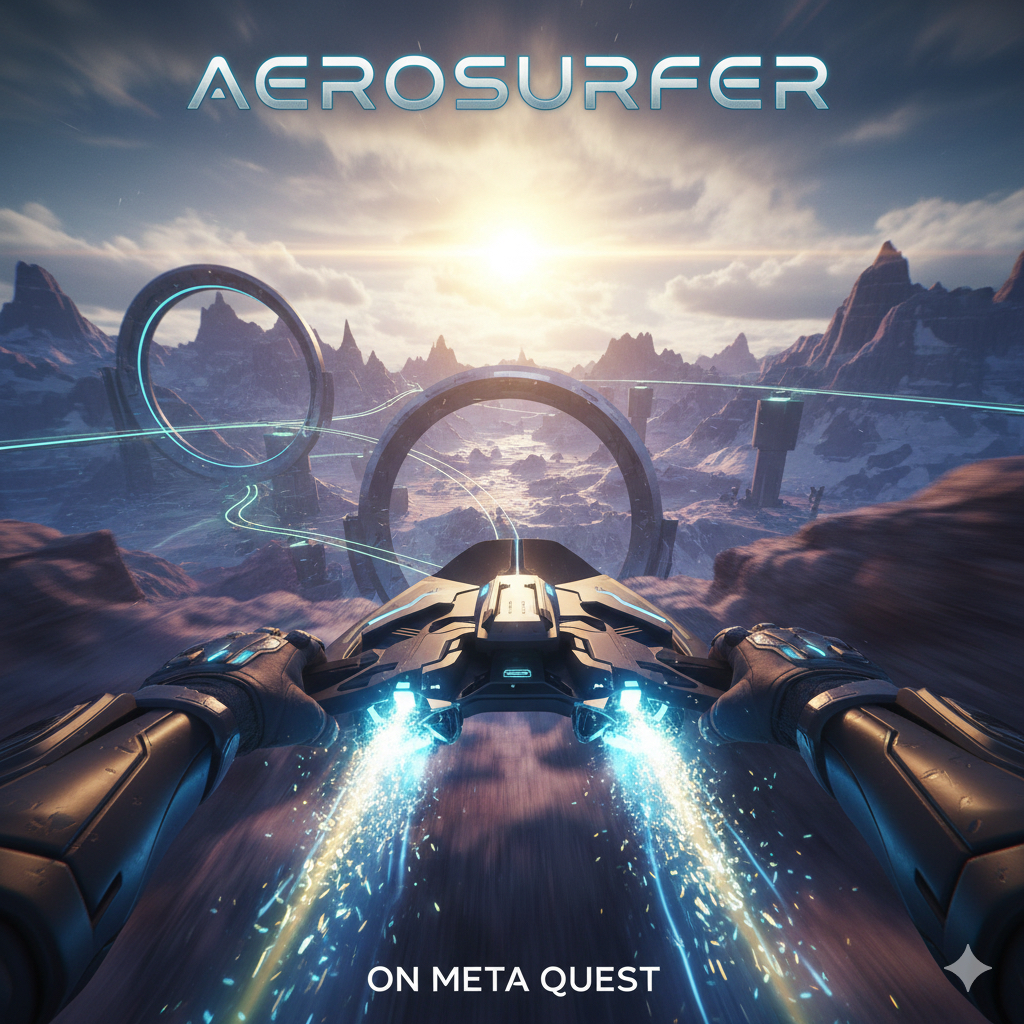
In a VR landscape dominated by shooters, narrative adventures, and cinematic experiences, Aerosurfer on Meta Quest arrives like a gust of fresh air — a high-octane rhythm-movement title that blends reflex-driven traversal with pulse-pounding musicality. At its core, Aerosurfer is about motion: about how you feel as you glide, swoop, and twist through colourful, music-synced arenas at breakneck pace. Stretching beyond 800 words, this Game Critix review explores how it delivers on promise, where it stumbles, and ultimately how it stands as one of the most exhilarating movement experiences on standalone VR to date.
First Impressions: Setting the Tone
In Aerosurfer, the premise is simple: you control a high-speed hoverboard-like vehicle through vibrant, neon-infused courses, dodging obstacles, grinding rails, and syncing motion with thumping musical accompaniment. But “simple” here is evocative — the game doesn’t need a deep narrative or complex combat systems to engage; it relies on the immediacy of motion and the thrill of perfect timing.
Right from the tutorial, Aerosurfer makes its central identity clear: this is a game about movement. Smooth locomotion options — including full analog movement — give the player direct agency over traversal, reinforced by intuitive controls. Whether you’re a seasoned VR veteran or new to standalone VR, the onboarding process respects your comfort with movement while immediately immersing you in the physical rhythm loop the game thrives on.
Movement and Mechanics: Motion as Mastery
The beating heart of Aerosurfer is its movement system. The hoverboard (or “aerosurf platform”) is responsive, fluid, and physically expressive in VR. Steering, accelerating, and performing aerial tricks all hinge on precise timing and spatial awareness — a design choice that rewards practice but never feels punishingly obtuse.
The mechanics are expertly balanced. There’s a sweet spot between over-responsiveness (which can feel chaotic) and under-responsiveness (which kills momentum). Turning, leaning, and trajectory adjustments feel natural within the player’s body space, and VR tracking remains consistently accurate even during rapid directional changes. The sense of speed you get while ripping through courses is not just visual — it feels like motion, thanks to a combination of smooth frame pacing, spatial audio cues, and haptic feedback that reinforces every grind, jump, and punch-through section.
Movement isn’t just functional — it’s expressive. Players quickly learn how to link slides, aerial smashes, and directional dodges into fluid sequences that feel almost dance-like when executed cleanly. The learning curve is friendly at first, but mastery — especially at higher difficulty tiers — demands genuine skill and spatial intuition.
Level and Course Design: Rhythm Meets Environment
Where Aerosurfer distinguishes itself most from the broader pack of VR movement titles is in its synchronisation of motion and musicality. Each course is built around a song — not just a soundtrack slapped on top — but a track that defines pacing, rhythm cues, and environmental dynamics. Obstacles, rails, and timing windows all align with musical beats, creating a sense of choreography between player, machine, and sound.
This design choice does more than look or sound pretty. It turns every run into a rhythmic engagement where success feels like performing rather than naively reacting. Courses escalate in complexity, introducing split paths, surprise hazards, and branching opportunities that demand not only reflexes but memorisation and anticipation. Later levels are designed like musical scores — crescendos of intensity interleaved with moments of breathless speed or deft precision.
Visually, environments are vibrant without becoming overwhelming. A tasteful use of neon, contrast, and motion blur ensures readability even at full speed. Tracks and platforms are visually distinct, which helps in fast decision-making. Performance remains steady even in visually busy segments — an achievement considering the demands of full analog VR motion.
Audio Design: Rhythmic Feedback and Spatial Presence
Audio is not merely an accessory in Aerosurfer — it’s a co-pilot. Tracks range from upbeat electronic beats to heavier synthwave, each sculpted to match the pacing and mood of its course. Sound cues don’t just accompany movement; they inform it. Clear audio markers signal to players where to turn, jump, or brace for impact, making the sonic landscape a gameplay tool rather than ambient backdrop.
Spatial audio reinforces movement fluidly — collisions, landings, and obstacle interactions carry positional sound that encourages reactive movement. Combined with music that feels like an extension of the course itself, the result is a cohesive audio-movement synergy that few VR titles achieve. It’s a standout aspect of the experience, and arguably central to why Aerosurfer feels more like performance than play.
Difficulty Curve and Accessibility
Epic Airplane Flying Simulator strikes a clever balance between accessibility and challenge. Early levels introduce mechanics gently, while advanced tiers demand substantial focus and precision. The game never indulges in cheap difficulty spikes; instead, it scales complexity through layered mechanics — split timing cues, advanced aerial dodges, and multipath decision points.
Movement comfort options are comprehensive. Players can adjust locomotion speed, opt for reduced motion vignette effects, or choose between various control mappings to suit personal comfort levels. These options make Aerosurfer accessible even to players sensitive to VR locomotion, while still offering breadth for movement purists who want full dynamic control.
The tutorial and onboarding systems are smooth and integrated, teaching mechanics through gameplay rather than separate, linear instruction screens. This design respects player agency and encourages learning through play.
Progression, Replay Value, and Competitive Elements
Progression in Aerosurfer is threaded through skill mastery rather than narrative depth. The game encourages players to improve — chasing personal bests, mastering trick chains, and refining timing to unlock higher scores.
Unlike some VR rhythm titles that rely on surface-level leaderboards, Aerosurfer integrates performance tracking meaningfully. Players can see how their run compares to their own history, nudging long-term engagement. However, the lack of robust online leaderboards — or broader competitive ecosystems like weekly challenges or community events — means the social longevity feels slightly restrained. With such a kinetic movement foundation, deeper competitive layers would be a natural and welcome evolution.
Still, the game’s built-in scoring mechanics, time trials, and difficulty tiers keep replay value high for players who enjoy self-paced mastery.
Critiques and Limitations
No title is without limitations, and Aerosurfer is no exception. While movement mechanics and musical synchrony are strong, the experience can feel repetitive over very long sessions. Map variety is solid but limited in thematic breadth; additional biomes, dynamic weather effects, or narrative contexts could elevate the long-term journey beyond its current arcade loop.
Another minor issue is accessibility for completely VR-novice players. Despite friendly onboarding, the game assumes comfort with analog movement early on. A fully segmented beginner mode with slower pacing might help onboarding for a broader audience.
Finally, the lack of robust community features — leaderboards, time-attack tournaments, or shared replay challenges — means that Aerosurfer’s competitive potential remains partially untapped.
Final Verdict
Aerosurfer isn’t just a game about movement — it’s about rhythmic mastery, spatial intuition, and embodied momentum. It stands out in the Meta Quest library as a title that not only embraces full analog motion but celebrates it through music, course design, and sensory feedback. Its flight-like pacing, intuitive controls, and immersive audiovisual synergy make it one of the most compelling movement-centric VR experiences available today.
Whether you’re chasing high scores, refining your reflexes, or simply reveling in the sensation of speed, Aerosurfer delivers a potent mix of challenge and exhilaration.