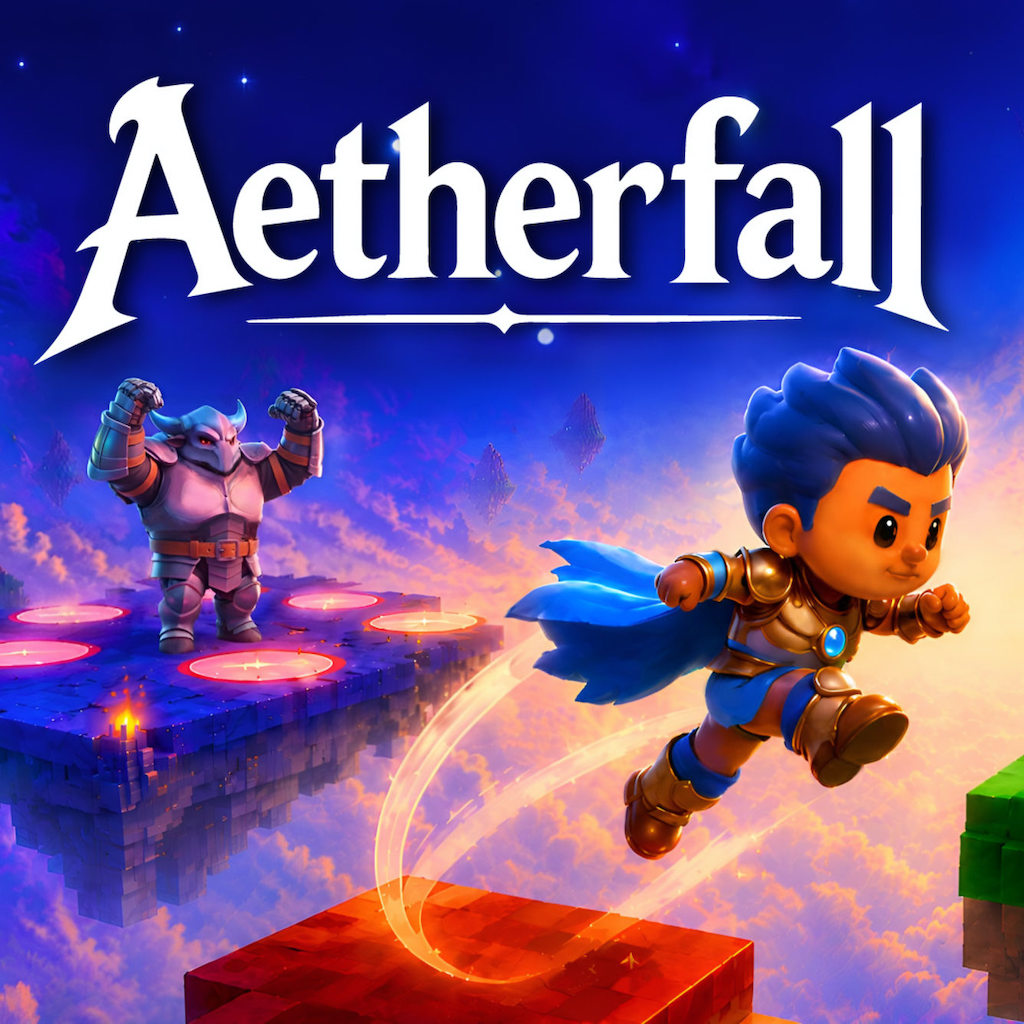
There is something immediately appealing about a game that throws you into a world of floating islands, collapsing ruins and enough supernatural energy to make standing still feel like a particularly bad idea. Aetherfall takes that wonderfully dramatic setting and builds an action RPG around fast combat, exploration, elemental abilities and the ever-present temptation to push your luck just a little further. It is a game that clearly understands the appeal of smashing your way through hordes of monsters, grabbing increasingly ridiculous loot and then thinking, “I reckon I can survive one more room.” Sometimes you can. Sometimes you really, really cannot.
At its heart, Aetherfall is a game about movement and momentum. Whether you are leaping between platforms suspended above a seemingly endless abyss or cutting through enemies in a chaotic rift, there is a constant sense that stopping is not really an option. The combination of platforming challenges, environmental puzzles and hack-and-slash combat gives the adventure a pleasing variety, while the roguelike structure ensures that no two trips into its dangerous rift zones play out the same way. It is familiar territory in places, but there is enough personality here to make the journey worthwhile.
Welcome To The Shattered Realms
The world of Aetherfall certainly knows how to make an entrance. Floating sky islands, crumbling temples and swirling cosmic storms create a setting that feels as though someone took a traditional dark fantasy world and simply tore the ground out from under it. Instead of travelling through forests, castles and caves in the usual fashion, you are constantly looking down into the abyss, which gives even the quieter moments a slightly uncomfortable edge.
Playing as an Aetherblade warrior, your job is to venture into corrupted rift zones, battle the creatures twisted by cosmic energy and recover the resources needed to strengthen your character and sanctuary. It gives the adventure a straightforward purpose without drowning it in exposition. There is a satisfying simplicity to knowing that something has gone horribly wrong and that you are the unfortunate person who has to clean it up.
The presentation helps considerably. The stylised dark fantasy visuals use strong contrasts, glowing magical effects and imposing environments to create a world that feels dangerous without becoming visually muddy. When elemental attacks explode across the screen, enemies are flung through the air and magical particles fill the battlefield, Aetherfall can look rather spectacular.
Hack, Slash And Keep Moving
Combat is where Aetherfall really finds its rhythm. Light and heavy attacks can be chained together, enemies can be launched into the air, and quick dodges let you avoid incoming attacks and immediately get back into the action. The movement feels responsive, and that matters enormously when a game expects you to react quickly rather than simply hammering the attack button until everything stops moving.
The dodge and parry mechanics add another layer to the fighting. Knowing when to attack is important, but knowing when not to attack can be even more valuable. A reckless player can charge into a group of enemies and quickly discover that confidence and survival are two very different things. Once you start learning enemy patterns and combining attacks with well-timed defensive moves, combat becomes considerably more satisfying.
There is also a nice sense of escalation as the battles become more complicated. Early encounters give you time to understand the basics, while later fights begin throwing larger groups, tougher enemies and more dangerous situations at you. The game wants you to become better at fighting rather than simply handing you bigger numbers, and that is always a welcome approach.
The Elemental Advantage
The elemental system is one of the more enjoyable parts of Aetherfall. Weapons can be infused with Fire, Ice, Arcane or Lightning, allowing you to experiment with different combinations and status effects. Rather than simply giving you four different colours of damage, these elements can interact with one another to produce more dramatic results.
There is something deeply satisfying about freezing an enemy before following it up with an attack that shatters the effect, or setting up a chain reaction that turns a crowded battlefield into a miniature magical fireworks display. These combinations give you another reason to experiment with your equipment rather than automatically reaching for whichever weapon happens to have the biggest number attached to it.
It also makes the roguelike structure more interesting. Each run becomes an opportunity to see what kind of build you can put together, and discovering a combination that works particularly well can make you feel like you’ve stumbled across a secret formula for destruction. Of course, the next run may hand you completely different options and remind you who is really in charge.
Into The Rift
The procedural rift dungeons form the backbone of the experience. These areas are filled with branching routes, environmental traps, challenge chambers and elite enemies, encouraging you to make decisions rather than simply following a single corridor from beginning to end. There is a constant question hanging over every run: do you take the safer route and bank what you have, or push deeper in search of something better?
That risk-and-reward system works particularly well because losing valuable resources gives your decisions weight. Finding rare materials is exciting, but there is always that little voice in your head telling you that perhaps extracting now would be sensible. Naturally, you ignore it because the next room might contain something brilliant. This is how games like Aetherfall get you, and once the loop clicks, it becomes remarkably difficult to stop playing.
The floating environments also give exploration a physical quality that helps separate it from more conventional dungeon crawlers. Platforming sections require precise jumps, while buttons, crates, moving obstacles and environmental interactions can open up new routes. Coins and secrets provide additional reasons to look beyond the obvious path, and completionists will undoubtedly find themselves checking corners that looked completely unimportant five minutes earlier.
Every Chapter Has A Surprise
The level design benefits from introducing new mechanics as you progress. Instead of throwing everything at you from the start, Aetherfall gradually expands its vocabulary of obstacles and challenges. That makes the journey feel like it is going somewhere, because your growing understanding of the game is reflected in what it asks of you.
The chapter structure also gives the adventure useful punctuation. Each chapter builds towards a distinctive boss encounter, giving you a chance to put everything you’ve learned to the test. These fights are naturally more demanding than the regular encounters, but they also provide some of the most memorable moments because they force you to combine movement, attacks, dodges and elemental abilities under pressure.
Boss battles are particularly effective when they make you think rather than simply survive a larger health bar. Aetherfall benefits when its encounters ask you to understand what is happening around you, find an opening and then make the most of it. There is a lovely little rush when a strategy finally comes together and a boss that had been giving you grief suddenly starts falling apart.
Build, Improve, Repeat
Back at the sanctuary, resources gathered during successful runs can be invested in permanent improvements. Aether Shards can unlock passive abilities via the skill tree, and vendors and equipment can be upgraded. This gives every run a sense of purpose, even when things go horribly wrong.
That persistent progression is important because roguelike games live or die by whether failure feels worthwhile. Nobody enjoys spending twenty minutes fighting through a dangerous area only to feel as though they’ve achieved nothing. Aetherfall avoids that trap by giving you reasons to keep coming back, gradually turning each attempt into another small step towards becoming more powerful.
The equipment and build variety also gives the game replay value. You can experiment with different elemental affinities and combat approaches, finding combinations that suit the way you prefer to play. Some players will want to get up close and overwhelm enemies with aggressive attacks, while others will naturally gravitate towards a more careful style built around dodging, counters and exploiting elemental effects.
A World Worth Looking At
Despite the violence and frantic combat, Aetherfall has a surprisingly attractive world. Its floating temples and ruined islands have a strong sense of atmosphere, while glowing magical effects provide welcome colour against the darker environments. The visual style does not attempt photorealism, and that works in its favour, as the exaggerated fantasy presentation gives the world its own identity.
The orchestral soundtrack deserves a mention too. Exploration is accompanied by more atmospheric music, while battles bring heavier percussion and a greater sense of urgency. When a boss fight begins and the music swells, the game knows exactly how to make you feel as though something important is about to happen.
Sound effects also play their part in making combat feel satisfying. Hits have weight, elemental attacks have their own character, and the general chaos of a crowded encounter gives the world plenty of energy. It is the sort of game where turning the volume up noticeably improves the experience.
Familiar Ideas With Plenty Of Energy
There is no getting around the fact that Aetherfall is working with familiar ingredients. Dark fantasy, roguelike progression, elemental weapons, procedural dungeons and hub upgrades have all been explored extensively elsewhere. The platforming elements add something different, but they do not completely reinvent the genre.
Thankfully, originality is not always about inventing an entirely new formula. Sometimes it is about taking established ideas, putting them together in a way that feels good and ensuring the basic mechanics are enjoyable. Aetherfall largely succeeds on those terms because its combat is responsive enough to keep you engaged and its progression system gives you a genuine reason to return after a failed run.
There are moments when the familiar structure can make the experience feel slightly predictable, particularly if you have spent a lot of time with roguelikes and action RPGs. Yet when the combat is flowing, the elemental effects are chaining together and you are desperately trying to decide whether to extract or risk another room, those concerns tend to fade into the background.
Final Verdict
Aetherfall is an enjoyable action RPG that understands the importance of making its core gameplay feel good. The combination of fast hack-and-slash combat, precise movement, elemental combinations, procedural exploration and permanent progression creates a loop that is easy to grasp yet surprisingly hard to put down. Its floating dark fantasy setting gives it a strong visual identity, while the environmental puzzles and platforming sections provide welcome breaks from constant combat.
It does not completely reinvent the roguelike action RPG, and some of its ingredients will feel familiar to anyone who has spent considerable time in the genre. What it does offer is a polished and satisfying blend of ideas, with enough variety to keep each run worthwhile and enough progression to make failure part of the journey rather than the end of it.
Most importantly, Aetherfall has that elusive quality that makes you want to have another go. Maybe the next run will give you the perfect elemental combination. Maybe you’ll finally beat that boss. Maybe you’ll simply get a little further into the rift before everything goes spectacularly wrong. Whatever the reason, there is always another floating island waiting somewhere above the abyss, and that is more than enough reason to keep jumping.