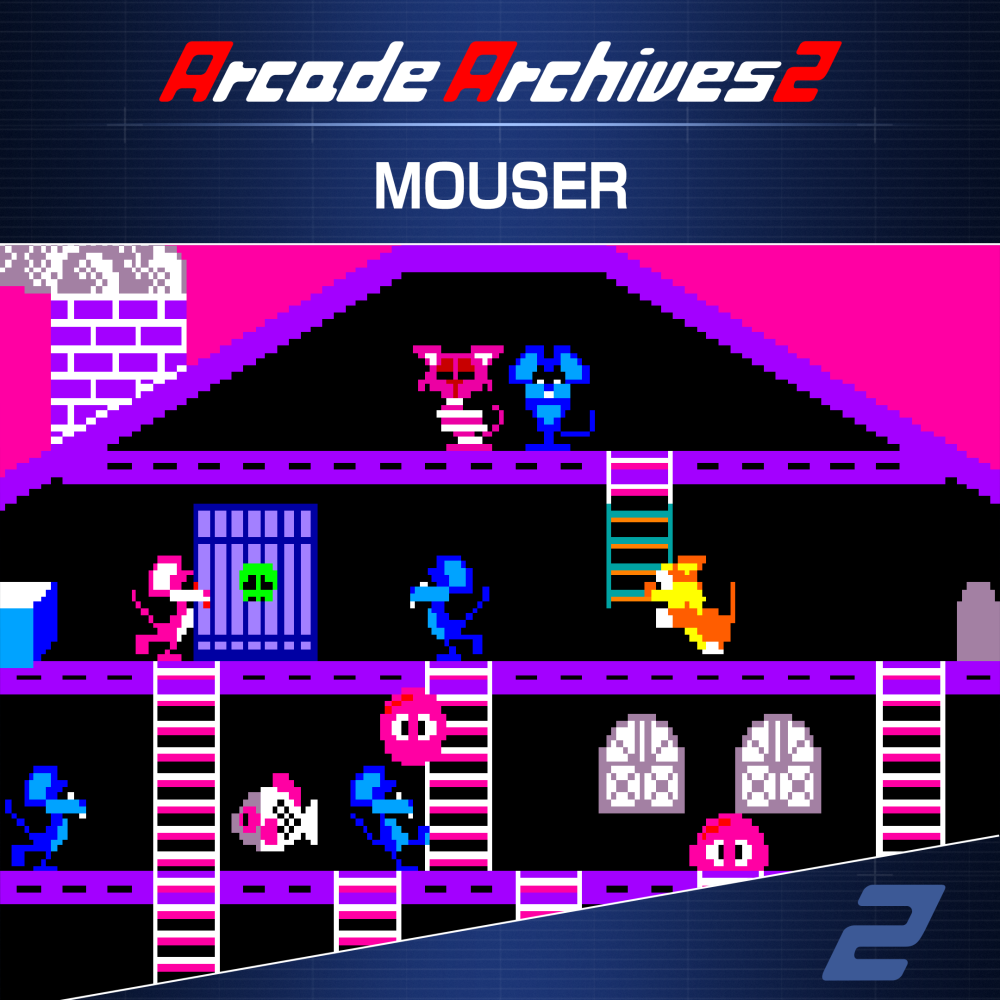
The beauty of the Arcade Archives series has never been about preserving only the greatest hits. Of course, everyone remembers giants like Pac-Man, Galaga, and Dig Dug, but arcades were built on far more than household names. For every legendary cabinet that drew crowds, there were dozens of lesser-known games quietly building their own loyal audiences. Some disappeared because they were overshadowed by bigger releases, while others simply arrived at the wrong time. MOUSER belongs firmly in that second category.
Originally released by UPL in 1983, MOUSER is one of those games that feels like a fascinating snapshot of arcade history. It arrived at a time when developers were still experimenting with what platform games could become, several years before the genre truly exploded. Now, thanks to HAMSTER’s Arcade Archives 2 treatment, this charming curiosity has another chance to introduce itself to modern players. It may not possess the lasting appeal of arcade royalty, but beneath its simple premise lies a surprisingly addictive challenge that rewards patience, persistence, and a willingness to embrace old-school game design.
Simple Premise, Serious Challenge
MOUSER wastes no time getting started. Players take control of Nyanta, a determined tomcat whose fiancée, Mariya, has been kidnapped by a gang of mischievous mice. The objective is straightforward: climb through a series of increasingly dangerous single-screen stages, avoid the traps laid by your tiny enemies, and rescue the love of your life.
Like many arcade games of the early eighties, the story merely serves as motivation. The real focus is mastering movement and surviving long enough to improve your score. There are no lengthy tutorials or carefully paced introductions. Within seconds, you’re climbing ladders, making risky jumps, and desperately trying to avoid being overwhelmed.
That immediate accessibility remains one of the game’s greatest strengths. Anyone can understand what they’re supposed to do almost instantly, yet genuine mastery takes considerably longer. Success depends less on quick reactions alone and more on understanding enemy behaviour, recognising safe routes, and committing those lessons to memory.
Timing Is Everything
At first glance, MOUSER appears deceptively simple. Players move across platforms, climb ladders, dodge mice, and clear each stage before progressing. Spend a little more time with it, however, and the subtle depth begins to emerge.
Enemy movement is rarely predictable enough to allow mindless play. The mice attack from multiple directions, dropping hazards and forcing constant adjustments to your route. Every successful jump feels earned because a mistimed leap often leads directly into danger.
Unlike modern platformers that usually offer generous checkpoints or forgiving recovery systems, MOUSER reflects its coin-operated origins. Mistakes are punished immediately, encouraging players to learn through repetition rather than hand-holding. It can certainly feel unforgiving, but there’s also something strangely satisfying about gradually improving through experience.
This style of design won’t appeal to everyone. Modern audiences accustomed to smoother progression may find the difficulty abrupt, yet players willing to embrace the arcade mentality will discover a game that constantly encourages one more attempt.
An Important Piece of Platforming History
One aspect that makes MOUSER particularly interesting is its historical significance. The game was designed by Ryuichi Nishizawa, who would later become one of the industry’s most influential creators through the Wonder Boy series.
Looking back, small glimpses of that future success are already evident here. While MOUSER is naturally much simpler than Wonder Boy, it shares an emphasis on responsive movement, clear objectives, and gameplay driven almost entirely by player skill.
That historical context gives the game additional value beyond its mechanics. Arcade Archives has often served as a digital museum for interactive entertainment, and MOUSER deserves its place within that collection. Even if it never reached the same legendary status as later platform classics, it remains an interesting stepping stone in the evolution of the genre.
Arcade Archives 2 Adds Welcome Modern Comforts
HAMSTER continues to understand exactly how classic arcade games should be preserved. Rather than altering the experience, Arcade Archives 2 surrounds the original release with thoughtful quality-of-life features that make these older games significantly easier to enjoy.
Perhaps the biggest newcomer is Time Attack Mode. Instead of chasing high scores, players race through the game as quickly as possible, creating an entirely different competitive experience. It complements the existing Original Mode, Hi Score Mode, and Caravan Mode, offering multiple reasons to revisit the game long after the initial novelty has faded.
Rewind functionality once again proves invaluable. Games from this era were intentionally brutal, as every mistake was designed to encourage another coin. Being able to instantly undo a costly jump removes much of the frustration without diminishing the underlying challenge for those who choose not to use it.
Multiple save slots also make practising later sections far more manageable than repeatedly starting from the beginning. Combined with adjustable difficulty settings, button remapping, display filters, and online leaderboards, the package feels comprehensive without ever compromising the integrity of the original game.
Variable Refresh Rate support is another subtle but appreciated improvement. While many players may never consciously notice it, the smoother presentation contributes to more responsive controls, which is especially valuable in a game built around precise movement and split-second timing.
Charming Presentation Frozen in Time
Visually, MOUSER remains unmistakably a product of 1983. Character sprites are small, animations are limited, and environments are necessarily simple given the hardware constraints of the period. Yet despite those restrictions, the game possesses an undeniable charm.
Nyanta is instantly likeable despite his limited animation frames, while the mischievous mice display plenty of personality as they scamper across each stage, causing chaos. The colourful pixel art captures the cheerful spirit that defined many early arcade games, creating an inviting presentation even when the gameplay itself becomes relentlessly demanding.
The soundtrack is similarly uncomplicated, relying on brief melodies and energetic sound effects that fit the era perfectly. Like many arcade cabinets of its generation, the audio focuses on reinforcing player actions rather than delivering lengthy musical compositions. It may not linger in your memory for years afterwards, but it certainly complements the frantic pace of each stage.
A Product of Its Era
As enjoyable as MOUSER can be, its age inevitably shows. Stage variety is limited, enemy behaviours eventually become familiar, and the gameplay loop lacks the mechanical evolution players often expect from modern platformers.
Long play sessions can therefore feel repetitive. This is very much a game designed for quick bursts rather than marathon sessions, making it perfectly suited to dipping in for twenty minutes while chasing a higher score.
The steep difficulty curve will also divide opinion. Some players will appreciate the uncompromising arcade challenge, while others may find it frustrating. Thankfully, HAMSTER’s generous collection of accessibility features allows players to tailor the experience to their preferences without diminishing its historical authenticity.
Final Verdict
Arcade Archives 2 MOUSER may not be one of arcade gaming’s forgotten masterpieces, but it remains an entertaining reminder of an era when simple ideas and demanding gameplay ruled amusement halls. Its straightforward platforming, responsive controls, and relentless challenge continue to deliver satisfying bursts of old-school entertainment, particularly for players who enjoy mastering difficult arcade games through repetition and perseverance.
HAMSTER has once again delivered an exemplary preservation effort. Time Attack Mode, rewinds, VRR support, save states, online leaderboards, and numerous display options ensure this is easily the best way to experience MOUSER today. While the game itself inevitably feels dated compared with later platform classics, it remains a fascinating slice of gaming history that deserves to be remembered.
MOUSER won’t replace the genre’s all-time greats, but it doesn’t need to. Sometimes preserving gaming history isn’t about revisiting perfection. Sometimes it’s about rediscovering the overlooked games that helped pave the way for everything that followed.