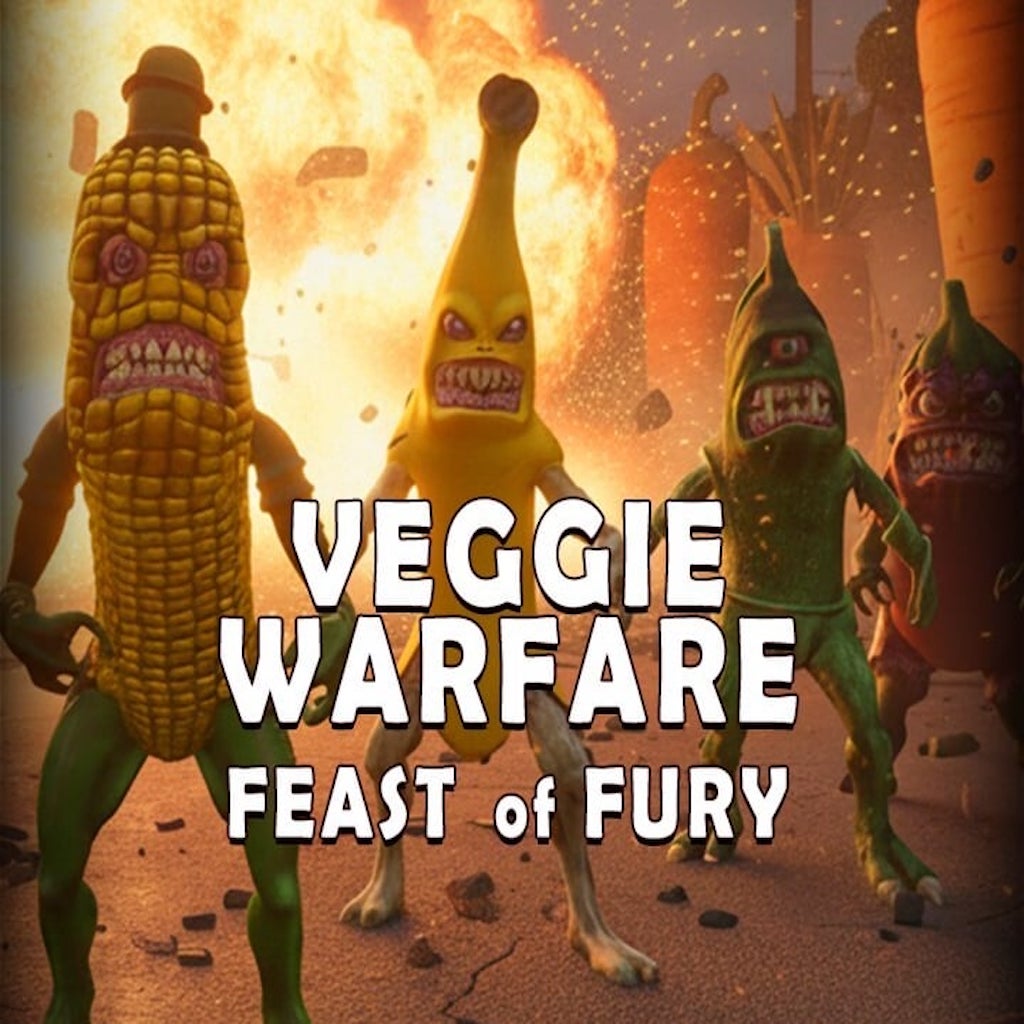
Released across multiple platforms in March 2026, Veggie Warfare – Feast of Fury finally completed its rollout with the Nintendo Switch release on 12 March 2026. Developed by TB Games and published on Switch by EpiXR Games, the game offers a delightfully absurd premise: the vegetables have had enough.
Carrots charge across the battlefield, onions explode in clouds of rage, and mutant tomatoes roll toward the player with destructive intent. Your task is simple — survive the Feast of Fury by blasting through waves of enraged produce in this fast-paced rogue-like first-person shooter.
While the concept may seem comedic at first glance, Veggie Warfare attempts to combine arcade-style gunplay with rogue-like progression systems. The result is a chaotic shooter that embraces its ridiculous premise while delivering surprisingly satisfying gameplay.
A Kitchen Gone Completely Mad
The story of Veggie Warfare is deliberately minimal. At some point, the vegetables decided they would no longer be dinner — and now they are fighting back.
This premise sets the scene for a shooter that never takes itself too seriously. Players enter arenas where swarms of hostile vegetables attack relentlessly, turning what might have been a peaceful garden into a full-scale battlefield.
Despite its lighthearted setup, the game wastes little time on exposition. Within seconds of starting a run, waves of animated vegetables begin charging towards the player.
The message is clear: survive first, ask questions later.
Fast-Paced Arena Combat
At its core, Veggie Warfare – Feast of Fury functions like a traditional arena shooter.
Players navigate compact combat arenas while defending themselves against waves of enemies. The pace is rapid, encouraging constant movement and aggressive gunplay.
Vegetable enemies approach from all directions, requiring players to stay aware of the entire battlefield. Standing still for too long quickly results in being overwhelmed.
Weapons range from basic firearms to more unusual tools of destruction that can clear large groups of enemies simultaneously.
Because enemies spawn continuously, the action rarely pauses. The goal is straightforward: survive long enough to complete each wave while collecting upgrades to boost your character.
Rogue-like Upgrades and Progression
What gives Veggie Warfare its lasting appeal is the rogue-like upgrade system layered on top of the arcade shooting mechanics.
During each run, players collect upgrades that boost weapons, enhance defensive abilities, or grant special skills.
These upgrades can significantly change how a run unfolds. Some boosts increase firepower, while others introduce area-of-effect attacks that instantly wipe out groups of enemies.
Since the upgrades appear randomly, each run players experience is slightly different.
Players need to adapt their tactics based on which abilities become available.
This unpredictability keeps the gameplay engaging and motivates players to try multiple times to craft powerful upgrade combinations.
Mutant Produce with Personality
While the game’s enemies are technically vegetables, the developers clearly enjoyed designing them.
Carrots charge like angry spears, onions detonate when approached, and tomatoes bounce unpredictably across the arena.
Later enemies introduce even more unusual variations — mutated vegetables with strange attack patterns that force players to adapt their tactics.
The variety helps prevent gameplay from becoming monotonous too quickly.
Although the enemies are deliberately cartoonish, their relentless aggression ensures the combat stays intense.
Unlocking New Arenas
Progression in Veggie Warfare goes beyond simple upgrades.
Players gradually unlock new arenas that introduce fresh layouts and environmental challenges.
These arenas change how players navigate combat scenarios. Some maps feature narrow corridors that direct enemies towards the player, while others offer more open spaces that allow for greater movement.
Learning how to utilise the environment effectively becomes a key part of survival.
Although the arenas are fairly small, their varied layouts help maintain diversity between runs.
A Bright and Chaotic Presentation
Visually, Veggie Warfare features a bright and colourful art style that matches its playful premise.
Vegetable enemies are exaggerated and expressive, displaying animated faces and dramatic reactions when defeated.
Explosions of chopped produce and flying vegetable pieces create a chaotic spectacle during combat.
The environments are relatively simple yet functional, prioritising readability during intense firefights.
Performance remains solid across platforms, with smooth frame rates helping to sustain the game’s fast pace.
The Nintendo Switch version performs unexpectedly well considering the constant stream of enemies appearing on screen.
Arcade Energy with Short Sessions
One of the game’s strongest features is its suitability for short play sessions.
Individual runs rarely last more than a few minutes, making the game perfect for quick bursts of action.
This setup works particularly well on the Nintendo Switch, where players can jump into a round during short breaks or whilst travelling.
However, the simplicity of the gameplay loop means that extended sessions can start to feel repetitive.
While new arenas and upgrades help keep variety alive, the main objective — surviving waves of enemies — remains unchanged throughout the experience.
Pros & Cons
Pros
- Fast-paced and satisfying arcade-style shooting
- Creative and humorous enemy designs
- Rogue-like upgrades keep each run fresh
- Unlockable arenas add variety
- Perfect for short play sessions
Cons
- Limited long-term depth
- Repetition becomes noticeable during extended play
- Minimal story or narrative context
Final Verdict
Veggie Warfare – Feast of Fury is exactly the kind of game its title suggests: chaotic, absurd, and unapologetically silly.
Its combination of arena shooter mechanics and rogue-like progression creates a gameplay loop that is easy to learn but difficult to master.
The constant flow of enemies keeps players alert, while the random upgrade system introduces enough variety to make each run feel slightly different.
Although the game lacks deeper systems or long-term progression seen in larger shooters, it excels at delivering quick bursts of energetic arcade action.
For players seeking a lighthearted shooter that embraces its ridiculous premise, Veggie Warfare offers plenty of frantic fun.
After all, it’s not every day that dinner fights back.