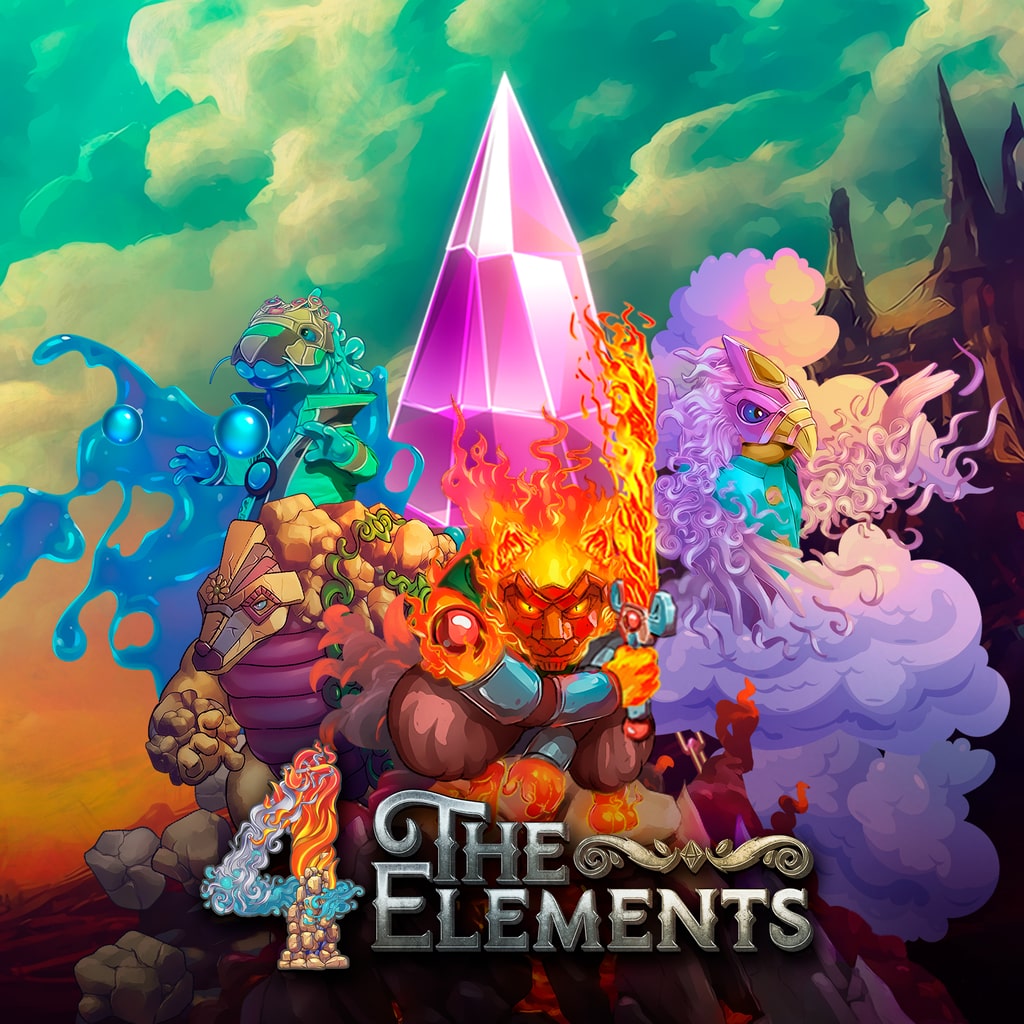
There is something wonderfully nostalgic about a game that remembers when platformers were happy to throw you into a colourful world, give you a handful of abilities and simply tell you to figure things out. 4 The Elements clearly has a deep affection for the 2D action platformers of the 1990s, but it is not content to simply recreate the look and feel of an older generation. Developed and published by Brazilian indie studio Mito Games, this elemental adventure takes the familiar foundations of classic platforming and builds its identity around a particularly clever idea: four characters sharing a single body, each with their own powers, movement abilities and combat style.
The result is a game where switching characters is not just something you do because it looks cool. It is the key to almost everything. Fire, Water, Earth and Air are trapped inside a mysterious magical crystal, forced to share the same physical form while their powers have been scattered throughout a strange world born from elemental chaos. To escape, they must explore four dangerous realms, recover their lost abilities and defeat gigantic guardians who hold the crystal keys they need. It is a simple premise, but one that gives the adventure a clear sense of purpose from beginning to end.
Four Heroes, One Body
The central mechanic is introduced early and quickly becomes the foundation of the entire experience. You can switch between Fire, Water, Earth and Air in real time, with each element bringing a distinct set of strengths. Fire may be better suited to aggressive combat, Water can provide abilities suited to particular environments, Earth brings a sense of weight and power, while Air offers greater mobility.
The clever part is how naturally these differences feed into exploration. You are not simply choosing the character you like most and sticking with them. The game constantly presents situations where one element is clearly better suited to the problem in front of you, encouraging you to experiment with your entire elemental team.
This makes the swapping mechanic feel meaningful rather than cosmetic. You begin to look at an obstacle and instinctively consider which element might be able to overcome it. That is exactly what a good character-switching system should achieve.
A Love Letter to the 90s
There is no hiding where 4 The Elements gets its inspiration. The colourful presentation, side-scrolling structure and emphasis on exploration immediately evoke the era of classic 2D platformers.
Thankfully, it does not feel like a museum piece. The game takes those familiar ideas and combines them with a more modern approach to progression and environmental design. The result is nostalgic without being entirely dependent on nostalgia.
That distinction matters. There is a fine line between making a game that feels inspired by the 90s and making something that simply looks like it was released in the 90s. 4 The Elements generally lands on the right side of that line, using its influences as a foundation rather than a substitute for new ideas.
The Crystal’s Strange Worlds
The environments are perhaps the most visually striking aspect of the adventure. Rather than simply giving each element its own conventional stage, Mito Games has created worlds born from the collision of elemental forces.
That gives us places such as Ice, Magma, Mud and Smoke. Each environment feels like the physical result of two opposing or complementary forces colliding, and that concept gives the game a stronger identity than simply having a fire world followed by a water world.
Thematically, it is a smart decision. The environments feel connected to the story rather than existing purely because platformers traditionally have different themed stages. There is a sense that the crystal itself is producing these chaotic worlds, and the further you explore, the more curious you become about exactly what happened to the four trapped elements.
Exploration With a Purpose
Although 4 The Elements is built around traditional platforming, there is a strong Metroidvania influence running through the adventure. You will encounter obstacles that cannot initially be overcome, areas that seem tantalisingly close yet remain inaccessible, and pathways that clearly require abilities you have yet to obtain.
That creates the familiar rhythm of exploration, discovery and return. You move forward, find something you cannot reach, acquire a new ability elsewhere, and then remember the earlier obstacle waiting for you.
This is one of the most satisfying structures in gaming when executed well, as it makes the world feel interconnected. Instead of simply moving through a sequence of levels, you gradually learn how the world works.
Runes and Lost Power
The four elements begin the game with much of their power sealed away. Scattered across the realms are runes that contain their lost essences, and finding them gradually expands what each character can do.
This provides a strong incentive to explore beyond the obvious route. You are not just looking for collectibles because the game expects you to. These discoveries have tangible gameplay consequences.
The new abilities also feed directly back into the elemental switching system. As your powers grow, previously inaccessible areas become reachable, while familiar enemies can sometimes be approached in entirely different ways.
It creates a pleasing sense of progression because you are not simply becoming stronger. You are becoming more capable of understanding the world.
Platforming Through Elemental Chaos
The platforming itself is at its best when the different abilities work together. A particular obstacle might require one ability to open a path before another can safely cross it. A section of terrain may favour one movement style, while the next demands something completely different.
This constant variation keeps the basic movement from becoming stale. You are not simply jumping from platform to platform for hours. You are thinking about which ability gives you the best chance of navigating the environment.
There is also something satisfying about switching in the middle of a challenge. Rather than pausing to select a different character, you can change on the fly, making the four elements feel like parts of a single versatile hero.
Enemies and Elemental Combat
Combat follows the same philosophy. Each element has its own attack style, and understanding those differences is important when dealing with the creatures that inhabit the crystal realms.
Some encounters are straightforward, while others prompt you to consider which elemental ability will give you the advantage. It is not an especially complicated combat system, but its integration with character swapping gives it more depth than the basic attacks might initially suggest.
The strongest moments occur when movement, combat and switching all come together. You might be navigating an environmental hazard, suddenly encounter an enemy, and immediately realise that changing elements is the safest way through the situation. Those moments demonstrate why the central mechanic works.
Guardians of the Crystal Keys
Every major area culminates in a giant guardian, and these encounters provide some of the game’s toughest tests. The bosses are not simply oversized versions of regular enemies. Like the environments themselves, they are elemental hybrids, designed around the characteristics of their respective domains. This gives each encounter its own personality. You cannot simply walk into every boss fight with the same strategy and expect it to work.
The guardians also provide a satisfying sense of progression. Defeating one does not merely mean you have reached the end of another level. You have claimed one of the crystal keys necessary to eventually escape the prison. There is a clear purpose behind every major confrontation, which helps maintain momentum throughout the adventure.
Learning to Think in Four Dimensions
Perhaps the biggest challenge in 4 The Elements is learning to stop thinking of the characters as separate entities. Once you understand that Fire, Water, Earth and Air are four tools belonging to the same character, the game becomes much more intuitive.
You begin to see a room differently. Instead of asking whether you can reach the platform, you ask which element can reach it. Instead of wondering how to defeat an enemy, you consider which elemental attack is most appropriate.
That shift in perspective is where the game’s smartest design lies. The player is effectively learning a new language of movement and problem-solving.
Where It Could Go Further
The elemental swapping system is undoubtedly the game’s greatest strength, but it also sets expectations that are not always fully met. Once you understand how the four characters work, some situations can feel more straightforward than the premise initially suggests.
There are also moments when the platforming and combat can feel familiar rather than genuinely surprising. The game clearly draws on established conventions, and while that nostalgia works for much of the experience, players seeking a radically new take on the Metroidvania genre may find some elements predictable.
The same applies to progression. The rune system works well, but there is room for even more experimentation with how the abilities interact. The foundation is strong enough that you occasionally find yourself imagining just how far the developers could take it.
The Heart of the Adventure
What makes 4 The Elements enjoyable is that it never loses sight of its central idea. Everything ultimately comes back to the relationship between the four elements.
The story may begin with them trapped together, but their shared predicament gradually becomes an advantage. Their differences become their greatest strength, and the player learns to use them to overcome obstacles.
There is something fitting about that. Fire, Water, Earth and Air are fundamentally different forces, yet the game asks them to work together because none of them can escape alone. It is a simple theme, but one that gives the adventure a little more heart than its colourful platforming initially suggests.
Final Verdict
4 The Elements is a charming and thoughtful 2D action platformer that wears its 90s influences proudly while bringing enough of its own personality to the formula. The real-time elemental switching mechanic is the star of the show, turning what could have been a conventional platformer into an adventure where every obstacle prompts you to consider which character is best equipped to handle it.
The elemental worlds are another highlight. Ice, Magma, Mud and Smoke provide distinct environments that also make sense within the game’s central concept of elemental forces colliding inside the mysterious crystal. The runes and ability upgrades give exploration a satisfying purpose, while the giant guardians provide memorable milestones as you work towards collecting the four crystal keys.
It is not without limitations. Some of the combat and platforming can feel familiar, and the clever character switching occasionally feels as though it could have been pushed further. There are moments when the potential for more complex interaction between the four elements is evident, though the game ultimately delivers less. Even so, there is a lot to like here. 4 The Elements understands why classic 2D platformers remain so appealing. It combines colourful worlds, straightforward controls, satisfying exploration and a clear progression loop with a central mechanic that gives the adventure its own identity.
Most importantly, it is fun to play. There is something satisfying about encountering an obstacle, switching elements and immediately understanding what needs to be done. When the game gets the balance right, you feel clever without feeling cheated, and that is exactly the sweet spot a puzzle platformer should aim for.
4 The Elements may not completely reinvent the genre, but it does not need to. It builds on a familiar foundation, adds a genuinely useful elemental switching mechanic and wraps it in a colourful world filled with secrets, abilities and enormous creatures waiting to test what you have learned. For fans of classic 2D adventures and Metroidvania exploration, this is an elemental journey worth taking.