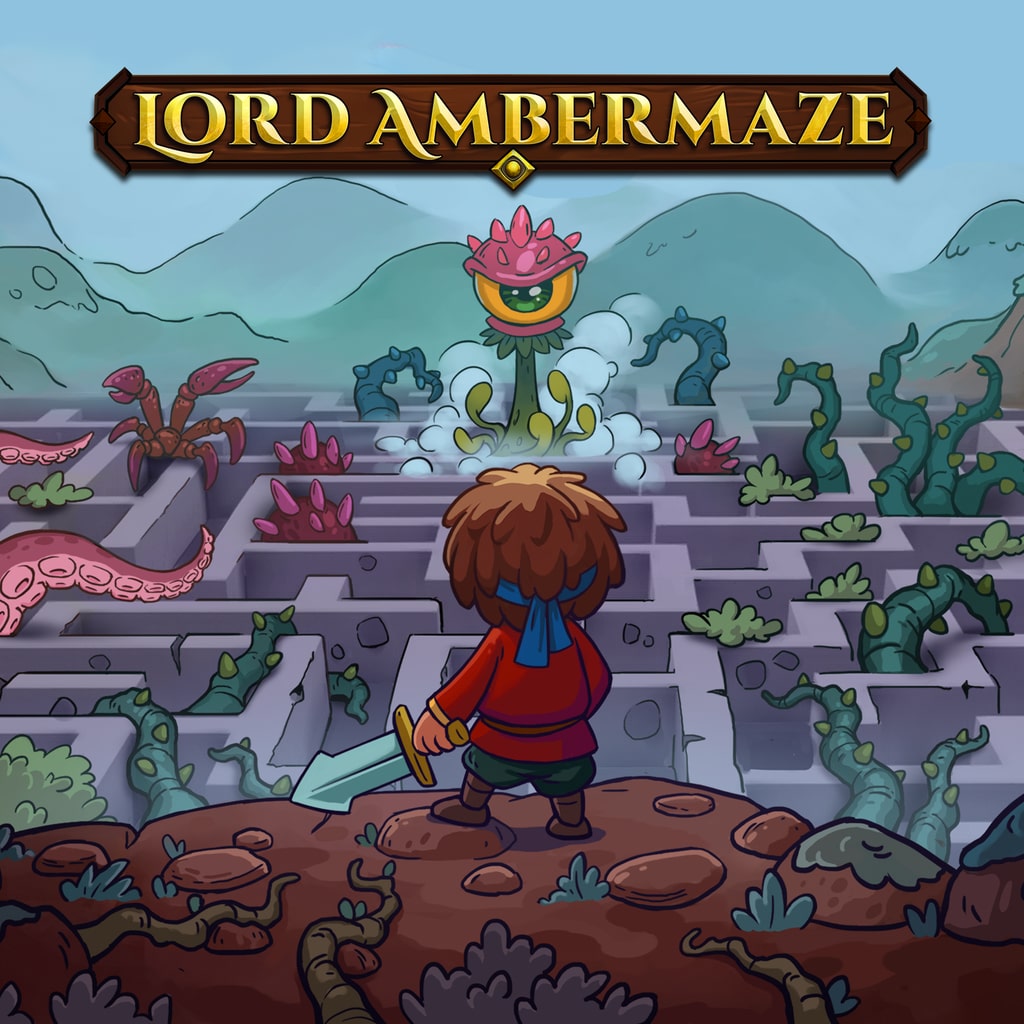
Lord Ambermaze begins with a familiar setup. A young adventurer named Zeyn sets out to rescue his captured sister, armed with the mysterious Sword of Motion. It sounds like the start of a traditional fantasy tale, but the game quickly reveals that its heart lies elsewhere.
The island you explore is frozen in a peculiar way. Not in time, exactly, but in motion. Nothing moves unless you do. Enemies, traps, projectiles, even environmental hazards remain suspended until you take a step. That single idea changes everything.
What follows is not a fast-paced dungeon crawl but a careful, deliberate journey in which each action carries weight. You are not reacting to danger. You are inviting it forward, one move at a time.
Combat as Thought, Not Reflex
At its core, Lord Ambermaze turns combat into a puzzle. Every encounter is a small, contained problem waiting to be solved. Enemies patrol in predictable patterns, projectiles hang in mid-air, and hazards lie dormant until you choose to advance.
This creates a rhythm that feels closer to chess than to traditional action gameplay. You are always thinking a few steps ahead, considering how each movement will ripple through the environment.
There is something deeply satisfying about this structure. Failure rarely feels unfair. If you make a mistake, it is because you misjudged a sequence or overlooked a detail. Success, on the other hand, feels earned through understanding.
The absence of time pressure allows you to experiment. You can pause, reconsider, and try again without the stress of real-time consequences. It creates a space where learning becomes part of the enjoyment.
Dungeons That Feel Like Designed Spaces
The labyrinthine island at the centre of Lord Ambermaze is not just a series of randomised rooms. Each area feels deliberately constructed, with puzzles and enemy placements designed to challenge your grasp of the core mechanics.
Early sections introduce basic concepts. Simple enemy patterns, straightforward traps, and clear paths. As you progress, the complexity increases. Multiple threats overlap, environmental hazards interact in unexpected ways, and the margin for error narrows.
What makes this progression work is clarity. The game rarely overwhelms you with too many new ideas at once. Instead, it builds gradually, layering complexity in a way that feels natural.
Backtracking, a staple of the genre, is handled with care. Returning to earlier areas often reveals new possibilities, whether through abilities you have gained or a deeper understanding of the mechanics. It never feels like busywork. It feels like growth.
The Sword of Motion and the Language of Movement
The Sword of Motion is more than a narrative device. It is the foundation of how you interact with the world. Every action you take is tied to movement. Attacking, dodging, positioning, all of it flows from the simple act of stepping forward.
This creates a kind of language between player and game. You begin to read spaces differently, not just as obstacles but as sequences waiting to unfold.
A narrow corridor becomes a timing puzzle. An open room filled with enemies becomes a series of potential routes. Even something as simple as a projectile suspended in mid-air becomes a tool you can manipulate with careful movement. It is a system that rewards patience and observation. The more time you spend with it, the more it reveals.
A World That Balances Charm and Melancholy
Visually, Lord Ambermaze adopts a pixel-art style that feels nostalgic yet expressive. Characters are simple yet full of personality, and environments are detailed enough to convey a sense of place without becoming cluttered.
The frozen-island setting carries a subtle melancholy. There is a quiet loneliness to the world, reinforced by its stillness. Yet it is not bleak. There is warmth in the characters you meet, small moments of humour, and a gentle curiosity that keeps the tone balanced.
Music and sound design complement this atmosphere well. Tracks are understated, often leaning into soft melodies that reinforce the game’s reflective pace. Sound effects are clear and functional, providing feedback without overwhelming the experience.
More Than Just Dungeons
One of the pleasant surprises in Lord Ambermaze is the variety of activities beyond its core dungeon-crawling. Side content such as fishing, block-pushing puzzles, and even a light romance system adds texture to the experience.
These elements are not overly complex, but they provide welcome breaks from the more demanding puzzle sections. They also help flesh out the world, giving it a sense of life beyond the immediate goal of progression.
The pacing benefits from this variety. Just when the main gameplay loop begins to feel intense, the game offers a moment of relaxation or a different kind of challenge. It is a thoughtful touch that keeps the experience from becoming one-note.
Where Patience Becomes a Requirement
For all its strengths, Lord Ambermaze is not a game that will appeal to everyone. Its deliberate pace and emphasis on careful planning can feel slow, especially for players accustomed to more immediate feedback.
There are moments when puzzles demand extended thought, and progress can stall if you struggle to identify the correct sequence of actions. While this is part of the game’s design, it can lead to frustration if you are not in the right mindset.
Additionally, while the mechanics are consistently strong, they do not evolve dramatically beyond their initial framework. The depth comes from combination rather than expansion, which may feel limiting to some players.
Final Verdict
Lord Ambermaze is a thoughtful, carefully crafted puzzle dungeon crawler that turns movement into strategy and exploration into reflection. Its time-manipulation mechanic is simple in concept yet rich in execution, delivering a gameplay experience that rewards patience, foresight, and curiosity.
While its slower pace and methodical structure may not suit every player, those willing to engage with its systems will find a deeply satisfying, quietly memorable adventure. It is a game about thinking before acting, about understanding before progressing, and about finding meaning in every step you take.