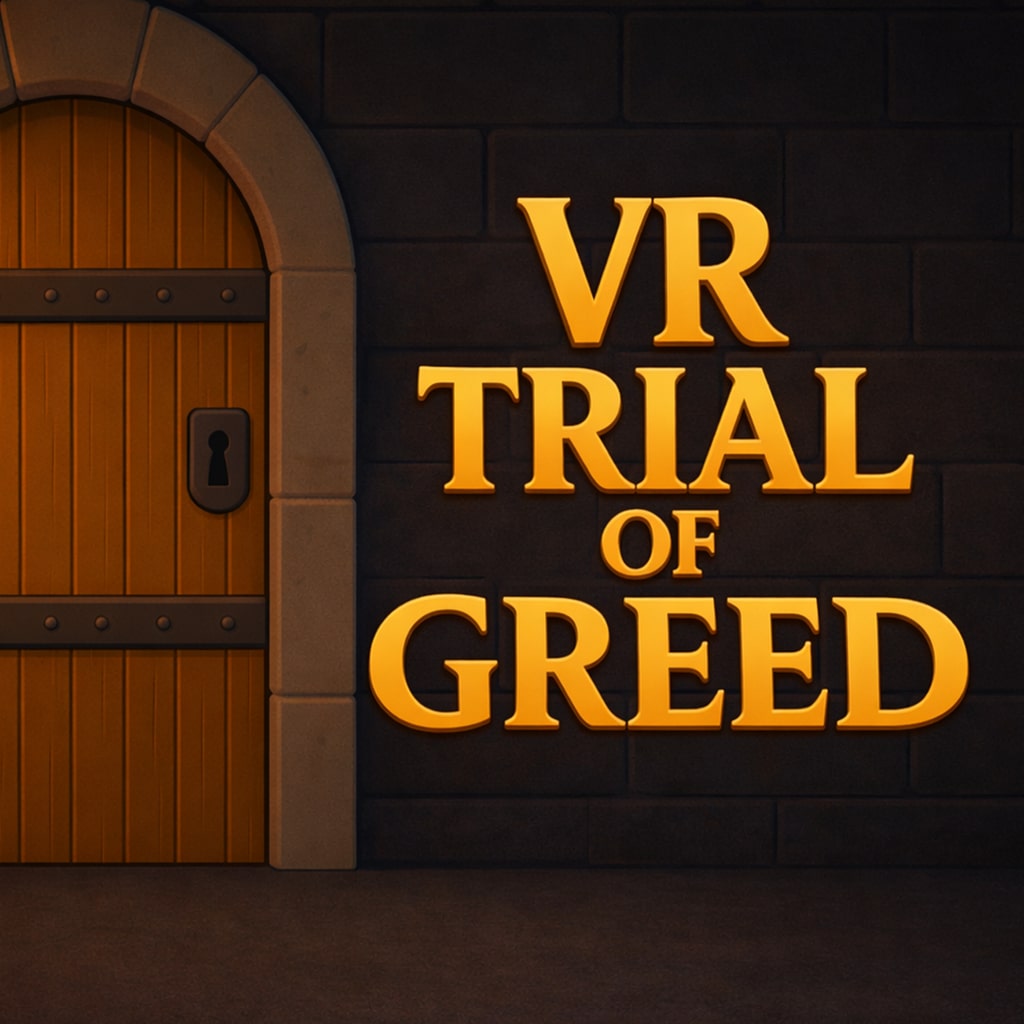
VR adventure games often live or die by how well they make space feel meaningful. When you’re physically turning your head to peer around corners, reaching out to open ancient doors, or hesitating before stepping into a dark corridor, immersion becomes everything. Trial of Greed VR, developed and published by Nextgo24 UG, attempts to build its entire experience around that idea—pairing Egyptian-inspired dungeon exploration with a simple yet effective risk-versus-reward loop.
Released exclusively for PlayStation VR2, it presents itself as a tense, treasure-hunting adventure where curiosity is both your greatest advantage and your most dangerous flaw. The deeper you go, the richer the rewards become—but so do the traps, hazards, and consequences.
It’s a straightforward concept, but one VR is uniquely suited to enhance.
The Temptation of Gold
At its core, Trial of Greed VR is about escalation. You begin cautiously, stepping into dimly lit ruins filled with basic puzzles, simple locked doors, and easily accessible treasure chests. The early hours set a clear rhythm: explore, collect keys, open chests, and gather gold.
But even from the start, the game makes its intentions clear. Every item you collect pushes you further into danger. Doors become more elaborate, corridors more deceptive, and the environments themselves grow increasingly hostile.
The central question is always the same: do you leave now with what you’ve gained, or risk it all for more?
This push-and-pull forms the backbone of the experience, and when it works, it creates genuine tension. There’s a satisfying psychological weight to turning back, knowing you could continue but choosing not to. Likewise, there’s an equally powerful thrill in pushing forward despite the warning signs, driven by the promise of greater rewards.
A World of Ancient Peril
Visually, Trial of Greed VR leans heavily into its Egyptian-inspired aesthetic. Sand-swept corridors, towering stone statues, hieroglyph-covered walls, and flickering torchlight dominate the environment. It’s a familiar setting for adventure games, yet it retains a natural sense of mystery and scale.
On PlayStation VR2, the environments are rendered with solid clarity and depth. Lighting plays a key role in shaping the atmosphere—long shadows stretch across narrow hallways, while golden glows from hidden treasures lure you forward like bait.
However, while the atmosphere is effective, it rarely evolves beyond its initial impression. Environments tend to follow a similar visual language throughout, and while this consistency helps maintain immersion, it also limits variety. After extended play, some areas begin to feel interchangeable.
That said, the sense of scale is handled well. Temples feel imposing, corridors feel restrictive, and hidden chambers often deliver a satisfying sense of discovery when revealed.
The Loop: Risk, Reward, Repeat
Gameplay in Trial of Greed VR centres on exploration and light puzzle-solving. You search for keys, unlock doors, and collect treasure scattered throughout each area. Occasionally, simple environmental puzzles block your progress, requiring you to manipulate objects or identify hidden mechanisms.
The real hook, however, is the risk system. As you gather more treasure, the environment grows increasingly dangerous. Traps activate more frequently, paths become more deceptive, and hazards escalate in complexity.
This gradual build-up of tension is where the game finds its strongest identity. It creates a natural rhythm of hesitation and temptation, forcing you to constantly reassess how far you’re willing to go.
Do you stop now, secure in your gains? Or do you push further into the unknown, knowing that everything could collapse at any moment?
When this system is at its best, it creates moments of genuine tension that feel uniquely suited to VR. Standing in front of a glittering treasure chest, fully aware that opening it might trigger something catastrophic, is exactly the kind of experience VR excels at delivering.
Interaction and Immersion
Interaction in Trial of Greed VR is deliberately simple. You reach out to grab objects, pull levers, open doors, and collect items. The controls are intuitive and responsive, designed to minimise friction and maximise immersion.
On PSVR2, haptic feedback adds a subtle but welcome layer of physicality. Opening heavy stone doors or triggering ancient mechanisms offers slight tactile resistance that enhances the sense of presence.
However, the simplicity of the interaction system also limits depth. There’s little mechanical complexity beyond basic object manipulation. While this keeps the experience accessible, it also means the gameplay rarely evolves beyond its core loop.
Puzzles and Progression
Puzzles in Trial of Greed VR are functional rather than inventive. Most revolve around finding keys, activating switches, or solving straightforward environmental puzzles. They serve their purpose in pacing the experience but rarely stand out as memorable challenges.
Progression is similarly linear. Each area leads naturally into the next, with difficulty increasing primarily through environmental hazards rather than mechanical complexity. The sense of escalation is effective, though somewhat predictable.
There’s a clear emphasis on maintaining flow rather than challenging the player intellectually. This approach supports immersion, but may leave puzzle enthusiasts wanting more depth.
Atmosphere Over Action
One of the game’s strengths is its restraint. Trial of Greed VR avoids combat entirely, focusing instead on atmosphere, tension, and exploration. This choice allows it to commit fully to its core theme: the psychological pull of greed.
Sound design plays a crucial role. Echoing footsteps, distant mechanical clicks, and the subtle hum of ancient machinery all contribute to a constant sense of unease. Silence is used effectively, often making empty spaces feel more threatening than populated ones.
The absence of combat also reinforces vulnerability. You are not a warrior or adventurer in the traditional sense—you are an explorer, and everything around you feels older, heavier, and potentially more dangerous than you.
Where It Falters
Despite its strong thematic foundation, Trial of Greed VR struggles with repetition. The core gameplay loop remains largely unchanged throughout the experience, and while the risk-reward system adds tension, it does not evolve significantly over time.
Environmental variety is also somewhat limited, and after several hours the sense of discovery begins to diminish. You become more aware of the game’s structure, which can reduce the unpredictability that initially makes it engaging.
Additionally, while the simplicity of the mechanics aids immersion, it also restricts long-term engagement. There’s little incentive to revisit completed areas or experiment beyond the intended path.
Final Thoughts
Trial of Greed VR is a focused, atmospheric VR experience that knows its strengths. It doesn’t try to overwhelm players with complex systems or combat mechanics. Instead, it builds a slow, deliberate experience centred on temptation, tension, and exploration.
When it works, it works very well. The risk-versus-reward system creates meaningful decisions, and the VR implementation enhances the sense of presence in a way flat-screen games simply cannot replicate.
However, its limited mechanical depth and repetitive structure prevent it from reaching greater heights. It is a strong concept executed competently, but not developed as far as it could have been.