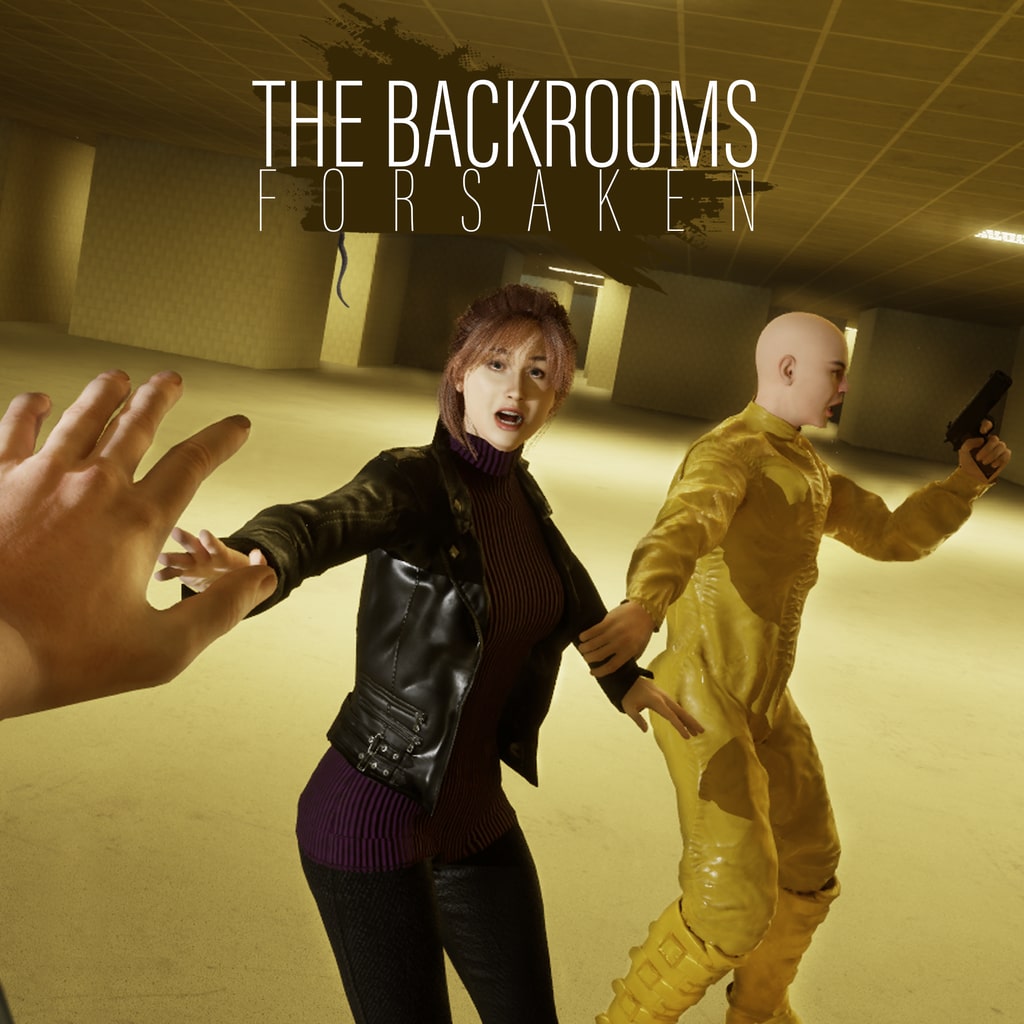
There is something uniquely unsettling about an empty corridor. Put a monster in front of us, and most of us know what to do. We run, we hide, we fight, or at the very least we scream and hope somebody else hears us. But give us an endless series of identical yellow rooms, buzzing fluorescent lights, and absolutely no idea where we are going, and suddenly our own imagination becomes the greatest threat of all. That is the simple but wonderfully effective idea at the heart of The Backrooms: Forsaken, a short psychological horror adventure that understands how uncomfortable a familiar place can become when something about it is fundamentally wrong.
Based on the ever-expanding Backrooms mythology, The Backrooms: Forsaken takes the familiar concept of being trapped in a seemingly endless dimension and turns it into a roughly two-hour narrative experience. You are not simply wandering around hoping to survive until the credits roll. This time, there is someone with you, and that companion changes the experience considerably. Their presence gives the journey a more personal quality, while the story provides a reason to keep pushing through the seemingly endless corridors, flooded rooms, and abandoned spaces that make up this strange nightmare.
Welcome to the Backrooms
The opening moments do a good job of establishing exactly what kind of horror experience The Backrooms: Forsaken wants to deliver. There is no enormous opening spectacle or a barrage of monsters. Instead, the game lets the environment do the heavy lifting, placing you in spaces that feel familiar enough to recognise but wrong enough to make your skin crawl.
The infamous yellow corridors are perhaps the best example. Their simplicity is precisely what makes them effective. Yellow walls, stained carpet, repetitive rooms and the constant hum of artificial lighting create a feeling of isolation that is difficult to shake. There is nowhere obvious to go and no comforting landmark to tell you that you are making progress, so even something as mundane as turning a corner can become strangely nerve-racking.
This is liminal horror in its purest form. The game does not always need to show you something frightening because the environment itself suggests that something should not be there. An empty room feels suspicious. A distant sound feels important. A corridor that looks exactly like the previous twenty corridors suddenly makes you question whether you have somehow gone backwards. That atmosphere is arguably The Backrooms: Forsaken’s greatest strength.
You’re Not Alone
The introduction of a companion is one of the more interesting decisions the game makes. The Backrooms concept often works because of its extreme isolation, so giving the protagonist someone to talk to could easily have undermined that feeling. Instead, the companion provides a surprisingly effective emotional anchor.
The conversations lend the adventure some personality, particularly because the dialogue is fully voiced. Suddenly, the endless rooms are not simply somewhere you are wandering through alone. There is another human presence experiencing the nightmare alongside you, and that changes how you perceive the situation.
It also gives the story an opportunity to breathe between the more unsettling moments. Horror can become exhausting when every second is dedicated to trying to scare the player, and The Backrooms: Forsaken wisely understands the value of quieter moments. Conversations and exploration create little pockets of normality before the game inevitably reminds you that something is very wrong with the world around you.
The relationship between the characters is not going to redefine storytelling in horror games, but it is considerably more engaging than simply having a disembodied voice barking instructions at you. There is enough personality here to make you care about what happens to the people involved, and that gives the journey a little more emotional weight than its modest length might suggest.
Getting Lost
Much of your time is spent doing exactly what you might expect from a Backrooms game: getting lost. Navigation is deliberately disorientating, with maze-like environments that force you to pay attention to your surroundings. There are puzzles to solve, areas to explore, and objects to locate, with battery scavenging adding another small layer of pressure. None of these mechanics are especially complicated, but that is not necessarily a criticism. The point is to make exploration feel uncertain rather than turn the game into a brutally difficult puzzle box.
There is something quite enjoyable about slowly figuring out where you need to go. You might pass the same room several times before noticing something you missed, or recognise a landmark that gives you a vague indication you are finally moving in the right direction. The game occasionally manages to create that wonderful feeling of relief when an apparently insignificant detail suddenly makes sense.
The problem is that the same design can also become frustrating. Some of the battery-collection sections interrupt the atmosphere rather than enhancing it, and the relatively straightforward objectives can occasionally feel more like padding than meaningful progression. In a game that lasts only around two hours, these slower sections are noticeable because the experience is otherwise moving at a brisk enough pace. Still, when the exploration works, it works because The Backrooms: Forsaken understands that getting lost is the point.
A World of Different Nightmares
One of the game’s other strengths is its willingness to move beyond the familiar yellow corridors. The Backrooms mythology has grown enormously over the years, and The Backrooms: Forsaken draws on that variety by taking players through different environments.
The flooded poolrooms are particularly effective. There is something deeply unsettling about swimming or walking through an abandoned aquatic environment when you have no idea what might be lurking around the next corner. The combination of empty architecture, water and silence creates a different kind of tension from the opening areas.
Other abandoned structures provide further visual variety, helping prevent the game from becoming a single extended trip through yellow wallpaper. This is important because repetition is one of the biggest risks associated with the Backrooms concept. If every environment looked identical, the very thing that creates the game’s atmosphere would eventually become tedious.
Instead, the progression gives the adventure a sense of moving deeper into something increasingly strange. Each new location offers a slightly different interpretation of the nightmare, which helps maintain curiosity even when the gameplay itself remains fairly simple.
When the Fear Fades
Unfortunately, The Backrooms: Forsaken does not always sustain the tension it builds so effectively in its quieter moments. Some of the chase sequences lack the sense of danger you would expect from a horror game. Being pursued should trigger that wonderful panic when you stop thinking rationally and simply run, but here the stakes can occasionally feel too low. When you realise that a particular encounter is unlikely to result in anything particularly devastating, the fear naturally begins to fade.
That is a shame, because the game has already done the hard work of establishing an unsettling atmosphere. Its environments can be genuinely creepy, and the sound design and visual presentation often encourage you to imagine something horrible just outside your field of vision. When the game actually reveals the threat, however, it does not always deliver the same impact.
There are also some technical rough edges that remind you this is an indie production. Character animations can look awkward, movement occasionally lacks polish, and some interactions do not have the smoothness you would expect from a larger horror production. None of these problems completely derail the experience, but they can break the illusion at precisely the wrong moment.
Short, Strange and Surprisingly Memorable
The two-hour running time will inevitably divide players. Some will finish The Backrooms: Forsaken wishing there had been more levels, puzzles and story, while others will appreciate that the game knows when to leave before its central idea is exhausted.
Personally, the shorter format suits the concept well. The Backrooms works brilliantly in concentrated doses. Spending ten or fifteen hours wandering through increasingly similar liminal environments could easily turn an intriguing nightmare into a chore. At around two hours, The Backrooms: Forsaken feels more like an unsettling story you have experienced than a game that has overstayed its welcome.
There is also something refreshing about its ambitions. It does not attempt to become the definitive Backrooms survival horror experience. It is a focused narrative adventure built around atmosphere, exploration, puzzles and a small cast of characters. It succeeds when those elements come together and struggles when it attempts to manufacture conventional horror from them.
Final Verdict
The Backrooms: Forsaken is a short but atmospheric horror adventure that gets a surprising amount of mileage from a simple idea. Its greatest achievement is not in the occasional scares but in the uncomfortable environments it creates. The endless yellow corridors, deserted spaces and flooded rooms capture the strange appeal of liminal horror beautifully, while the companion character gives the story an emotional element that many Backrooms experiences lack.
There are certainly weaknesses. The technical presentation can be rough, some character animations are noticeably janky, and the pacing occasionally slows during battery collection and exploration sections. The chase sequences also lack the urgency needed to deliver genuinely frightening moments. Yet these shortcomings never completely overwhelm the atmosphere, and the variety of environments gives the adventure enough visual and narrative momentum to carry it through to the end.
Most importantly, The Backrooms: Forsaken understands that horror does not always need to shout. Sometimes it is the empty corridor, the flickering light, the sound of footsteps somewhere you cannot see, or the growing realisation that you have absolutely no idea where you are. That is where this little adventure is at its best, and those moments linger considerably longer than some of its more conventional scares.