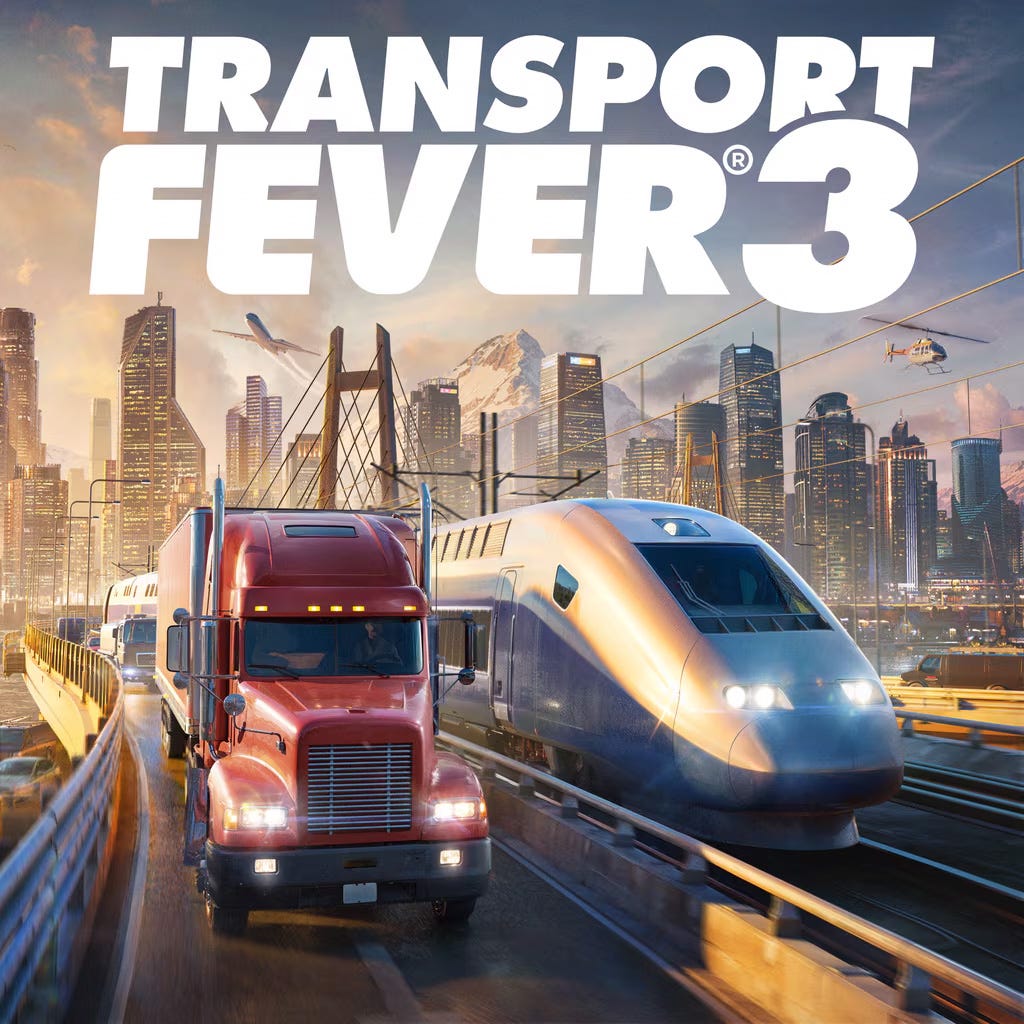
There is something strangely satisfying about watching a railway line stretch across a landscape once untouched. One minute you are staring at a sleepy little settlement surrounded by empty fields, and the next trains are rumbling through the countryside, buses are carrying passengers into town, ships are moving cargo across the water, and aircraft are connecting distant cities. Transport Fever 3 understands that satisfaction better than most management games because it is not really about building roads, railways or airports. It is about watching a living world slowly change because of the decisions you make.
Developed by Swiss studio Urban Games and published by Paradox Interactive, Transport Fever 3 is the latest instalment in a series that has steadily grown from a niche transport simulation into an impressively comprehensive management experience. The formula remains familiar, but this latest entry expands the scale considerably, with more than 300 vehicles, four distinct environments, and a dynamically simulated world that reacts to the networks you create. It can be intimidating at first, particularly for newcomers, but once the various systems begin to click into place, there is an addictive rhythm to making everything run smoothly.
All Aboard
The opening hours can feel like being handed the keys to a railway company without quite enough instruction to know where the brakes are. There are routes to establish, towns to connect, industries to supply, and vehicles to purchase, and each decision has consequences further down the line. A passenger service might look profitable until you realise the station is poorly positioned, while a seemingly straightforward freight route can become an enormous logistical puzzle once multiple industries depend on it. The learning curve is real, but there is something rewarding about gradually understanding why your network works, or perhaps more importantly, why it does not.
Once that initial barrier has been overcome, Transport Fever 3 becomes wonderfully engrossing. You begin thinking several steps ahead, considering not only where a railway should go but also what it will need to support five, ten or twenty years down the road. The best moments come when a complicated network suddenly starts working exactly as intended, with goods moving efficiently and passengers flowing through your transport empire without everything grinding to a halt. It is the sort of satisfaction that makes you say you will make one small adjustment before bed, only to realise an hour later that you are still playing.
A World That Moves
One of the biggest improvements is how the world itself feels more dynamic. Settlements and industries can evolve in response to the transport infrastructure around them, making your network feel like an active part of the environment rather than a collection of disconnected routes. A thriving transport link can help a settlement grow, while poorly served areas can struggle to develop at the same pace. This creates a pleasing sense that you are influencing the world rather than simply building on top of it.
The four environments also help give different maps their own personality. Temperate landscapes provide the familiar foundation, while desert and tropical environments introduce their own visual character and logistical considerations. The new sub-Arctic environment is particularly welcome because it makes the world feel broader and gives long-term players another setting in which to experiment. The terrain itself is important too, because mountains, coastlines and other geographical features can turn what looks like a simple connection into a major engineering project.
The Joy Of The Network
At its heart, Transport Fever 3 is about logistics, and this is where the game can become wonderfully obsessive. Connecting two cities is easy enough, but building an efficient network that supports passengers, raw materials, factories and finished goods is another matter entirely. Suddenly you are thinking about transfer points, vehicle capacity, journey times and whether your freight trains are spending too much time travelling empty. The game has a remarkable ability to turn something as simple as getting a bus from A to B into a much larger strategic puzzle.
There is also enormous satisfaction in watching those supply chains operate. Raw materials leave one location, arrive at a processing facility and are transformed into something that needs to be transported elsewhere. A carefully designed railway can then move those goods towards a city while passenger services operate on adjacent lines. When everything is working, the network develops an almost hypnotic rhythm, and it becomes very easy to sit back and watch your creation do exactly what you intended.
A Century Of Transport
The historical progression is another major attraction. Starting with humble horse-drawn wagons and early steam-powered vehicles, and gradually moving towards modern trains, aircraft, supertankers and helicopters, gives the game a wonderful sense of technological evolution. More than 300 authentic vehicles are available across trains, buses, trams, trucks, ships, planes and helicopters, giving transport enthusiasts plenty to discover. The vehicles are also detailed enough to make their historical differences feel meaningful rather than merely cosmetic.
There is something particularly satisfying about watching an old steam locomotive disappear into the distance before replacing it with a much more advanced train decades later. The same applies to road transport and aviation, where technological progress gradually changes what your network is capable of achieving. The passage of time becomes part of the experience rather than simply a number on the screen. You are effectively watching a miniature history of transport unfold through the network you have built.
From Roads To The Skies
The variety of transport options means Transport Fever 3 rarely feels restricted to a single style of play. Some players will naturally gravitate towards railways, carefully designing junctions and stations until their network resembles something from a railway engineer’s fever dream. Others may prefer roads, buses and trucks, while shipping routes present an entirely different logistical challenge. Aviation adds another layer once the technology becomes available, and helicopters offer a new way to connect places that traditional infrastructure might struggle to reach.
The important thing is that these systems complement one another. A successful transport empire is rarely about choosing one method and ignoring everything else. Instead, the fun comes from finding ways for different forms of transport to work together, allowing trucks to feed railway stations, trains to supply ports and aircraft to handle long-distance passenger routes. The possibilities become increasingly complex as the decades pass, but that complexity is also what gives the game so much longevity.
Building A Living Economy
There is a satisfying cause-and-effect relationship running through the simulation. Improving transport can help cities expand, while better connections can increase demand and create opportunities for new routes. The more successful your network becomes, the more ambitious your plans can be, and before long you are looking at the map less like a landscape and more like a giant puzzle waiting to be solved.
This is also where the game can occasionally become overwhelming. Large networks require constant attention, and the amount of information available can be intimidating when you are trying to understand why a particular route has suddenly become inefficient. Managing a huge fleet can also become cumbersome, particularly on consoles, where navigating menus with a controller is not always as intuitive as it could be. The interface generally provides the information you need, but finding it can sometimes take longer than it should.
The Campaign
For those who prefer more structure, the campaign offers a useful alternative to simply disappearing into a sandbox and building whatever comes to mind. Historical scenarios give context to the mechanics and provide objectives that encourage you to approach transport problems in particular ways. They also demonstrate the simulation’s breadth, showing how transport evolved across different periods and environments.
The voice acting can occasionally be a little theatrical, and some of the campaign presentation has a slightly campy quality that may not appeal to everyone. Personally, though, I found it added a certain charm rather than being a serious problem. The important thing is that the scenarios provide enough direction to help new players understand what the game is asking of them without removing the freedom that makes the sandbox so compelling.
When The World Gets Busy
Performance is generally impressive given how much is happening on screen, particularly when you start building enormous networks with hundreds of vehicles. Watching trains, buses, ships and aircraft operate simultaneously can be surprisingly beautiful, especially as the landscape gradually fills with infrastructure. However, there can be late-game performance stutters on particularly large maps, and this becomes more noticeable once your transport empire reaches genuinely enormous proportions.
It is a reasonable compromise given the simulation’s complexity, but it is worth noting because the late game is precisely where many players will spend their time. The larger your network becomes, the more impressive it looks, but the harder the game has to work to keep track of everything. Thankfully, these issues do not undermine the overall experience, and the visual presentation remains one of the game’s strengths.
A Sandbox With Almost No Ceiling
The sandbox is where Transport Fever 3 can become dangerously addictive. Once the restrictions of a particular scenario lift, you are free to build the transport empire you want, whether that means constructing an elaborate railway network or attempting to connect an entire map with an absurd mix of buses, ships and aircraft. There is no single correct way to play, and experimentation is actively encouraged. Every map becomes an opportunity to try something slightly different.
That freedom gives Transport Fever 3 a remarkable lifespan. You can spend hours perfecting a single railway junction or become fascinated by the challenge of making an entire city’s public transport system run efficiently. You can create a vast industrial freight network or focus on passenger transport between growing towns. The game does not dictate what your transport empire should look like, and that freedom is arguably more valuable than any traditional progression system.
A Simulation With Soul
What surprised me most about Transport Fever 3 is that, despite all the spreadsheets, statistics and logistical calculations, it can have a genuine sense of personality. There is something almost nostalgic about watching a steam train pull into a station or an old-fashioned bus trundle along a country road. The gradual transition from nineteenth-century transport to modern aviation gives the game a sense of history that makes your network feel like it has a story.
It is also a game where failure can be strangely enjoyable. A route that seemed like a brilliant idea might turn out to be a financial disaster, forcing you to rethink the entire operation. A congested station can become a problem that takes an hour to solve, but when you finally untangle it and watch everything start flowing again, the satisfaction is enormous. Transport Fever 3 understands that management games are often at their most enjoyable when something goes wrong and you have to figure out how to fix it.
Verdict
Transport Fever 3 is a deep, ambitious and wonderfully absorbing transport simulator that takes an already impressive formula and expands it in almost every direction. The combination of more than 300 vehicles, four distinct environments, dynamic settlements, complex logistics and a century of technological progression creates an experience capable of consuming enormous amounts of time. It has the depth that dedicated simulation fans will be looking for, while the increasingly visible cause-and-effect relationship between transport and settlement growth gives the world a welcome sense of life.
It is not the easiest game to learn, and newcomers should be prepared to spend some time understanding how its various systems fit together. The interface can become cumbersome when managing enormous fleets, particularly with a controller, while very large late-game maps can occasionally suffer from performance hiccups. Some of the campaign presentation also has a slightly overenthusiastic quality that may not suit everyone. These are relatively minor blemishes on an otherwise impressively comprehensive simulation.
The real magic of Transport Fever 3 comes from the feeling that you are not simply playing with trains and buses. You are creating a living network that changes the world around it. A tiny railway can become the foundation of a thriving city, a modest freight route can grow into a sprawling industrial operation and a simple bus service can eventually become one small part of an enormous transport empire stretching across an entire continent.
There are games that give you objectives and games that give you worlds, but Transport Fever 3 gives you something slightly different. It gives you a world and asks what you can build within it. Whether you are a veteran of the series or someone who has always looked at transport simulations from a safe distance, there is something immensely satisfying about watching your first successful network come to life. Once the pieces start moving, the cities start growing and the money starts flowing, it becomes remarkably difficult to stop.