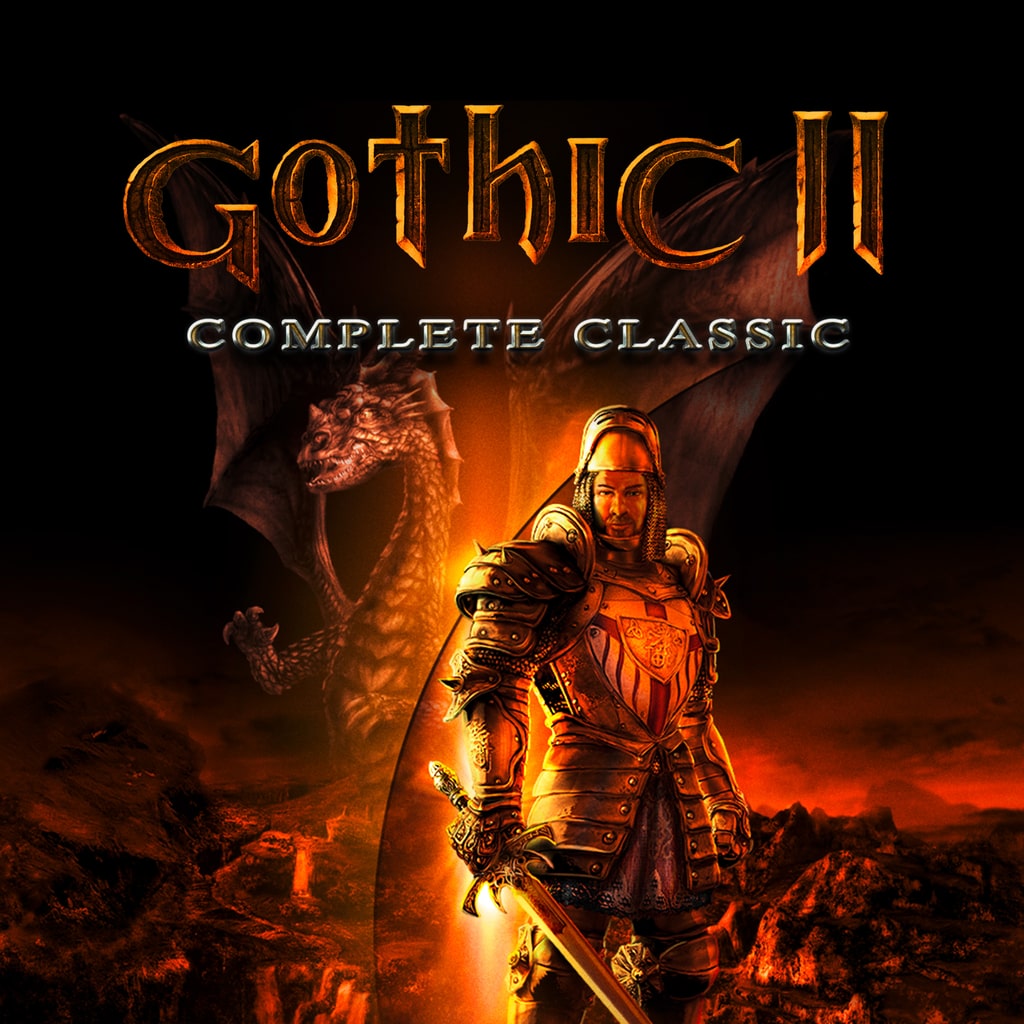
There is something wonderfully unfashionable about Gothic II Complete Classic. In an era when open-world games routinely throw enormous maps, endless quest markers and carefully choreographed adventures at the player, Piranha Bytes’ classic RPG seems almost deliberately determined to leave you to your own devices. It does not particularly care whether you feel powerful, whether you know where you are going, or even whether you are ready for what is waiting around the next corner. That stubbornness is a huge part of its identity, and on PlayStation 5, Gothic II Complete Classic gets another chance to show modern players why this particular kind of role-playing adventure still has a devoted following.
Originally released in 2002, Gothic II continues the story of the nameless hero following the events of the original game. The magical barrier surrounding the Valley of Mines has been destroyed, and the prisoners who were once trapped there have been set loose, leaving the island of Khorinis in a dangerous state. Bandits roam the countryside, the town militia is stretched beyond its limits, and rumours of dragons are beginning to spread. The situation is already precarious, but the arrival of a much greater threat means somebody has to step forward, and, unfortunately for our reluctant hero, that somebody is him.
With Night of the Raven included as part of the Complete Classic package, this is far more than a simple re-release of an old RPG. It is the definitive way to experience Gothic II, bringing together the original adventure and its substantial expansion into one sprawling journey. There is an enormous amount to see and do, and although its age is impossible to hide, there is still a sense of freedom and discovery here that many modern open-world games struggle to reproduce.
Welcome to Khorinis
Khorinis is perhaps the game’s greatest achievement. It is not simply a large map filled with activities waiting for the player to tick off. It feels like a place that existed before you arrived, with people going about their business, factions pursuing their own interests, and danger lurking beyond the relative safety of civilisation. More than 500 characters inhabit the world, and their routines help create the impression that life continues whether the nameless hero is watching or not.
That design philosophy makes exploration genuinely exciting. Walking away from the safety of Khorinis can feel like a decision rather than a formality, particularly during the opening hours, when even relatively ordinary enemies can make short work of an inexperienced character. A creature that looks insignificant from a distance can become a serious problem when your character lacks the skills, equipment and combat experience to deal with it. There is no great shame in running away, either. In fact, knowing when to turn around and live to fight another day is one of the most important lessons Gothic II teaches.
This can feel refreshingly honest. The game does not constantly reassure you that you are the hero and therefore capable of overcoming anything. Instead, the world has its own hierarchy of power, and you are initially very near the bottom of it. As your skills improve, previously intimidating locations gradually become accessible, and there is a wonderful sense of progression in realising that somewhere which once forced you to flee is now somewhere you can confidently explore.
A World That Does Not Hold Your Hand
The freedom offered by Gothic II extends into its quest design. With more than 100 quests, there is plenty of content to keep you engaged for well over 50 hours, but the important thing is that many of these objectives do not have a single obvious solution. Your faction, abilities and relationships can all affect how situations unfold, allowing you to approach problems in different ways.
The three main guilds are central to this. Players can align with the militia and the royal paladins, join the mercenary ranks, or pursue the path of the mages. Each route changes your relationship with the world around you and offers its own skills, allies and enemies. It is a system that encourages replaying the game simply to discover how differently things can develop when you make another choice.
That sense of consequence is one of the game’s most appealing qualities. Modern RPGs often give players dialogue choices while ultimately guiding everyone towards roughly the same destination. Gothic II feels less concerned with making every player experience the same carefully constructed story. It gives you the tools and then lets you make mistakes, upset people, miss opportunities and occasionally stumble into something wonderful.
There is also something satisfying about learning the world organically. You are not constantly showered with icons telling you exactly where to go next. Information comes from conversations, books, observations and sometimes simply paying attention. It can be frustrating when you are used to modern conveniences, but once you settle into its rhythm, the lack of hand-holding becomes one of its most distinctive strengths.
Combat That Demands Patience
Combat is where the years are perhaps most obvious. Gothic II was never built around the slick responsiveness of modern action RPGs, and its melee system can initially feel awkward. Positioning, timing and understanding your opponent matter, but the controls and lock-on mechanics can take considerable adjustment.
The early difficulty curve can also be brutal. Your character starts out weak, and wandering into the wrong area can result in a very quick death. That can be frustrating, especially when a modern player expects the world to scale around their character. Here, it does not. The world is dangerous because it is dangerous, and your job is to become strong enough to deal with it rather than expecting everything else to politely wait for you.
Yet there is a strange satisfaction to the system once it clicks. Developing your combat skills through practice makes your character feel genuinely improved, rather than simply increasing a collection of statistics behind the scenes. The game offers more than 200 weapons and magical spells, giving you plenty of room to develop a fighting style that suits you.
Magic also provides an enjoyable alternative to simply swinging a sword at everything that moves. The three guilds encourage different approaches to character development, while the broader progression system gives you plenty of reasons to experiment with skills and equipment. It is an old-fashioned RPG system, but there is real substance behind it.
The Night Gets Darker
Night of the Raven adds another substantial layer to the adventure and is an important part of what makes this Complete Classic release so appealing. Rather than feeling like a disposable extra bolted onto the original campaign, the expansion expands the world and introduces additional story and challenges that make the already sizeable adventure feel considerably richer.
The expansion also reinforces one of Gothic II’s greatest strengths: atmosphere. Khorinis can be beautiful, but it can also feel oppressive and dangerous, particularly when darkness falls and the wilderness becomes harder to read. There is always an uncomfortable feeling that something could be waiting just beyond your field of vision.
That atmosphere is enhanced on PS5. The modern presentation cannot magically transform a game designed more than two decades ago into a contemporary visual showcase, but higher resolution, improved lighting and shadow fidelity, and a smoother 60 frames per second target make the experience considerably more comfortable on modern hardware. Native 4K support in the appropriate visual mode gives the environments greater clarity, while the improved presentation allows the world to retain more of its character without losing the rough edges that make it recognisably Gothic.
A Classic With All Its Rough Edges
Those rough edges are worth acknowledging. Gothic II Complete Classic may have received a modern console presentation, but beneath the surface it remains very much a game from 2002. NPC pathfinding can occasionally behave oddly, combat can feel clunky, and the interface takes time to learn. At times, you can practically feel the age of the original code beneath the modern hardware.
For some players, these quirks will be charming reminders of another era of RPG design. For others, they will be genuine obstacles. There is no point pretending that Gothic II has suddenly become as mechanically polished as a modern open-world RPG simply because it now runs at 60 FPS on a PlayStation 5.
Thankfully, the controller improvements help considerably. Refined radial menus make navigating equipment and abilities more manageable, while DualSense support gives the game a more natural connection to modern PlayStation hardware. These improvements do not fundamentally change the experience, but they reduce some of the friction involved in playing a game whose original interface was designed for a very different generation of hardware.
Still Worth Getting Lost In
What ultimately makes Gothic II Complete Classic special is not its technology. It is the way the game treats the player. Khorinis is not a theme park built around your character. It is a world with its own rules, its own people and its own dangers, and you have to earn your place within it.
That philosophy can be demanding, occasionally frustrating and sometimes downright unforgiving. But it also creates moments that feel personal because the game has not manufactured them specifically for you. Finding a new route through the wilderness, finally defeating an enemy that once seemed impossible, or earning the trust of a faction can feel like genuine achievements rather than simply ticking another objective off a list.
There is an undeniable sense of history here, too. Gothic II belongs to a period when RPGs were more willing to let players get lost, make mistakes and work things out for themselves. Night of the Raven only strengthens that experience by adding more depth to an already fascinating world.
Final Verdict
Gothic II Complete Classic is not a remake pretending that 2002 never happened. It is arguably more interesting: a chance to experience a hugely influential RPG largely on its own terms, with modern hardware making the journey smoother and more appealing without sanding away its personality.
The PS5 version’s improved resolution, lighting, shadows, 60 FPS performance and DualSense support are welcome additions, but the real attraction remains the world itself. Khorinis is wonderfully atmospheric, the faction system encourages experimentation, and the quest design rewards curiosity rather than simply following a glowing marker from A to B. The combat and interface can be awkward, the early difficulty remains punishing, and the occasional technical oddity reminds you just how old this game really is.
Those imperfections will not be for everyone, but they are part of what gives Gothic II its character. Beneath the dated presentation lies an RPG with remarkable confidence in its own world and a willingness to let players discover it without constantly holding their hand.
For newcomers willing to meet it halfway, Gothic II Complete Classic remains a fascinating adventure. For returning fans, it is a welcome opportunity to step back into Khorinis with considerably less hardware friction. More than two decades later, this is still an RPG that understands something many modern games sometimes forget: getting lost can be just as rewarding as knowing exactly where you are going.