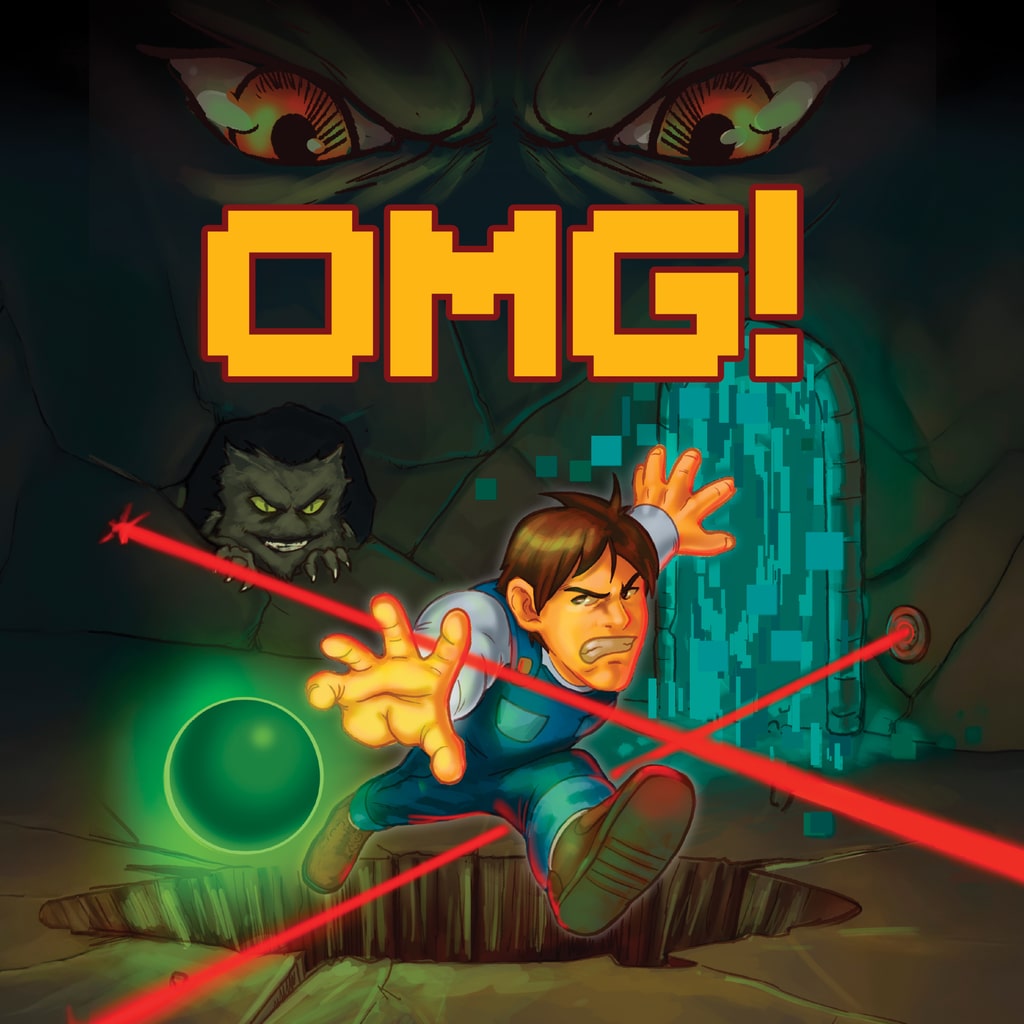
There is something wonderfully refreshing about a game that knows exactly what it wants to be. OMG! – Overhead Micro Game arrives without a sprawling open world, a hundred-hour campaign or a progression system designed to keep you playing long after the credits should have rolled. Instead, it gives you a tiny grid, a handful of deadly obstacles, a green Exit Orb at the end of the room and a very simple instruction: dash, dodge, die, try again. It sounds almost laughably simple, but in practice it can be anything but.
Developed and published by Freddicus Game Studios, OMG! takes the idea of a puzzle game and strips it back to its bare essentials. Everything happens on a single screen, with each level presented as a compact little death trap built around the game’s wonderfully peculiar movement system. You do not walk from one tile to the next. Instead, you dash exactly three tiles in one of four directions, sailing over whatever happens to be in the spaces between. That single rule is the foundation upon which the entire experience is built, and it proves to be an impressively effective one.
Small Screen, Big Ideas
The first few levels of OMG! are almost deceptive in their simplicity. You see the Exit Orb, assess the obstacles between you and it, and instinctively start planning the route you need to take. Then you dash straight into something horrible, explode or otherwise meet your tiny pixelated demise, and find yourself right back where you started. It is an introduction that teaches you the game’s most important lesson: failure is not something to fear; it is part of the process.
There is no dramatic death animation and no lengthy loading screen designed to make you sit and contemplate your mistakes. You simply touch a hazard, disappear, and immediately get another chance. It is an incredibly clean approach to failure, and it means dying never feels like an interruption to the experience. Instead, every failed attempt becomes another piece of information that helps you work out the solution.
That distinction matters because OMG! is built around experimentation. You are expected to get things wrong, and the game almost encourages you to do so because there is practically no penalty for trying something different. A laser might be harmless one moment and lethal the next, while a pit can be crossed safely if you time your dash correctly but will end your attempt instantly if you land in it. Teleporters can completely alter your intended route, switches introduce timing into the equation, and then there is Leslie, the one thing on the screen that moves.
Three Tiles at a Time
The genius of OMG! is that its movement system initially feels restrictive but gradually becomes liberating once you understand it. Because you always move three tiles at a time, the game forces you to think about where you will land rather than simply where you want to go. It sounds like a subtle difference, but it completely changes how you approach each puzzle, as every move must be considered as part of a larger sequence. You are not simply moving around a room; you are plotting a route through it.
A laser might be positioned in a way that looks impossible until you realise you can dash over it. A gap that appears harmless can become a death sentence if you forget where your movement will actually end. A switch might need to be activated before you can safely cross another section, meaning the obvious route is not necessarily the correct one. The more complicated levels begin to resemble tiny logic problems, where understanding the rules is every bit as important as good timing.
Eventually, you stop thinking about individual movements and start mentally plotting entire sequences. You look at the screen, identify the hazards, and begin imagining the exact route your character needs to take before making the first move. Sometimes you can execute that plan immediately, while other times a tiny mistake sends you back to the beginning and forces you to rethink everything. When a solution finally clicks into place, the satisfaction comes from realising that the answer was sitting in front of you all along.
Learning to Love the Failure
Trial and error can be a dangerous thing in puzzle games because failure can quickly become frustrating. Make it too punishing and players become reluctant to experiment, while making it too forgiving can rob a successful solution of its sense of achievement. OMG! finds a pleasing middle ground largely because restarting is instantaneous, allowing you to make mistakes without feeling the game is wasting your time. That creates a wonderfully addictive rhythm in which failure becomes another form of progress.
One more attempt quickly becomes two, and two can easily become five or ten without you even noticing. Before long, you are staring at a tiny 12×12-pixel arena with the sort of concentration usually reserved for much larger and more complicated games. The simplicity of the presentation makes the challenge more compelling because nothing distracts you from the puzzle itself. You know exactly what needs to be done, but getting there is what matters.
There are some lovely moments of discovery along the way. The game is not necessarily interested in making every puzzle fiendishly complicated. Instead, it often gives you a relatively small problem with one deceptively simple trick hidden inside it. Once that trick clicks, the solution suddenly feels obvious, and there is a genuine little burst of satisfaction as you execute the sequence correctly. It is the sort of design that reminds you why simple puzzle games can be so addictive when the underlying mechanics are strong enough.
Leslie and the Other Things That Want You Dead
Most of the obstacles in OMG! are static, which makes Leslie particularly important. While lasers, pits, switches and teleporters can all be studied and understood, Leslie introduces movement into the equation and forces you to account for something that is not going to politely remain where you expect it to be. Learn the pattern and you can work around it, but misjudge the timing and another carefully planned attempt can disappear in an instant. It is a small addition, but it gives certain levels an extra layer of tension.
The lasers are particularly effective because of the different ways they behave. Some blink on and off at predictable intervals, others move at a different pace, and some remain active until you have worked out how to trigger the relevant switch. This means that simply knowing where an obstacle is located is not always enough, because you also need to understand what it is doing. The later levels are where these systems start to be combined, and that is when the game begins to demand genuine forward planning.
There are occasional difficulty spikes, particularly when multiple hazards are brought together, but the instant restart system does a great deal to soften those rough edges. You are rarely angry about having to repeat a level because you can be back in the action almost immediately. The frustration tends to come from knowing you were one move away from solving something, rather than from feeling that the game has wasted your time. That is an important distinction, and OMG! handles it very well.
Old School Charm
Visually, OMG! wears its retro credentials proudly. The entire experience is built around its tiny 12×12-pixel aesthetic, and there is something wonderfully authentic about it that goes beyond simply applying a pixel filter to a modern game. The presentation, mechanics and soundtrack all feel as though they have been designed with the same philosophy, creating a cohesive little package that knows exactly what it wants to be. It is deliberately basic, but never feels unfinished.
The 8-bit chiptune soundtrack deserves particular praise because it does far more than simply provide background noise. The music is energetic, catchy and surprisingly memorable, with melodies that have a habit of lodging themselves in your head long after you have stopped playing. There is a certain charm to knowing that the soundtrack is not merely imitating retro music but genuinely embraces that old-school chiptune style. It perfectly complements the tiny arenas and the game’s frantic little bursts of movement.
There is also a deliberately silly personality running through the whole experience. The villain is called The Expositor, which tells you almost everything you need to know about the game’s sense of humour, and the story embraces its wonderfully corny premise rather than pretending to be something it is not. The Expositor watches over your repeated deaths as part of some grand experiment, turning your endless failures into a strange sort of entertainment. It is ridiculous, but OMG! understands that being ridiculous is part of its appeal.
More Than Just a Quick Fix
With more than 50 hand-crafted levels across three phases, OMG! offers a surprisingly substantial collection of puzzles despite its deliberately bite-sized design. Each screen feels like its own little problem to solve, and there is very little sense that the developers have padded the experience simply to make the numbers look more impressive. The focus remains firmly on delivering one clever challenge after another. For a game built around such a simple concept, that level of consistency is impressive.
There is also more here for completionists than simply reaching the Exit Orb. Three hidden purple orbs are scattered throughout the game, with one in each phase, and collecting them all unlocks the true ending. You can technically finish the game without finding them, but doing so means missing a small part of what OMG! quietly asks you to discover. They provide an extra incentive to revisit levels and look beyond the most obvious route.
Speedrunners have another reason to stick around. Once you understand the layouts and have mastered the movement system, the question shifts from whether you can complete a level to how quickly you can execute the solution. That gives the game’s compact design another layer of longevity, particularly for players who enjoy chasing leaderboard times and shaving seconds from their runs. It is a sensible way to extend an experience that deliberately avoids unnecessary filler.
A Tiny Game With Plenty of Character
There is a certain confidence in OMG! that I really appreciate. It knows its concept is small and does not try to disguise that fact, instead taking that tiny concept and polishing it until the basic act of moving three tiles at a time becomes surprisingly deep. There is something almost admirable about a game that refuses to overcomplicate itself when so many modern releases seem determined to throw endless systems at the player. OMG! simply gives you a puzzle and asks you to solve it.
The shorter runtime may be a criticism for some players, especially those who are not interested in speedrunning or hunting down the hidden purple orbs. There are also moments when the difficulty takes a noticeable jump, and newcomers may need a little time to fully understand how the three-tile movement system affects their planning. Yet those issues never really undermine the central experience because the game is so efficient with the player’s time. It knows when a puzzle has done its job and moves on before the idea becomes stale.
Most importantly, OMG! understands the satisfaction that comes from solving a problem yourself. There are no elaborate tutorials constantly telling you what to do and no complicated progression systems distracting from the central mechanic. You observe, experiment, fail, learn and try again until everything falls into place. When you finally reach that green Exit Orb after several failed attempts, it feels like your achievement rather than the game’s.
Final Verdict
OMG! – Overhead Micro Game is a brilliantly focused little puzzle experience that proves you do not need a huge world to create a compelling adventure. Its three-tile movement system is simple to grasp yet surprisingly rich in practice, while the combination of lasers, pits, switches, teleporters and Leslie offers plenty of scope for clever level design. The whole thing is wrapped in a wonderfully authentic retro presentation that gives the game an identity of its own.
The catchy chiptune soundtrack, deliberately cheesy humour and instant restart system all work together to create something that feels remarkably cohesive. There are occasional difficulty spikes, and the overall experience may feel brief for players who are not interested in chasing high scores or finding every secret, but the game never feels padded or wasteful. Every level exists for a reason, and every death gives you another chance to understand what went wrong.
More importantly, OMG! has that increasingly rare quality of making you say, “Just one more try.” It can look almost absurdly simple from the outside, but once you are sitting in front of one of its tiny puzzle rooms, working out whether you can clear that laser or land safely on the other side of a pit, the simplicity disappears. What remains is a wonderfully pure little game about movement, timing, observation and persistence, and sometimes that is more than enough.