There are games that want you to feel powerful, games that want you to feel clever, and then there are games that seem to take genuine pleasure in watching you fall. Sklime: A Difficult Climbing Adventure belongs firmly in that last category. It is a deliberately cruel physics platformer built around one deceptively simple idea: take a tiny slime, give each of its arms individual controls, remove every checkpoint you can, and ask the player to climb out of the depths without losing their mind. It sounds ridiculous, and sometimes it is, but beneath the frustration lies a surprisingly elegant climbing system that rewards patience, practice, and the willingness to make the same mistake twenty times until your hands finally understand what your brain has been trying to explain.
Developed and published by Sklime Studio, the game sits comfortably alongside the likes of Getting Over It with Bennett Foddy and A Difficult Game About Climbing, wearing its influences proudly while adding its own wonderfully strange identity. You play as a slime that has fallen to the bottom of an enormous underground world and must somehow work its way back home. There are seven colourful environments standing between you and freedom, each filled with awkward surfaces, moving hazards, narrow ledges, and physics-based obstacles designed to turn even the smallest error into a catastrophe. There are no checkpoints waiting to save you when things go wrong, so every metre climbed feels earned.
Welcome to the Pain
The first thing Sklime teaches you is that climbing is not something you simply do. It is something you learn. Your slime is wonderfully awkward, with each arm requiring individual control and every movement affected by momentum, tension and the strange elasticity of its gelatinous body. You cannot simply hold a direction and expect the character to behave.
Instead, you have to understand how your movements affect the entire body. Stretch too far and you may lose your grip. Launch yourself too aggressively and you could fly straight past the ledge you were aiming for. Move too cautiously and you may not generate enough momentum to reach the next platform.
It is this relationship between control and physics that defines Sklime. The game is difficult, but not because the developers have simply thrown impossible obstacles at you. It is difficult because the controls demand a level of physical understanding that most platformers never ask for.
Two Arms, One Very Angry Player
Controlling the slime’s arms individually is the foundation of the experience, and it takes time to feel natural. At first, your movements can feel almost completely disconnected from what you intended. You will reach for a ledge, attach yourself awkwardly, swing around in a way you never anticipated, and then fall straight back to the bottom.
There is a strange comedy to these early failures. Watching a tiny blob of slime desperately flail its way across a rock face is funny, particularly when you know exactly why everything has just gone wrong. The humour fades slightly after the same mistake costs you ten minutes of progress, but that is part of the emotional rollercoaster the game deliberately creates.
Eventually, something clicks. You begin to understand how much force you need, when to release a grip, and how to use the slime’s body weight to your advantage. What initially feels random starts to feel remarkably precise, and that transition is one of Sklime’s greatest achievements.
The Mountain Never Forgives
The decision to remove checkpoints entirely is perhaps the game’s boldest choice. There is no convenient platform halfway up the mountain where you can pause and know your progress is safe. If you fall, you fall, and the mountain is perfectly happy to send you tumbling back through areas you thought you had conquered.
That can be brutal. There are moments when you spend twenty minutes carefully climbing, reach a section that finally feels familiar, and then make one tiny mistake that sends you hurtling downwards. You can watch the progress disappear in front of you, and the temptation to quit can become almost overwhelming.
Yet that is also why reaching a new height feels so good. Sklime understands something about difficult games that is increasingly rare. Progress only feels truly meaningful when failure has consequences. When you finally reach an area that previously seemed impossible, there is a genuine sense of achievement because you know the game did not hand you that progress.
Seven Worlds Above
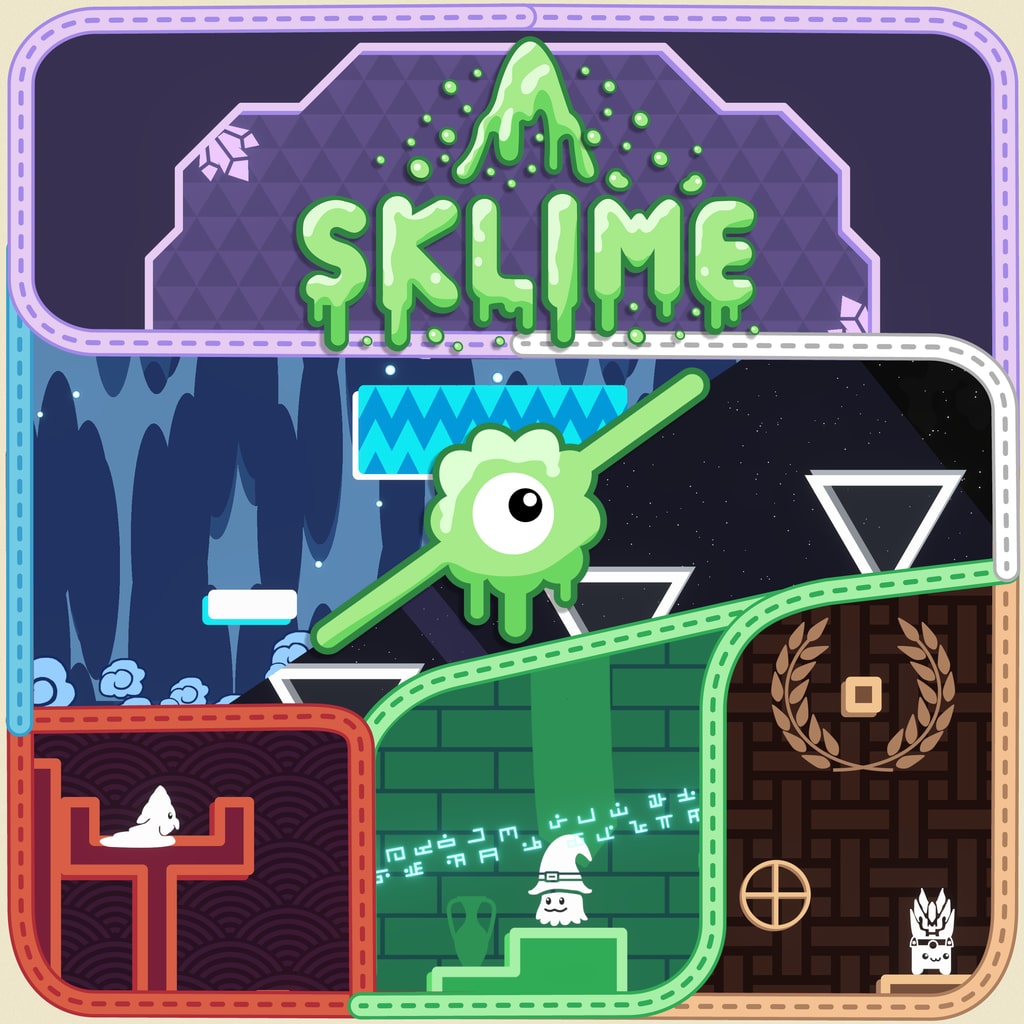
Although the climbing system is the star, the environments provide welcome variety. The seven colourful areas each introduce distinct visual identities and new hazards, ensuring the journey does not feel like repeatedly climbing the same wall with a different background.
There are slippery surfaces, narrow platforms, spinning machinery and physics-based obstacles that demand different approaches. Some sections test your ability to maintain control, while others are designed around timing and momentum. The game constantly asks you to adapt rather than simply memorise a single movement pattern.
The colourful presentation is particularly effective because it creates an interesting contrast with the difficulty. Sklimelooks friendly. Its little protagonist is cute, the environments are colourful and the overall presentation has a playful quality. Then you miss a grip and spend the next thirty seconds watching your slime bounce helplessly towards the bottom of the world.
Failure Becomes a Teacher
The relationship between failure and learning is central to Sklime. Every fall teaches you something, even if the lesson is occasionally delivered with the subtlety of a brick through a window. You learn which surfaces can be trusted, how far your arms can reach, and how much momentum is too much.
This means the game gradually becomes less about fighting the controls and more about working with them. The slime’s awkwardness never completely disappears, but you become better at anticipating it. You start making movements before the next jump rather than reacting after something has already gone wrong.
That progression is deeply satisfying. Your character does not become dramatically more powerful as you play. You do. The real upgrade system is the knowledge in your hands.
Secrets, Trials and Extra Pain
For players who survive the main climb, Sklime has plenty more punishment in store. Each area contains a hidden trial that can be completed for cosmetic rewards, offering another reason to explore locations you might otherwise rush through.
There are also challenge modes that dramatically increase the difficulty. Tiny Arms and One Arm alter the fundamental rules of climbing, while the Nightmare map is presented as the ultimate test for players who have somehow decided the standard game was not painful enough.
This additional content is a welcome inclusion because it gives mastery a purpose. Once you have finally conquered the main route, you can return and test yourself under completely different restrictions. The game becomes less about simply reaching the top and more about proving that you truly understand its mechanics.
A World Full of Other Climbers
Multiplayer is another interesting addition. Rather than turning Sklime into a traditional cooperative climbing game, other players can appear as they attempt to escape The Depths. There is something strangely comforting about seeing another slime struggle with the exact same obstacle that has been ruining your evening.
Leaderboards add a competitive layer for those who want to chase the fastest possible ascent. The online PvP minigame goes even further, allowing players to compete directly and providing a welcome change of pace from the solitary focus of the main climb.
These features do not replace the core experience, but they give Sklime a little more life beyond the main mountain. Watching other players fail spectacularly can also offer a small measure of reassurance. At least you are not the only one falling.
The Sound of Silence
One of the more surprising elements of Sklime is its approach to music. Rather than filling every moment with frantic sound effects and constant musical stimulation, the game uses an atmospheric soundtrack that grows increasingly serene as you climb higher.
It creates an unusual emotional contrast. You might be furious after falling hundreds of metres, yet the soundtrack remains calm and almost peaceful. There is something oddly beautiful about that juxtaposition.
The minimalist presentation also keeps your attention on the climb. There are no unnecessary distractions competing with the controls. When you approach a difficult section, you can hear and feel the tension because the game gives you room to concentrate.
The Mental Game
Ultimately, Sklime is as much a test of emotional control as it is of dexterity. The game can make you angry, particularly when you know the mistake was entirely your own. It asks you to accept failure, take a breath and try again, rather than immediately throwing yourself back into the same situation with even more frustration.
That is easier said than done. The absence of checkpoints means the psychological pressure increases the higher you climb. Every successful move carries the knowledge that one bad decision could undo it all.
But when you learn to control that frustration, something changes. You stop fighting the game and start respecting it. The mountain becomes less of an enemy and more of a teacher, albeit one with absolutely no sympathy for your mistakes.
A Difficult Game With a Clear Purpose
There is no question that Sklime will not appeal to everyone. Players seeking a relaxing platformer or something to casually pick up for ten minutes may find the experience exhausting. The controls demand commitment; the lack of checkpoints can be punishing, and the physics occasionally produce moments that feel more chaotic than precise.
For the right audience, though, those qualities are exactly what make it special. Sklime understands the appeal of difficult climbing games and embraces it without apology. It does not try to make failure painless because it knows the pain is part of the reward.
Most importantly, it gives the player something worth mastering. Once the controls start to make sense, the game becomes an elegant dance of movement, momentum and timing. You are no longer desperately trying to make a slime climb a wall. You are manipulating its body with purpose.
Final Verdict
Sklime: A Difficult Climbing Adventure is a game that knows exactly what it wants to be. It wants you to struggle, fall, swear, laugh, try again, and eventually reach somewhere you once believed was impossible. The individual arm controls are initially awkward, but that awkwardness gradually becomes the heart of the experience as players learn to manipulate the slime’s momentum and elastic body.
The seven colourful environments provide enough variety to keep the climb interesting, while hidden trials, leaderboards, multiplayer features, and increasingly brutal challenge modes give dedicated players plenty of reasons to keep going. The absence of checkpoints remains the game’s most divisive design decision, but it is also what gives the journey its incredible sense of consequence. Every successful climb feels like something you genuinely achieved rather than something the game allowed you to have.
There are frustrations along the way. Some falls can feel devastating, particularly when you lose a huge amount of progress because of a single poorly judged movement. The physics can occasionally leave you wondering whether you made a mistake or simply got caught on the wrong side of the game’s interpretation of momentum.
Even so, the underlying control system is compelling enough to carry the experience. Once your hands begin to understand the slime, the game becomes far more satisfying than it first appears. You stop thinking about individual button presses and start thinking about weight, trajectory, tension, and timing.
That is when Sklime becomes genuinely special.
It is not a game about reaching the top quickly. It is about becoming the sort of player who can reach the top at all. Every fall becomes part of the journey; every successful grip feels meaningful, and every new section represents another small victory over both the mountain and yourself.
For anyone who enjoys brutally difficult physics games and has the patience to learn rather than rage-quit, Sklime is an entertaining, occasionally maddening, and surprisingly rewarding climb. Just remember one thing before you start: there is no safety net waiting for you below.