There is something wonderfully comforting about a game that knows exactly what it wants to be. Quest of Dungeons does not arrive with a sprawling cinematic introduction, a cast of hundreds or an enormous open world demanding that you invest the next six months of your life. Instead, it gives you a dungeon, four classes, a collection of increasingly dangerous enemies and a very simple objective: the Dark Lord has stolen all the light, and somebody needs to go down there and get it back. What follows is a wonderfully old-fashioned roguelike that understands the pleasure of taking one more turn, opening one more door and convincing yourself that the next room will surely contain the treasure you desperately need.
Developed by Upfall Studios, Quest of Dungeons wears its retro influences proudly. Its 16-bit presentation immediately evokes the golden age of dungeon crawling, while its turn-based structure makes every decision feel considerably more important than its straightforward appearance might suggest. Beneath the charming pixel art lies a game built around risk, reward and the eternal roguelike question of whether to push your luck or turn around while you still have the chance. It is uncomplicated in the best possible way, yet there is enough depth here to keep you coming back long after your first heroic expedition ends in an embarrassing death.
Welcome to the Darkness
The story is deliberately simple. An evil Dark Lord has stolen the world’s light and hidden it in his lair, leaving you to venture into the darkness and set things right. It is the sort of setup that could have appeared in a fantasy game decades ago, and Quest of Dungeons makes no attempt to hide its affection for those classic adventures.
What matters is what happens once you step through that first dungeon entrance. Every playthrough generates a new environment, so you never quite know what is waiting around the next corner. An apparently promising corridor can lead to a treasure chest, a shop or a powerful enemy, while another route might leave you wishing you had paid more attention to your dwindling health.
That uncertainty is one of the game’s greatest strengths. You quickly learn that exploration is not simply about finding the exit. It is about making sensible decisions with incomplete information. Do you investigate that suspicious-looking room because it might contain something useful, or conserve your health and head towards the next floor? There is rarely a completely safe answer, which makes even seemingly insignificant decisions surprisingly engaging.
Choose Your Hero
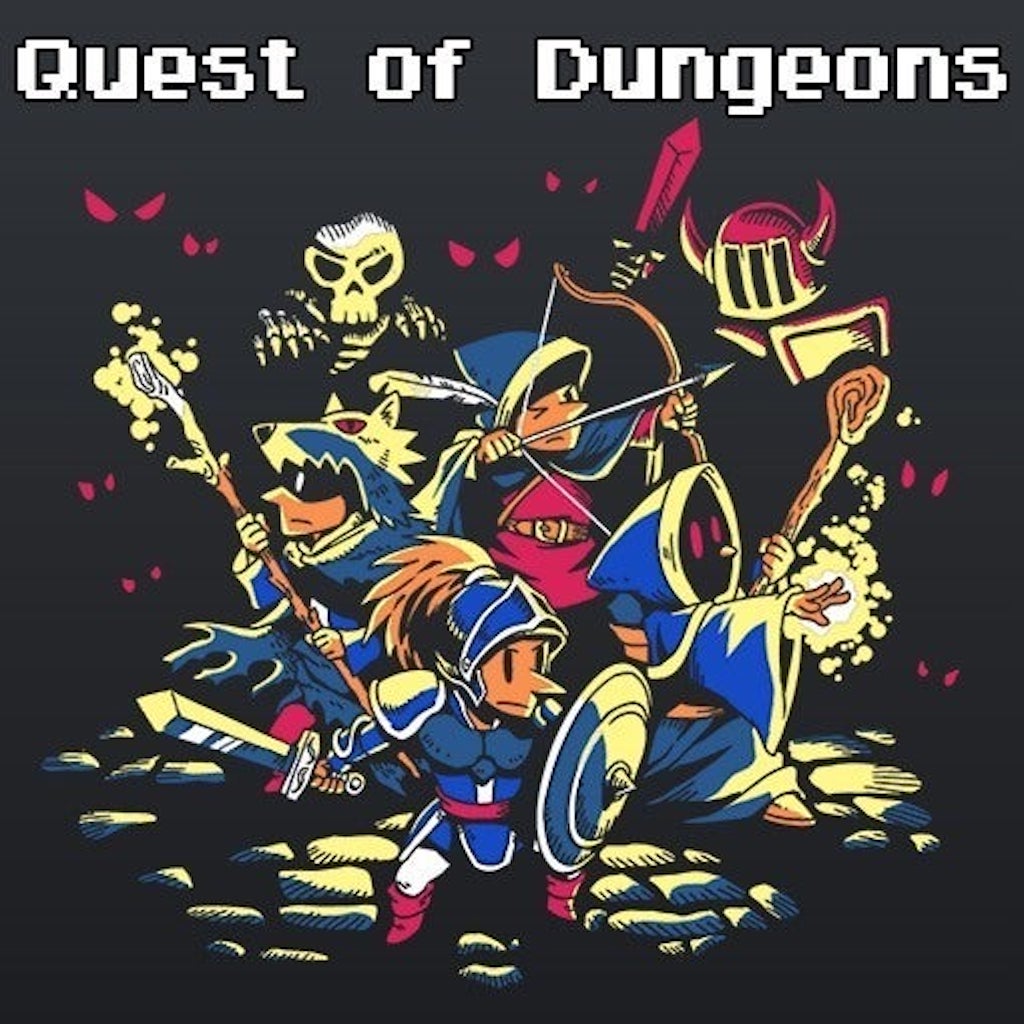
Quest of Dungeons offers four playable classes. While they are based on familiar fantasy archetypes, each provides a distinct way to approach the dungeon. The Warrior is the obvious choice for anyone who enjoys getting up close and personal, absorbing punishment while delivering plenty in return. The Wizard takes a more fragile approach, using magic and ranged attacks to keep enemies at a distance, while the Assassin relies on agility and devastating attacks to punish vulnerable targets.
Then there is the Shaman, who offers another interesting alternative with a mix of abilities that reward a slightly more flexible approach. None of these classes feels needlessly complicated, and that accessibility is important because the real challenge comes from understanding how your chosen character works within the unpredictable dungeon rather than wrestling with an overstuffed character sheet.
Finding new equipment and abilities gradually changes how your character feels. Weapons can transform an otherwise ordinary encounter into something manageable, while learning a useful skill from a Tome can completely change your priorities during a run. You are constantly weighing what you have against what you might find next, and that is where the game’s addictive quality really starts to emerge.
Every Turn Matters
The combat system is perhaps the most important part of Quest of Dungeons, and it works beautifully because of its simplicity. Movement and combat are turn-based, so enemies react to your actions rather than everything happening simultaneously. That gives you time to think, but it does not make the game easy. In fact, knowing that an enemy will move after you do makes every step a potential commitment.
There is a lovely tension in approaching an enemy when you are already running low on health. Perhaps you can defeat it in one or two attacks, but perhaps there is another creature around the corner that you have not spotted yet. Maybe using an ability now will save you health, but leave you without it when something stronger appears later. These little decisions are where the game feels most rewarding.
It is also refreshing that the game does not bombard you with tutorials explaining every possible system. You learn through playing, making mistakes and gradually understanding the rules. Death becomes part of that education, although it can still sting when a promising run collapses because you became slightly too confident.
Death Is Only the Beginning
Permadeath is central to the experience, and there is no escaping the consequences of a disastrous expedition. Once your character dies, that run is over. You do not simply reload a checkpoint and carry on from five minutes earlier. You begin again, choosing your class and heading back into a freshly generated dungeon.
That sounds punishing, but Quest of Dungeons handles failure in a way that makes starting again surprisingly appealing. Because the world, enemies and loot are procedurally generated, a new run does not feel like simply repeating the same journey. You are given another opportunity to experiment, another chance to try a different class, and another excuse to tell yourself that this time you absolutely will not make the same mistake.
The four difficulty settings also provide a useful sense of progression for players who want to push themselves further. Once the basic adventure begins to feel familiar, increasing the difficulty can turn even routine encounters into serious tactical problems. For players who really want to test their skills, the newer Mansion Abyss mode offers another challenge beyond the standard adventure, providing a particularly welcome reason for experienced dungeon crawlers to return.
A Dungeon That Never Quite Feels the Same
Procedural generation is not always enough to make a roguelike compelling, but Quest of Dungeons gets plenty of mileage from it. Enemy positions, equipment and dungeon layouts constantly shift, so you have to adapt rather than memorise the optimal route. There is always a bit of luck involved, but the game generally gives you enough control to feel that your decisions still matter.
The shops are another nice touch. Finding a merchant when your equipment is starting to look embarrassingly outdated can feel like discovering an oasis in the desert. You can buy useful items, sell unwanted equipment and make difficult decisions about what to carry forward.
Quests and boss encounters add further texture to the adventure without overwhelming the basic formula. The result is a game that feels remarkably focused. It knows that the pleasure of dungeon crawling comes from exploring, fighting, finding things and surviving, and it keeps returning to those fundamentals rather than burying them under layers of unnecessary complexity.
Retro Has Never Looked So Good
Visually, Quest of Dungeons is a lovely little time capsule. The 16-bit-inspired pixel art immediately establishes its personality, with colourful characters, chunky enemies and clean dungeon environments that are easy to read at a glance. There is a pleasing simplicity to the presentation that fits perfectly with the game’s old-school philosophy.
It does not attempt to compete with modern RPGs on graphical spectacle, and thankfully it does not need to. The pixel art gives every character and enemy enough personality to remain memorable, while the uncluttered design lets you focus on the tactical information that actually matters. It also suits handheld play particularly well, where clarity is far more important than visual extravagance.
The soundtrack completes the package nicely. Its retro-inspired compositions reinforce the feeling that you have stumbled across a forgotten dungeon crawler from another era, while the sound effects provide enough impact to make combat and spellcasting feel satisfying. It is not a soundtrack that demands attention, but it does exactly what it needs to do.
Simple, Addictive and Surprisingly Hard to Put Down
The biggest criticism that can be levelled at Quest of Dungeons is also one of its greatest strengths. It is a very traditional roguelike. If you are looking for elaborate character relationships, huge cinematic storylines or a revolutionary approach to the genre, you are unlikely to find them here.
There are moments when that simplicity can make the experience feel a little repetitive, particularly after several runs through the same broad gameplay formula. Yet there is something refreshing about a game that refuses to pad itself out. You can jump in, play for a short while, lose a character spectacularly, and immediately want to have another go.
That last point is probably the best compliment I can give it. A good roguelike makes failure feel like an invitation rather than a punishment, and Quest of Dungeons achieves exactly that. Every death leaves you thinking about what you could have done differently, and before long you are already planning the next expedition.
Verdict
Quest of Dungeons is a wonderfully focused turn-based roguelike that proves you do not need an enormous budget or an endless list of features to create an addictive dungeon crawler. Its combination of procedural environments, four distinctive classes, satisfying loot, meaningful turn-based decisions and brutal permadeath creates a simple formula that remains remarkably effective.
It is perhaps the game’s old-school personality that makes it so appealing. There is no hand-holding and little unnecessary fuss. You enter the dungeon, make your choices, collect your spoils and hope you have enough sense to recognise when it is time to stop pushing your luck. Sometimes you will emerge victorious, while other times a seemingly harmless mistake will send you back to the beginning.
For fans of classic dungeon crawlers and roguelikes, there is plenty here to enjoy. The addition of Mansion Abyss mode on Nintendo Switch 2 is a particularly welcome extra for anyone who has already mastered the original adventure, while the four difficulty levels give the core game plenty of longevity.
Quest of Dungeons may not reinvent the genre, but it does not need to. It takes the fundamentals of old-school dungeon crawling and packages them into an accessible, addictive and wonderfully replayable adventure. It is the video game equivalent of finding an old cartridge in the back of a cupboard, blowing the dust off it and discovering that, somehow, it is still just as much fun as you remembered.