There is something appealing about a game that revisits the traditional dungeon crawler and asks, “What if we made you wait for everything?” At first glance, Horripilant appears to be another dark fantasy adventure filled with monsters, mysterious ruins and a battered hero searching for answers. Spend a little time with it, however, and it becomes clear that this is something considerably stranger. Alexandre Declos, Pas Game Studio and Black Lantern Collective have created a grim little hybrid that blends incremental progression, automated combat, resource management and environmental puzzles into an experience that feels less like conquering a dungeon and more like being slowly swallowed by one.
That distinction is important because Horripilant is not a game about heroic momentum. You are not going to charge through its underworld with a glowing sword, cutting down everything in your path before marching triumphantly towards the next boss. Instead, progress comes in small steps. You chop wood, mine resources, improve your equipment, descend a little further, die, return stronger and try again. It is a deliberately repetitive structure, but there is an oddly hypnotic quality to it, particularly when the gloomy atmosphere starts getting under your skin.
Welcome to the Forgotten Underworld
The opening moments immediately establish that something has gone terribly wrong. You awaken as a battered knight with no memory of how you arrived in this forsaken place, surrounded by darkness and decay. Rather than being greeted by a kindly old wizard who explains your destiny, you are instead urged by an unsettling voice to start hitting a strange sapling and collecting twigs.
It is a wonderfully bizarre introduction because it takes the familiar language of the fantasy RPG and bends it into something far more uncomfortable. You are technically a hero, but you do not feel particularly heroic. You are confused, damaged and seemingly trapped in a place that does not want you there. The further you progress, the more questions arise, and Horripilant wisely refuses to answer them all immediately.
That mystery gives the incremental mechanics a surprisingly effective narrative purpose. Gathering resources is not simply busywork, as it represents your gradual attempt to establish some form of control over a world that is fundamentally hostile. Every upgrade makes the next expedition slightly more manageable, and every new discovery hints at something deeper beneath the surface.
The Joy of Doing Something Horrible Repeatedly
At its heart, Horripilant is an incremental game, and it makes no attempt to hide that. You gather wood, stone and iron, improve your ability to extract them, and eventually allow some of the work to happen automatically. There is a familiar satisfaction in watching numbers rise and resources accumulate, particularly when an upgrade that once seemed painfully expensive suddenly becomes affordable.
What makes the system work is how it feeds into everything else. Resources are not merely numbers that vanish into a meaningless upgrade screen. They help you improve your ability to survive, progress further into the dungeon and strengthen your overall capabilities. The loop gradually becomes a cycle of preparation, exploration, failure and improvement.
There is something almost meditative about it. You can actively participate, striking resource deposits yourself and intervening when opportunities arise, or allow parts of the system to continue working while you concentrate on something else. That flexibility makes Horripilant an easy game to dip into, although players expecting constant action may initially struggle with its deliberately patient pace.
Let the Knight Do the Fighting
Combat takes an interesting approach because much of it happens automatically. Your knight descends into the dungeon and fights monsters without requiring you to manually control every swing of the weapon. Instead, your role becomes one of preparation and intervention, ensuring your character is strong enough to survive and stepping in when the right opportunity arises.
This is where the weak point system becomes particularly important. During encounters, vulnerable areas can appear briefly, allowing you to tap them and inflict additional damage. It is a simple mechanic, but it gives you just enough direct involvement to prevent combat from becoming nothing more than watching health bars slowly disappear.
Boss encounters naturally provide some of the more engaging moments. They demand greater preparation and encourage you to make better use of the systems you have gradually built. When an enemy that previously seemed completely impossible finally falls, there is a genuine sense of achievement, even though much of the groundwork happened incrementally rather than through traditional action gameplay.
The use of meat and beast companions adds another layer to progression. Carrying capacity can be expanded, familiars can be recruited, and your growing collection of improvements gradually turns the battered knight from an almost hopeless survivor into something capable of venturing much deeper.
Death Is Part of the Routine
If you have played roguelikes before, the idea of dying and starting again will be familiar. Horripilant embraces that philosophy, but its approach is particularly well suited to incremental progression. Failure does not necessarily feel like wasted time, because your previous efforts help you grow stronger for the next attempt.
The Hemalith system is central to this. Reincarnation lets you exchange what you have earned during your adventures for permanent improvements, creating that familiar feeling of “just one more run”. You may not have reached the floor you wanted, but perhaps you collected enough resources to boost your damage or increase your efficiency.
That loop is surprisingly addictive. A failed expedition becomes less frustrating when you can immediately see how it contributed to your next attempt. You return to the dungeon better prepared, push a little further, and eventually find yourself repeating the process without even realising how much time has passed.
It is not a revolutionary approach to progression, but Horripilant understands why these systems work. The constant drip of improvement gives even small victories meaning, and the darkness surrounding the adventure makes every improvement feel like another tiny candle being lit.
There Is More Than Fighting Below
The campsite is another important part of the experience, helping prevent Horripilant from becoming nothing more than an automated dungeon crawler. It serves as your home between expeditions, but it is also filled with strange objects and environmental puzzles that gradually reveal more of the game’s secrets.
These puzzles are particularly welcome because they require you to step away from numbers for a while. Instead of wondering whether your damage is high enough, you are looking at objects, experimenting with items and trying to understand how the environment fits together. This gives the player a reason to pay attention to the world rather than treating it purely as a backdrop for resource collection.
There is also something pleasing about how the campsite evolves. What initially feels like a miserable little corner of an abandoned world slowly becomes a functional base. You are not exactly building a cheerful community, but you are creating somewhere that increasingly feels like your own.
The mysteries found there also help reinforce the game’s strange storytelling. Horripilant is at its best when it allows you to discover something rather than simply explaining it. There is a sense that the world existed long before your knight arrived, and that you are only gradually scratching away at its surface.
Darkness Has Never Been So Quiet
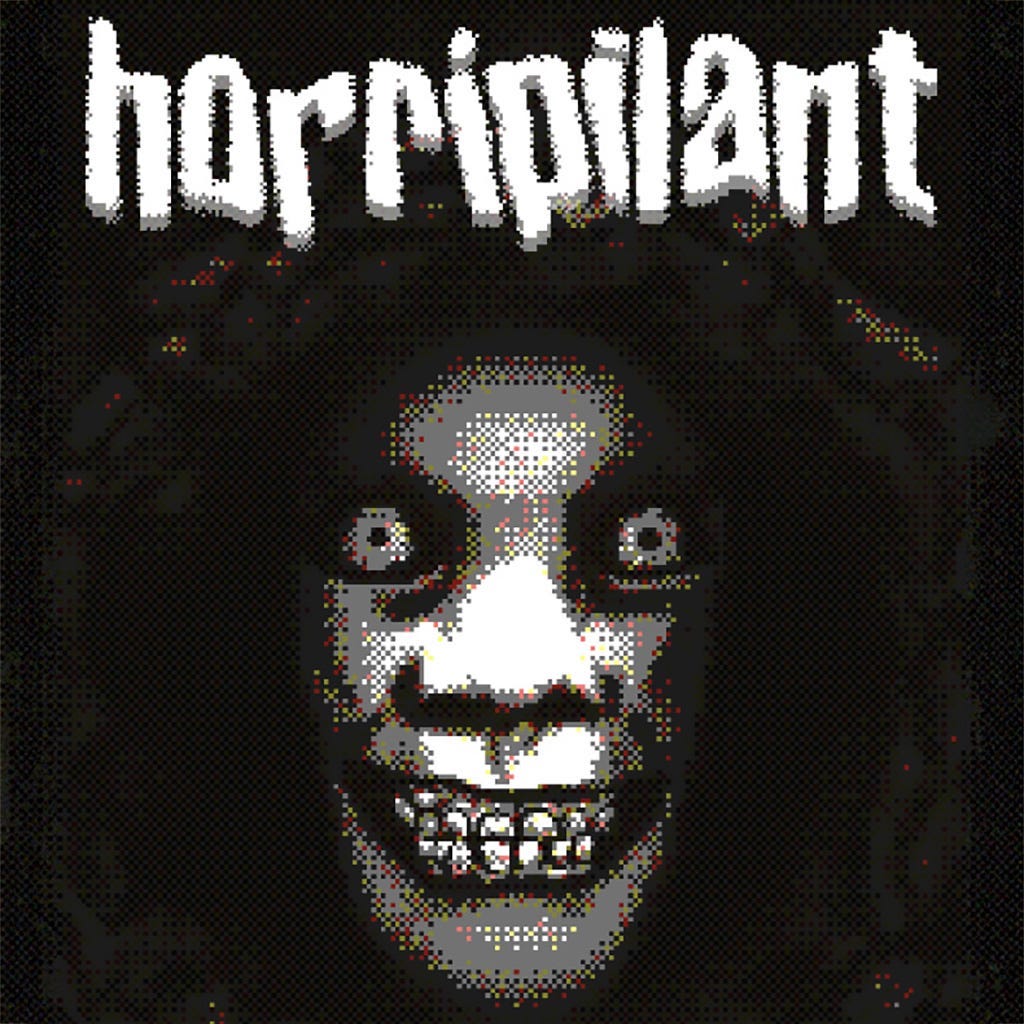
Visually, Horripilant embraces a grim pixel-art aesthetic that perfectly complements its subject matter. Everything feels worn down, dirty and forgotten. The environments are filled with gothic structures, strange creatures and an almost oppressive darkness, creating a world that feels appropriately miserable without relying on constant jump scares.
The enemy designs are particularly effective. They are grotesque without becoming cartoonishly excessive, and the limited animation style makes some of them even more unsettling. There is something about seeing a strange creature shuffle towards your knight down a dark corridor that works precisely because the game leaves some details to your imagination.
The sound design is arguably even more successful. Rather than filling every moment with an orchestral soundtrack, Horripilant often allows the environment to breathe. The sound of a tool striking wood, metal being mined, or an unseen monster growling in the distance becomes far more noticeable because there is so little else competing for your attention.
Silence can be incredibly powerful in horror, and the developers understand that. There are moments when the absence of music makes the underworld feel genuinely lonely. You are not being told that something is frightening. You are simply left alone with the sound of your own actions and whatever might be lurking beyond the next room.
Patience Is a Virtue
The biggest challenge for Horripilant is also built into its DNA. Incremental games live and die by pacing, and there will inevitably be moments when progress feels painfully slow. Waiting for resources to accumulate or returning to familiar tasks will not appeal to everyone, particularly players accustomed to constant progression and immediate rewards.
Console players may also find the structure less naturally suited to their usual gaming habits than PC players, who can leave an incremental title running in the background. That does not make the game unsuitable for consoles, but it does mean you need to approach it with the right expectations. Horripilant wants you to settle into its rhythm rather than rush through it.
Once you accept that, however, its charms become much easier to appreciate. The game is not trying to make every minute exciting. Instead, it creates a long-term progression loop in which small improvements gradually become meaningful. It is closer to tending a particularly unpleasant garden than to embarking on a traditional fantasy adventure. And somehow, that works.
Verdict
Horripilant is a fascinating little experiment that successfully blends several genres that do not immediately seem natural companions. Incremental resource gathering, automated dungeon combat, roguelike progression and environmental puzzles could easily have produced a confused mess, yet the pieces generally fit together surprisingly well.
Its greatest strength is atmosphere. The bleak pixel art, sparse audio and miserable little underworld create a setting that feels genuinely different from the colourful fantasy worlds that populate so many RPGs. There is no sense that you are destined for greatness here. You are simply another damaged soul trying to survive somewhere that has forgotten what sunlight looks like.
The incremental structure will inevitably divide opinion, and the slow pace means Horripilant will not be for everyone. Those looking for fast action should probably look elsewhere, but if you enjoy watching a character gradually become stronger while uncovering strange secrets and solving the occasional cryptic puzzle, there is plenty to like.
Most importantly, it has personality. Horripilant could easily have been another generic idle dungeon crawler with some dark artwork pasted over the top. Instead, it has created an unsettling little world that makes chopping wood, mining rocks and repeatedly getting beaten to death by monsters feel strangely compelling. It is grim, peculiar, patient and occasionally downright miserable. I rather liked it.