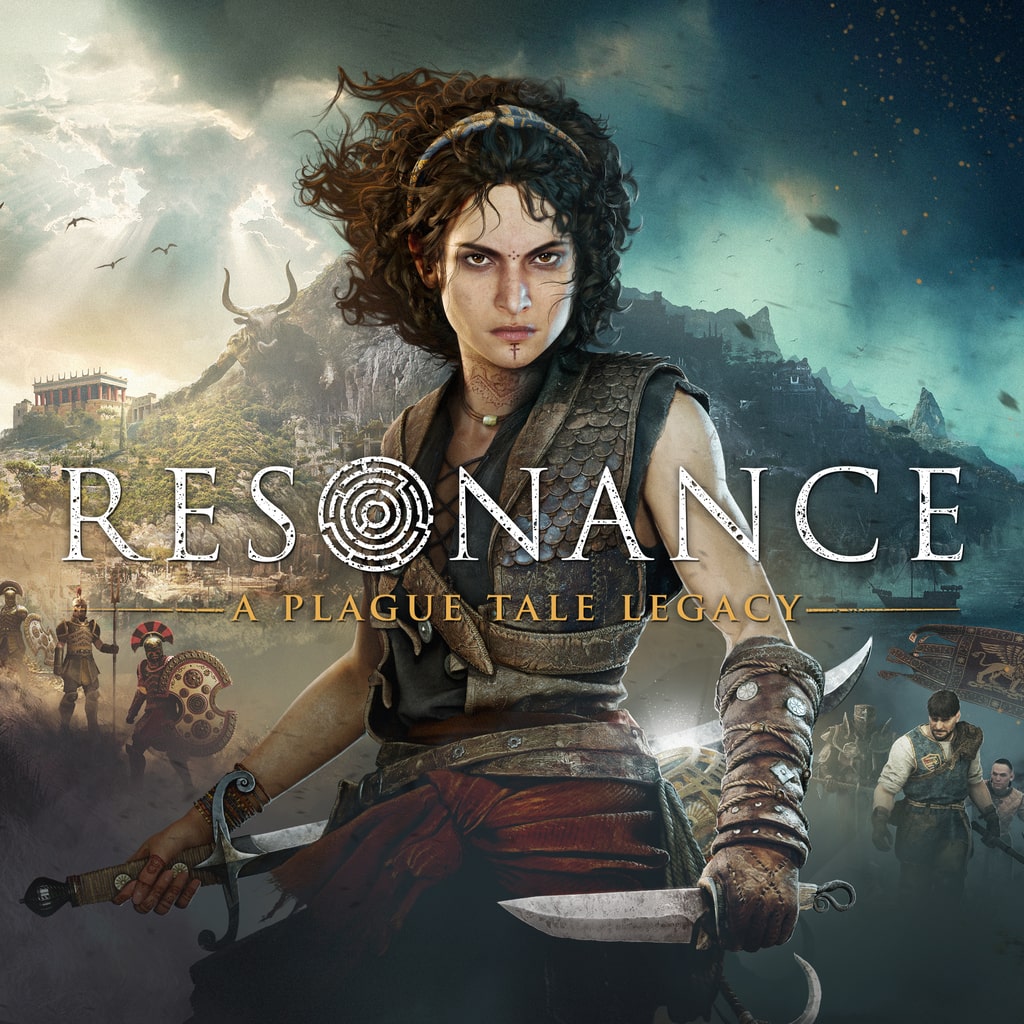
There is a certain melancholy that has always followed A Plague Tale. Even at its most beautiful, the series often harbours something lurking just beneath the surface, ready to turn a moment of wonder into something deeply unsettling. Resonance: A Plague Tale Legacy understands that feeling, but rather than simply recreating the adventures of Amicia and Hugo, Asobo Studio has taken the surprisingly brave decision to look elsewhere in its universe. The result is a prequel that feels familiar in all the right places while giving the series a considerably different flavour.
Set 15 years before the events of A Plague Tale: Requiem, Resonance puts us in the boots of Sophia, a fierce young plunderer whose life has been shaped by survival, secrets and a determination to discover where she truly belongs. Her search leads her towards the mysterious Minotaur Island, a place steeped in ancient mythology and surrounded by stories of those who ventured into its depths and never returned. What begins as a hunt for treasure soon becomes something far more personal, as Sophia finds herself caught between the history of an ancient civilisation and the mysterious legacy of the Macula.
It is an ambitious direction for the franchise, and thankfully, it largely works.
A New Hero for a Familiar World
Sophia is immediately distinct from Amicia, and that is perhaps the most important thing Resonance gets right. She isn’t another variation on the same vulnerable protagonist, nor does she spend the entire adventure trying to avoid confrontation. Sophia is a plunderer, accustomed to taking risks, getting her hands dirty and thinking quickly when things go wrong. That personality gives the adventure a different energy from the previous games and allows Asobo to introduce a combat system that would have felt completely out of place for Amicia.
Her journey to Minotaur Island is initially motivated by the promise of treasure and the possibility of uncovering secrets about her own past. Naturally, things don’t remain quite so straightforward. Sophia soon finds herself pursued by soldiers and other treasure hunters, while the island itself presents dangers that are considerably more frightening than any human enemy. Something else is watching her from the shadows, and the further she ventures into the island, the harder it becomes to distinguish ancient myth from horrifying reality.
That sense of discovery is one of the game’s greatest strengths. You are constantly encouraged to look beyond what is immediately in front of you, whether that means investigating ruins, studying clues in Sophia’s notebook or piecing together fragments of a history that stretches back centuries. The narrative doesn’t simply use its ancient setting as decoration either. The Minoan influence becomes an important part of the mystery, creating a fascinating bridge between the distant past and the medieval world Sophia inhabits.
Swords Instead of Slingshots
The biggest change, naturally, is the combat. Anyone coming directly from A Plague Tale: Innocence or Requiem might initially find it strange to be encouraged to stand your ground rather than desperately searching for somewhere to hide. Sophia carries a sword and knows how to use it. Parries, dodges, counters and powerful strikes give encounters a much more physical feel, turning battles into tense tests of timing rather than exercises in carefully avoiding detection.
This change could easily have destroyed the identity of A Plague Tale, but surprisingly, it gives Resonance a personality of its own. Combat isn’t simply about hammering the attack button until everyone around you falls over. Enemies need to be read, attacks anticipated and openings exploited. A well-timed parry can turn a dangerous confrontation into a satisfying counterattack, and there is a real sense of achievement when you begin to understand the rhythm of the combat.
Sophia also gains new abilities as the adventure progresses, allowing her combat options to expand naturally. The grappling hook is particularly useful, both as a traversal tool and as a means of manipulating enemies during encounters. Being able to pull an opponent out of position or use the environment against them adds another layer of tactical thinking, particularly when several enemies are surrounding you.
It isn’t quite as deep as the best dedicated action games, but that isn’t necessarily a criticism. Resonance isn’t trying to become Devil May Cry. Its combat exists to support the adventure, and it does that extremely well. More importantly, it gives Sophia an identity that feels completely separate from the protagonists who came before her.
An Island Full of Secrets
Exploration is another area where Resonance truly comes alive. Minotaur Island is a wonderfully atmospheric setting, blending Mediterranean landscapes with crumbling structures, underground passages and ancient Minoan architecture. There is something genuinely exciting about stepping into an abandoned ruin and wondering what might be waiting around the next corner.
The environments also offer plenty of opportunities for environmental puzzles. One of the most intriguing additions is the mysterious Minoan sphere and its ability to manipulate light. Players are required to redirect beams, activate ancient mechanisms and work out how seemingly unrelated pieces of machinery fit together. These puzzles provide a welcome change of pace between combat encounters and reinforce the idea that the island was once home to a civilisation capable of extraordinary things.
I particularly like the way the game uses Sophia’s notebook as part of this exploration. It gives the protagonist a practical connection to the mystery while providing information that helps make sense of what is encountered. Rather than simply following glowing objectives from one location to the next, there is a pleasant sense that you are actually investigating somewhere ancient and unfamiliar.
The Thing in the Shadows
If there is one element of Resonance that captures the unsettling spirit of the original games, it is the creature stalking Sophia across the island. This isn’t an enemy that simply waits for you to enter an arena before politely announcing that combat has begun. It feels like a presence.
You can sense you are being watched, which creates a different kind of tension from the sword fights. There are moments when pushing forward is clearly the only option, yet every instinct tells you to stop and think. The creature seems to anticipate your movements, turning exploration into a dangerous game of cat and mouse.
This is where the game reconnects most strongly with the horror elements of A Plague Tale. Even without relying on the enormous rat swarms that defined Amicia and Hugo’s adventures, Asobo manages to create a persistent sense of vulnerability. You may be carrying a sword, but that doesn’t mean you are safe.
A Beautifully Uncomfortable World
Visually, Resonance: A Plague Tale Legacy is a gorgeous game. The Mediterranean setting allows Asobo to move away from the muddy medieval villages and bleak countryside that dominated much of the previous games. Sunlight spills across ancient stonework, waves crash against rocky coastlines, and distant landscapes stretch towards the horizon.
That beauty creates an interesting contrast with the darker material beneath it. The island can look almost idyllic from a distance, but the closer you get, the more unsettling its secrets become. Ancient temples, forgotten passageways, and underground chambers gradually reveal the darker side of the location.
The sound design is equally important. The soundtrack adds a suitably mysterious and melancholy atmosphere, while the clash of swords and movement through the environment give combat a pleasing physical quality. The combination creates an adventure that can shift from peaceful exploration to outright terror remarkably quickly.
A Worthy New Chapter
Perhaps the most impressive thing about Resonance: A Plague Tale Legacy is that it doesn’t feel like an unnecessary spin-off. There was always a risk that moving away from Amicia and Hugo would make the game feel disconnected from what made the series special. Instead, Asobo Studio has used the opportunity to explore another corner of its world and, in doing so, has created something that feels surprisingly confident.
The opening can take a little while to find its rhythm, and anyone expecting the rat-filled survival horror of the previous games may initially wonder where the familiar identity has gone. But once Sophia reaches the heart of the island, the adventure starts to find its own voice. The blend of swordplay, ancient mythology, exploration and psychological tension works far better than it has any right to.
Most importantly, Sophia is an engaging protagonist. Her determination, curiosity and willingness to throw herself into danger make her easy to root for, while the mysteries surrounding her past provide enough emotional weight to keep the story moving beyond its spectacle.
Verdict
Resonance: A Plague Tale Legacy could have been little more than a side story designed to keep the franchise alive. Instead, Asobo Studio has used the opportunity to expand the mythology and introduce a protagonist who feels entirely her own. Sophia’s sword replaces Amicia’s sling, ancient Minoan mysteries replace the more familiar medieval landscapes, and a terrifying presence replaces the relentless tide of rats. Yet the emotional atmosphere that defines A Plague Tale remains firmly intact.
The combat is satisfying, the exploration rewarding, and Minotaur Island an excellent setting for a story about myth, memory and destiny. There are moments when the pacing feels a little slower than it should, and fans who fell in love with Amicia and Hugo may need time to adjust to such a dramatic change in direction. Nevertheless, once the pieces begin to come together, Resonance becomes an engrossing adventure that stands comfortably alongside the games that inspired it.
It is a different kind of A Plague Tale, but perhaps that is exactly what the series needed. Rather than looking backwards, Resonance: A Plague Tale Legacy takes the franchise somewhere new while remembering what made its predecessors so memorable. Beautiful, unsettling and surprisingly brutal, Sophia’s journey across Minotaur Island is a compelling reminder that there are still plenty of dark corners of this universe waiting to be explored.