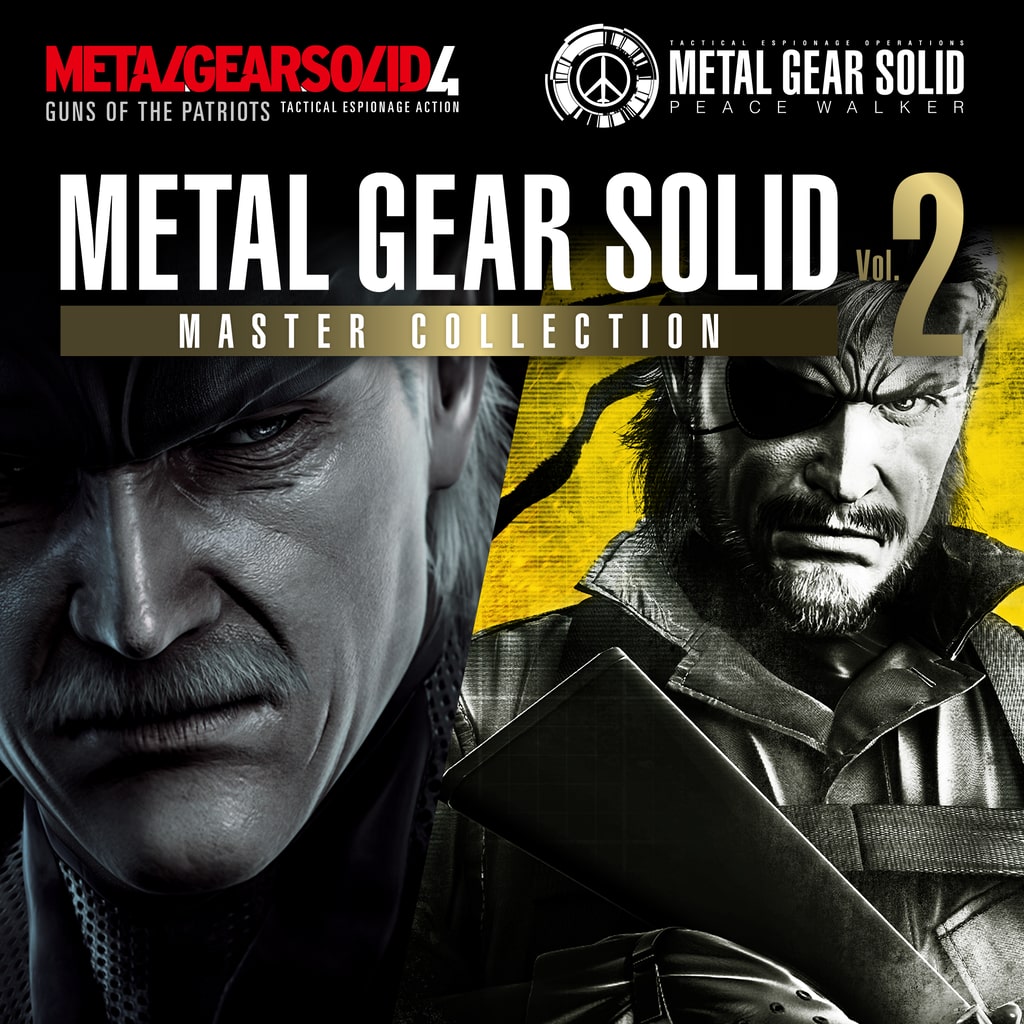
Some games become prisoners of their own hardware. They can be enormously important and hugely influential, yet remain frustratingly difficult to revisit because the machines they were created for have long since disappeared from living rooms. For years, Metal Gear Solid 4: Guns of the Patriots sat firmly in that category. It was one of the defining games of the PlayStation 3 era, yet actually playing it on modern hardware was an increasingly awkward proposition. Metal Gear Solid: Master Collection Vol. 2 finally opens that locked door, and that alone makes this collection feel rather special.
Konami’s second collection brings together Metal Gear Solid 4: Guns of the Patriots, Metal Gear Solid: Peace Walker and Metal Gear: Ghost Babel, creating a fascinating snapshot of the series as it moved from cinematic stealth adventure towards something much broader. These are very different games, both in structure and ambition, yet they share the same strange DNA. They are games about infiltration, identity, war and technology, yet they are equally comfortable being absurd, melodramatic, funny and occasionally gloriously ridiculous.
For anyone who grew up with the series, there is an undeniable sense of history here. For newcomers, however, this is more than an opportunity to tick three games off a list. It is a chance to experience some of the most interesting experiments the Metal Gear series ever produced, with Metal Gear Solid 4 finally getting the modern platform release it has deserved for years.
Returning to the Battlefield
Metal Gear Solid 4: Guns of the Patriots remains the obvious centrepiece. Set in a future where warfare is heavily controlled by technology and private military companies, the game returns players to the role of Solid Snake for what is essentially his final mission. Snake is older, tired and visibly deteriorating, yet he remains one of gaming’s most recognisable protagonists.
What makes revisiting MGS4 so interesting is how much it tries to accomplish. It wants to be a stealth game, an action game, a political thriller, a character drama and an interactive celebration of everything that came before it. At times, it succeeds brilliantly. At other moments, it feels as if the game is desperately trying to cram an entire lifetime of Metal Gear history into one enormous suitcase.
Yet that excess is part of its personality. Few games are as completely comfortable with their own mythology. Characters appear, disappear and reappear, bringing revelations that would seem utterly bonkers in almost any other franchise. Here, somehow, it feels like part of the furniture.
Stealth Still Feels Like Stealth
The core stealth mechanics have aged surprisingly well. Sneaking through hostile territory, watching patrol routes and deciding whether to slip past an enemy or take them down remain satisfying because the game gives you plenty of options.
The OctoCamo system is particularly memorable. Snake’s suit automatically adapts to match his surroundings, allowing him to blend into walls, floors and environmental surfaces. It is an ingenious continuation of the camouflage ideas established in previous games, and it still feels wonderfully tactile.
There is also a fascinating shift in MGS4, as the battlefield itself can become unpredictable. Rather than simply infiltrating enemy bases, Snake often finds himself operating within active warzones where opposing factions are already fighting each other. This creates opportunities that simply did not exist in the more controlled environments of earlier entries.
You can sneak around the edges, exploit the chaos, or become a more direct participant in the fighting. The choice is often yours, and that flexibility remains one of the game’s strongest qualities.
An Old Soldier’s Final Chapter
What gives Guns of the Patriots its emotional weight is Snake himself. This isn’t the confident, physically capable operative we remember from earlier adventures. Time has caught up with him, and the game isn’t subtle about reminding you.
His physical deterioration becomes part of the experience rather than merely background storytelling. There is a melancholy running through the campaign that occasionally catches you off guard, especially when familiar characters and locations return. For long-term fans, those moments can carry considerably more weight than the spectacular action sequences.
The game is also packed with cutscenes, sometimes to a frankly extraordinary degree. Whether that is a positive or negative will depend entirely on your tolerance for Kojima’s particular brand of storytelling. Personally, I think the sheer audacity of it remains part of the charm. Metal Gear Solid 4 doesn’t merely tell you its story. It wants to tell you everything.
Peace Walker Finds Its Feet
If MGS4 represents the enormous cinematic side of Metal Gear, Peace Walker is almost its opposite. Originally created with the PSP in mind, it embraces shorter missions and a more modular structure, making it much easier to dip into for a quick operation.
Don’t mistake that smaller scale for a lack of ambition, though. Peace Walker introduces some of the series’ most influential ideas, particularly around Mother Base and the recruitment of soldiers. Successfully completing missions allows you to expand your organisation, develop new equipment and build an increasingly capable private military force.
There is a wonderful feedback loop here. You complete a mission, recruit personnel, develop equipment, and then return to the battlefield with better tools. It makes Peace Walker feel almost like a tactical RPG hiding inside a stealth game.
The co-operative elements are another welcome inclusion, with support for multiplayer allowing players to tackle certain missions together. Even when played alone, though, the underlying structure remains compelling. This is Metal Gear, stripped down into smaller, more manageable pieces without losing the series’ eccentric personality.
Ghost Babel Is the Surprise
Then there is Metal Gear: Ghost Babel, perhaps the most intriguing inclusion for anyone who enjoys delving into gaming history.
Originally released for the Game Boy Color, Ghost Babel takes the franchise back to its top-down roots. It is considerably more compact than its console cousins, yet it captures the franchise’s core appeal. Avoid detection, study enemy movements, use the environment, and think before you act.
Its inclusion gives the collection a valuable historical perspective. You can see how the franchise’s stealth philosophy translated to completely different hardware, and it is surprisingly impressive how much of the classic formula survived the transition.
It may not have the spectacle of MGS4 or the progression systems of Peace Walker, but there is something charming about its simplicity. It feels like discovering an overlooked branch of the Metal Gear family tree that deserves far more attention than it traditionally receives.
Preservation Matters
One of the strongest aspects of Master Collection Vol. 2 is the additional archival material. Screenplay Books and Master Books offer useful companion material for players who want to delve deeper into the stories, characters and mythology.
The inclusion of the Metal Gear Solid 4 Database is particularly valuable, given how convoluted the wider timeline can become. Even veteran players can benefit from a reminder of exactly who betrayed whom, which organisation secretly controlled which, and why somebody who apparently died several games ago is suddenly standing in front of Snake again.
The digital soundtrack is another lovely touch. Metal Gear has always benefited enormously from its music, and being able to revisit those themes away from the main game is a fitting addition to a collection that is ultimately about preserving the franchise’s legacy.
A Collection With Real Historical Weight
Visually, MGS4 remains an impressive game for its age. The character models, environments and cinematic direction still possess a level of polish that many contemporary games would struggle to match. Some elements inevitably show their age, but there is a deliberate artistic identity here that modern resolution cannot erase.
Peace Walker naturally looks more modest, while Ghost Babel embraces its original portable presentation. Rather than feeling like an awkward mismatch, that contrast actually works in the collection’s favour. These games demonstrate how the same creative ideas evolved across generations and under vastly different technical constraints.
The sound design remains equally strong. Gunfire, radio conversations, environmental effects and the iconic musical themes all contribute to the distinctive Metal Gear atmosphere. There is something immediately recognisable about hearing that familiar codec chatter or one of the series’ musical motifs begin to play.
The Verdict
Metal Gear Solid: Master Collection Vol. 2 is an important collection because it finally makes Metal Gear Solid 4 accessible on modern hardware while framing it with two fascinating pieces of the franchise’s history. MGS4 remains excessive, dramatic and occasionally ridiculous, but beneath all of that lies a remarkably accomplished stealth game with genuine emotional resonance. Peace Walker offers a different experience altogether, with an addictive mission structure and the brilliantly conceived Mother Base progression system, while Ghost Babel serves as a delightful reminder of how adaptable the series has always been.
It isn’t a perfect package. The collection’s presentation could have been more cohesive, and players hoping for a huge treasure trove of new material may find the archival offering somewhat restrained. There are also elements of these older games that inevitably feel dated, particularly when compared with modern stealth titles.
But preservation isn’t about making history disappear beneath layers of modern design. Sometimes it is about giving important games a place where they can still be played, appreciated and discussed. Master Collection Vol. 2 does exactly that, and finally being able to experience Metal Gear Solid 4 without dragging a PlayStation 3 out of storage feels like a small victory in itself.
Metal Gear Solid: Master Collection Vol. 2 is a lovingly assembled return to one of gaming’s most distinctive franchises. With Snake’s final chapter finally escaping its PS3 prison, the collection brings together the brilliantly structured Peace Walker and the wonderfully unexpected Ghost Babel. It is packed with history, personality and genuinely memorable stealth action. It may occasionally remind you that these games belong to another era, but that is precisely why they are worth preserving. The cardboard boxes, codec calls and cardboard cut-outs are still waiting, and somehow, after all these years, sneaking through the shadows still feels rather wonderful.