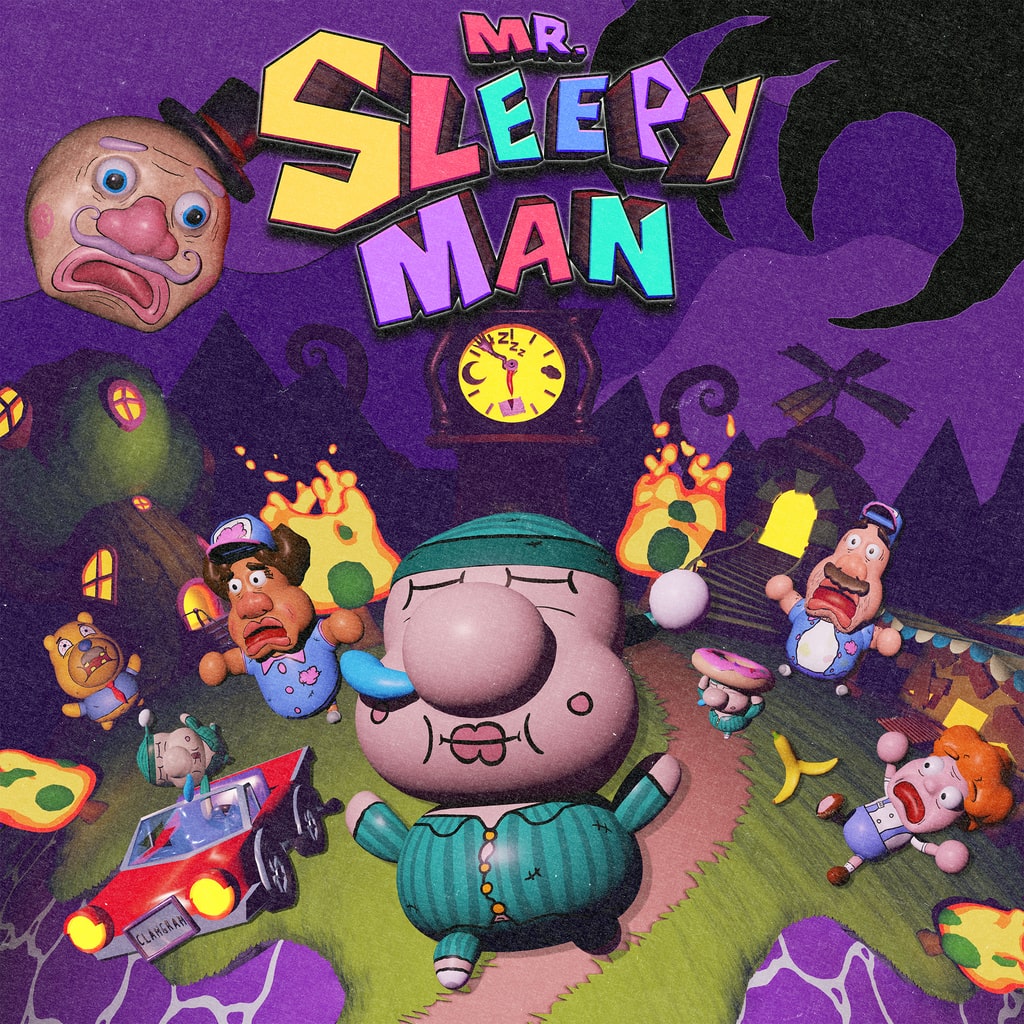
There are plenty of games about saving the world, rescuing princesses, defeating ancient evils and generally behaving like the sort of person society would be proud to have around. Mr. Sleepy Man is not one of them. Here, the great mission is to stay awake long past bedtime and cause such an extraordinary amount of trouble that the residents of Bedtime Town eventually wish you had simply gone to bed.
It is a wonderfully silly premise, but beneath all the absurdity lies a surprisingly accomplished 3D platformer that clearly understands why games from the late 1990s and early 2000s were so much fun. Developed over six years by solo creator Devin Santi, Mr. Sleepy Man combines fluid movement, an interconnected world, interactive environments, eccentric characters and a frankly ridiculous number of objectives into one wonderfully strange adventure. It feels like the sort of game that could only have been made by someone who genuinely loves the genre, rather than someone trying to recreate it from a checklist.
Staying Awake Is A Bad Idea
Mr. Sleepy Man is, as you might have guessed, extremely tired. Unfortunately for the residents of Bedtime Town, tiredness does not make him particularly sensible. Instead, it seems to turn him into a walking agent of chaos, and almost everything in the environment becomes an opportunity to make somebody’s day considerably worse.
The great thing is that the game never seems too concerned with telling you exactly how to cause that trouble. Objects can be picked up, thrown around and experimented with, while the environment itself often provides the tools required to complete an objective. This creates a lovely sense of freedom because you are not simply following a carefully marked route from one objective to the next. You are poking around, trying things and occasionally discovering that something completely ridiculous actually works.
That spirit of experimentation is essential to the game’s charm. Mr. Sleepy Man wants you to mess about. It wants you to wonder what happens if you pick something up, throw it somewhere it clearly does not belong and then wait to see who notices. Sometimes the answer is hilarious, sometimes it opens up a new objective and sometimes it simply makes the situation considerably worse.
Movement That Feels Fantastic
For all the comedy and chaos, the movement is arguably the game’s biggest achievement. Mr. Sleepy Man has an impressively expressive 3D platforming moveset that lets you jump, glide, dive and generally throw yourself around Bedtime Town with a surprising degree of control. There is a real sense of momentum behind the character, and once you get comfortable with the movement, simply travelling around the world becomes enjoyable in its own right.
That is particularly important in a game built around exploration. If movement feels clumsy, searching for hundreds of objectives quickly becomes a chore. Here, it feels more like an invitation to experiment. You can approach spaces from different angles, reach places that initially look inaccessible and use your momentum to uncover little secrets tucked away in the environment.
There are definite echoes of classic 3D platformers in how it all works, but Mr. Sleepy Man never feels like a simple imitation. The movement has its own personality, and the combination of fluid traversal and interactive environments makes getting from one ridiculous situation to another surprisingly satisfying.
The Town Is Your Playground
Bedtime Town is where the chaos really comes alive. Rather than a collection of isolated stages, the game offers an interconnected world filled with characters, objects, secrets and strange little challenges. The more you explore, the more you realise there is something tucked away in practically every corner.
This is where the game’s collectathon heritage becomes particularly obvious. There are more than 300 objectives and collectibles to discover, though the exact number varies depending on how they are counted. Either way, there is an enormous amount of stuff to find, and many objectives are deliberately hidden behind environmental experimentation rather than simply placed in obvious locations.
That approach makes exploration feel rewarding. You might wander into an apparently insignificant area and discover an object to manipulate, a character with an unusual request, or an entirely unexpected route to somewhere else. The game rarely gives you the feeling that you have completely seen everything, which is exactly what you want from this sort of adventure.
Don’t Annoy The Locals
One of the game’s cleverest ideas is its approach to NPC behaviour. The residents of Bedtime Town are not merely decorative characters standing around, waiting for you to press a button to hear a line of dialogue. They have their own personalities, and, more importantly, they remember how you treat them.
If you behave yourself, people may be friendly. If you spend your time causing trouble, stealing things, throwing objects around, and generally behaving like an absolute menace, their attitude towards you can change. Suddenly those friendly faces are not quite so welcoming, and the town begins to feel as if it has collectively decided that Mr. Sleepy Man is the problem.
It gives your actions a welcome sense of consequence. You are not simply completing objectives in a vacuum. The people around you react to what you do, and because different characters have their own logic and personalities, their responses do not always feel interchangeable. It is a small detail that adds a surprising amount of life to the world.
Chaos Is The Point
The environmental interactions are where Mr. Sleepy Man earns its title as a chaos simulator. Almost everything feels placed in the world for a reason, even if that reason is simply to give you something else to pick up and throw. The ability to manipulate objects transforms ordinary environments into little playgrounds where you can experiment with cause and effect.
Sometimes the solution to an objective is obvious, but the game is at its best when you stumble across something completely unexpected. Perhaps an object can be moved somewhere you had not considered, or an environmental interaction triggers an event you were never specifically looking for. These moments give the game a lovely sense of unpredictability.
It also helps that the humour does not constantly scream for attention. Much of it comes naturally from the situations you create. Watching an otherwise normal resident react to whatever ridiculous thing you have just done can be funnier than a scripted joke because you caused it yourself.
The Sleep Button
Then there is perhaps the most wonderfully bizarre feature of the entire game: the ability to go to sleep whenever you want. You would think that being able to put Mr. Sleepy Man to bed would simply be a joke, but it becomes another part of the game’s strange dream logic.
Switching between states can alter the world and reveal different possibilities, giving the sleep mechanic a purpose beyond the obvious gag. It fits perfectly with the game’s surreal tone because you are never quite sure whether you are dealing with something that genuinely happened or simply another bizarre dream.
The result is a world where reality feels deliberately unreliable. One moment you are wandering through a sleepy little town, and the next you are dealing with something that makes absolutely no sense yet somehow feels completely appropriate. It is the kind of nonsense that works because the game commits to it wholeheartedly.
A World Made For Wandering
Visually, Mr. Sleepy Man adopts a low-poly aesthetic that immediately evokes the classic 3D platformers of the N64 and early PlayStation 2 era. Chunky character models, simple textures and slightly muted environments lend Bedtime Town a strangely nostalgic look, while deliberately odd character designs deepen its dreamlike atmosphere.
It is not trying to compete with modern games on graphical fidelity, and nor should it. The visual style is part of the personality. There is something wonderfully tactile about the slightly rough edges and unusual proportions, particularly when combined with the game’s surreal situations.
The twilight setting also gives the game an atmosphere that feels quite different from the brightly coloured worlds normally associated with the genre. Bedtime Town feels sleepy, strange and slightly off, which is exactly what it should feel like.
A Soundtrack With Soul
The soundtrack deserves special attention because it is one of those details that makes the game feel genuinely personal. The entire soundtrack was written and performed by the developer, blending the musical language of classic 3D platformers with early 2000s alternative rock.
That combination sounds unusual on paper, but it works remarkably well. There are moments when the music feels playful and nostalgic, followed by sections where the alternative rock influences lend the game a little more attitude. It helps distinguish Mr. Sleepy Man from the many other retro-inspired platformers currently competing for attention.
More importantly, knowing that the developer created the soundtrack himself adds another layer of personality to the experience. This is not simply a collection of nostalgic references. It feels like someone putting their own musical tastes and memories into the game, which gives the soundtrack considerably more character.
Sometimes Getting Lost Is The Fun
The biggest challenge for some players will be the game’s willingness to let you figure things out for yourself. With so many objectives and so little hand-holding, it is entirely possible to spend a considerable amount of time wandering around, wondering what on earth you are supposed to be doing.
There are moments when a little more direction would certainly have helped. Finding a specific objective can become frustrating when the game gives you only the vaguest hint about what is expected, particularly when you have already explored an area several times. For some players, this will be part of the charm. For others, it could turn the hunt for completion into a test of patience.
Personally, I think it suits the game more often than it hurts it. The whole point of Mr. Sleepy Man is experimentation, and being allowed to explore without a giant objective marker constantly pointing you towards the next task makes the world feel more organic. It just means you need to be comfortable with the possibility of getting completely and utterly lost.
A Proper Indie Collectathon
There is a lovely sense of authenticity running through Mr. Sleepy Man. It feels like a game made because its creator genuinely wanted to make this particular game, rather than because a market analysis decided nostalgic 3D platformers were suddenly fashionable again.
That passion comes through in the movement, the soundtrack, the characters, and especially the sheer amount of interaction packed into Bedtime Town. Six years is an enormous amount of time to spend creating something as ambitious as this, and the result feels like a personal love letter to a very specific kind of game.
It is messy in places, deliberately strange, and occasionally frustrating, but those imperfections are part of its charm. Mr. Sleepy Man has character, and character cannot simply be added with another high-resolution texture or a bigger budget.
Final Verdict
Mr. Sleepy Man is a wonderfully weird, chaotic and surprisingly heartfelt 3D platformer that understands the joy of simply being allowed to mess around in a game world. Its movement is excellent, its interconnected environments are packed with secrets, and its NPCs give Bedtime Town a personality that many much larger games would struggle to replicate.
The sheer number of objectives means there is plenty to discover, although the intentionally vague guidance can occasionally leave you wandering around without a clue what you are looking for. That will not suit everyone, but for players who enjoy classic collectathons and the thrill of discovering things without being spoon-fed every answer, it is part of the appeal.
Most importantly, Mr. Sleepy Man feels like it has a soul. From its bizarre characters and wonderfully stupid situations to its original soundtrack and lovingly crafted movement system, this is clearly a game made with genuine affection for the genre. It takes the nostalgic spirit of classic 3D platformers, throws in a healthy dose of surreal comedy, and then gives you permission to cause as much trouble as possible. And honestly, what more could you ask from a game about a man who really should have gone to bed?