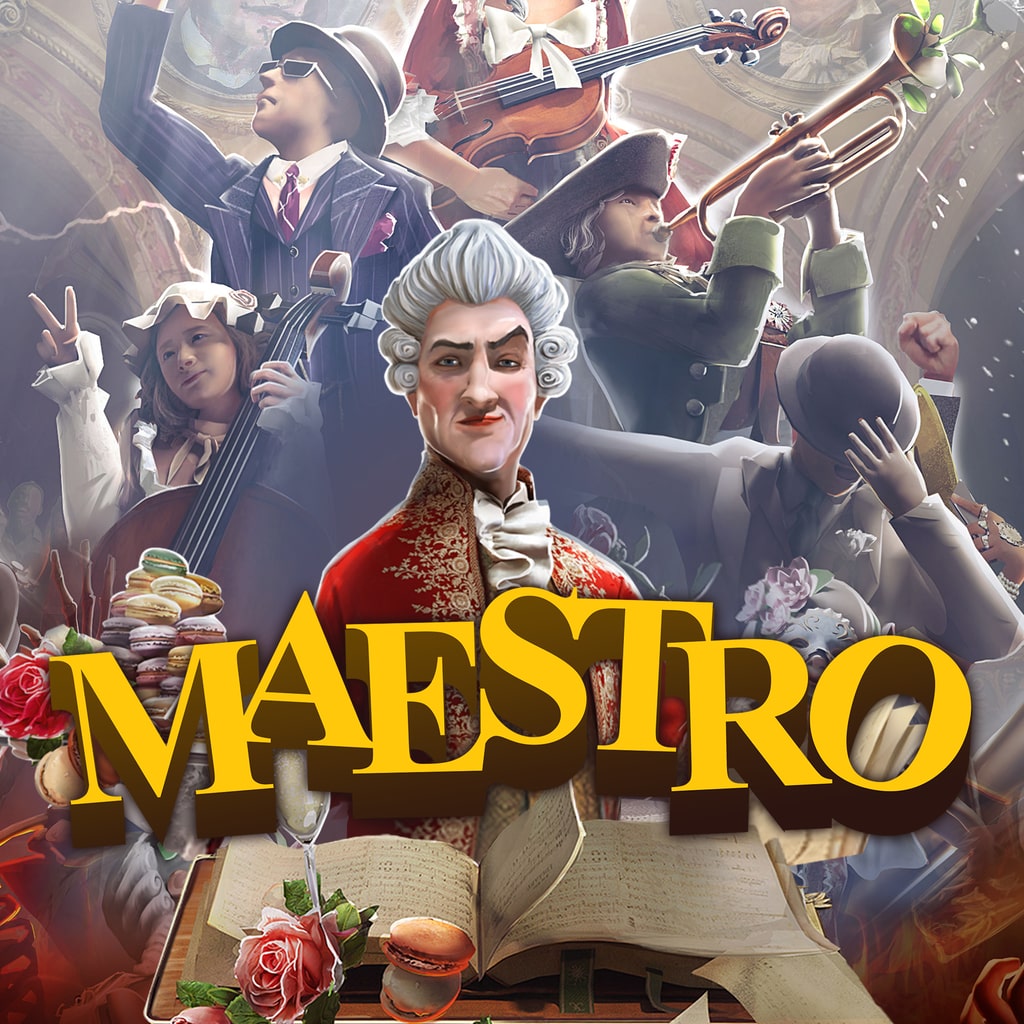
There are rhythm games that ask you to hit buttons, rhythm games that ask you to swing at things, and rhythm games that ask you to follow a sequence of lights while desperately trying not to fall behind. Maestro asks you to do something rather different. It puts you in front of a full orchestra, gives you a baton, and essentially says, “Right then, conductor, let’s see what you’ve got.” It is a wonderfully simple idea, but standing in front of an orchestra as the music builds around you creates a sense of occasion that very few rhythm games can match.
Developed by the Paris-based studio Double Jack, Maestro turns the art of conducting into an interactive musical performance. Rather than simply following a predetermined rhythm, you are responsible for keeping time, cueing sections, shaping the intensity, and helping guide the orchestra through each piece. It is easy to pick up because the basic gestures are wonderfully intuitive, but getting genuinely good at it requires concentration, timing, and a surprisingly good ear for music.
Conduct, Don’t Just Listen
The first thing that makes Maestro special is how quickly the central idea clicks. Your baton becomes an extension of your hand, and the basic conducting motion feels natural almost immediately. Keep the beat steady and the orchestra follows, while additional gestures let you shape the performance and bring different sections into the spotlight.
That distinction is important. You are not simply playing along with the music. You are actively participating in its performance. When the strings need to swell, you can guide them upwards. When the brass need to announce themselves, you can cue them in. When the music drops to something quieter and more delicate, your movements need to reflect that change.
It creates an unusually strong relationship between your actions and what you hear. A good performance does not simply result in a higher score. It feels better because the orchestra responds to you. When everything comes together and a dramatic passage builds exactly as intended, there is a genuine little rush of satisfaction that feels very different from successfully hitting another row of rhythm notes.
Easy To Learn, Difficult To Master
The controls are intuitive enough to grasp the basics within minutes, but Maestro is not a game you simply master after one performance. Keeping the tempo is one thing. Knowing when to cue an instrument section, when to increase the intensity and when to pull everything back is another.
The game gradually builds your confidence in your movements. Early performances let you focus on maintaining a steady beat, while later pieces demand greater attention and precision. Suddenly, the baton is moving, your other hand is giving instructions and you are trying to keep track of what the orchestra is doing around you.
That is where the rhythm game beneath the conducting fantasy really reveals itself. There is a constant battle between following the music and anticipating what is coming next. The better you become, the less you feel like someone completing a sequence of gestures and the more you feel like someone actually leading the performance.
An Orchestra At Your Command
One of the most enjoyable aspects is the ability to cue individual sections of the orchestra. Brass, strings and percussion each have their moments, and directing them at the right time adds another layer of involvement to the experience. Rather than watching the musicians as a passive audience member, you become responsible for bringing them into the performance.
There is something wonderfully theatrical about pointing to a section and hearing it respond. A powerful brass entrance can suddenly fill the hall, while a sweeping string passage can completely change the mood. Percussion can add impact at exactly the right moment, and when you have successfully coordinated several elements, the result can be spectacular.
It also makes mistakes much more noticeable. Miss a cue or lose the tempo, and the performance can quickly start to feel less polished. That is not necessarily a bad thing, because it gives your actions consequences. You learn to listen more carefully, anticipate the next change and keep your movements controlled rather than simply waving the baton around enthusiastically.
A Repertoire Worth Conducting
The music selection is one of the game’s biggest attractions. Maestro brings together classical masterpieces and music from film, television and gaming, creating a repertoire that should appeal to people with very different musical tastes.
Being able to conduct pieces associated with Star Wars, Game of Thrones, The Lord of the Rings, Harry Potter and Attack on Titan gives the experience an immediate sense of spectacle. These are pieces many players will already recognise, and hearing them performed by a virtual orchestra while you stand in the middle of the action makes them feel surprisingly fresh.
Then there are the classical composers. Beethoven, Mozart, Wagner and Vivaldi provide a completely different experience, giving the game an opportunity to demonstrate that its concept is about more than simply recreating famous cinematic moments. There is something particularly satisfying about moving between a huge cinematic arrangement and a timeless classical composition and realising that the fundamentals of conducting remain the same.
The variety also helps the game avoid becoming repetitive. Different pieces have different rhythms, moods and demands, so learning to conduct one successfully does not necessarily mean you will breeze through the next. The repertoire becomes something you want to explore rather than simply a list of levels to complete.
When The Orchestra Fights Back
The audience is another clever touch. Performances are not happening in an empty room, and the crowd’s reaction gives your success a little more emotional weight. Conduct well, and you can earn enthusiastic responses, while mistakes can result in noticeably less impressive reactions.
That might sound like a small detail, but it helps create the illusion that you are actually performing. The room feels like a place where something is happening rather than simply a backdrop for the mechanics. When you finish a difficult piece successfully and the audience responds accordingly, there is a genuine sense of accomplishment.
It also creates a little pressure. Knowing that people are watching makes missed cues feel more embarrassing, even when you are fully aware that there is no real orchestra sitting in front of you. Maestro understands that performance is as much about confidence as technical accuracy.
Parisian Charm
The presentation is suitably grand without becoming distracting. Concert halls, historic venues and elegant interiors provide the perfect backdrop for what you are doing, and the orchestra’s scale helps sell the fantasy. Standing in front of dozens of musicians while a large audience waits behind you is an impressive sight.
The visual cues are also thoughtfully integrated into the experience. When the music becomes more complex, you need clear information about what is expected of your movements, and Maestro does a good job of providing guidance without making the whole thing feel like a traditional rhythm game.
There is a pleasing sense of elegance throughout the presentation. It fits the Parisian setting and gives the experience a little more personality than a generic concert simulator might. Even when you are concentrating on the mechanics, there is always the sense that you have been invited into a rather special musical world.
The Sound Is The Star
Naturally, the audio is where Maestro absolutely has to deliver, and it does. The orchestral performances are rich, dramatic and detailed, with the music responding impressively to your conducting. When you get the pacing right and guide a piece through its quieter and louder moments, the difference is immediately apparent.
This is also where the game’s concept becomes more than a clever gimmick. You begin to listen differently because you have to. Instead of waiting for a cue to appear on screen, you start anticipating changes in the music itself. You learn to recognise when a section is about to enter and when the piece is building towards a major moment.
That is perhaps Maestro’s greatest achievement. It makes you pay attention to orchestral music. Even if you arrive primarily to conduct Star Wars or Harry Potter, you may find yourself listening more closely to the classical repertoire than you expected.
The Joy Of Getting It Right
The best performances are genuinely exhilarating. There is a point when you stop thinking about the controls and simply start conducting. Your hands move naturally, the orchestra responds, the music swells and the audience reacts, and for a few minutes the game convinces you that you really are standing on that podium.
Of course, getting there takes practice. Some performances will leave you feeling like the greatest conductor who ever lived, while others will remind you that keeping an entire orchestra under control is considerably harder than it looks. The game does not punish experimentation, which encourages you to replay pieces and improve.
That replayability is important because the experience is not just about completing each song once. You want to come back and conduct it better. You want cleaner timing, stronger cues and a performance that feels more controlled. As with learning an instrument, there is always something to improve.
A Rhythm Game With Real Personality
What I particularly like about Maestro is that it does not feel like a rhythm game with an orchestra pasted on top. The conducting concept genuinely informs the mechanics. Everything, from tempo control to section cues, is designed around the fantasy of being the person responsible for the performance.
That makes it stand out in a crowded genre. There are plenty of rhythm games competing for your attention, but very few offer this particular sensation. You are not smashing blocks or following coloured prompts. You are listening, anticipating and physically shaping the music.
There is also something wonderfully accessible about the idea. You do not need to understand music theory to enjoy it. You can simply pick up the baton, follow the beat and gradually discover that your movements have more influence over the performance than you first realised.
Final Verdict
Maestro is a beautifully conceived rhythm experience that takes something most of us normally only watch and turns it into something we can actively participate in. Standing in front of an orchestra and guiding a performance is an inspired idea, and the combination of intuitive motion controls, responsive musicians and an excellent selection of music makes it remarkably easy to become absorbed.
There are moments when the learning curve reminds you that conducting an orchestra is not quite as simple as waving your arms around, but that is part of the fun. The game gives you enough freedom to learn through practice while steadily introducing more demanding performances. When everything finally clicks, the feeling of bringing an entire orchestra together is genuinely special.
The varied repertoire is another major strength, moving comfortably between classical masterpieces and some of the most recognisable music from film, television and gaming. The presentation looks suitably grand, the audio is excellent and the motion controls make the whole thing feel physical in a way that traditional rhythm games rarely manage.
Most importantly, Maestro has soul. It understands that music is not just something you hear. It is something you feel, anticipate and shape. Whether you have always dreamed of standing on a podium or simply fancy discovering what happens when you give Beethoven, Vivaldi or Star Wars your best conducting performance, this is an experience that deserves to be heard.