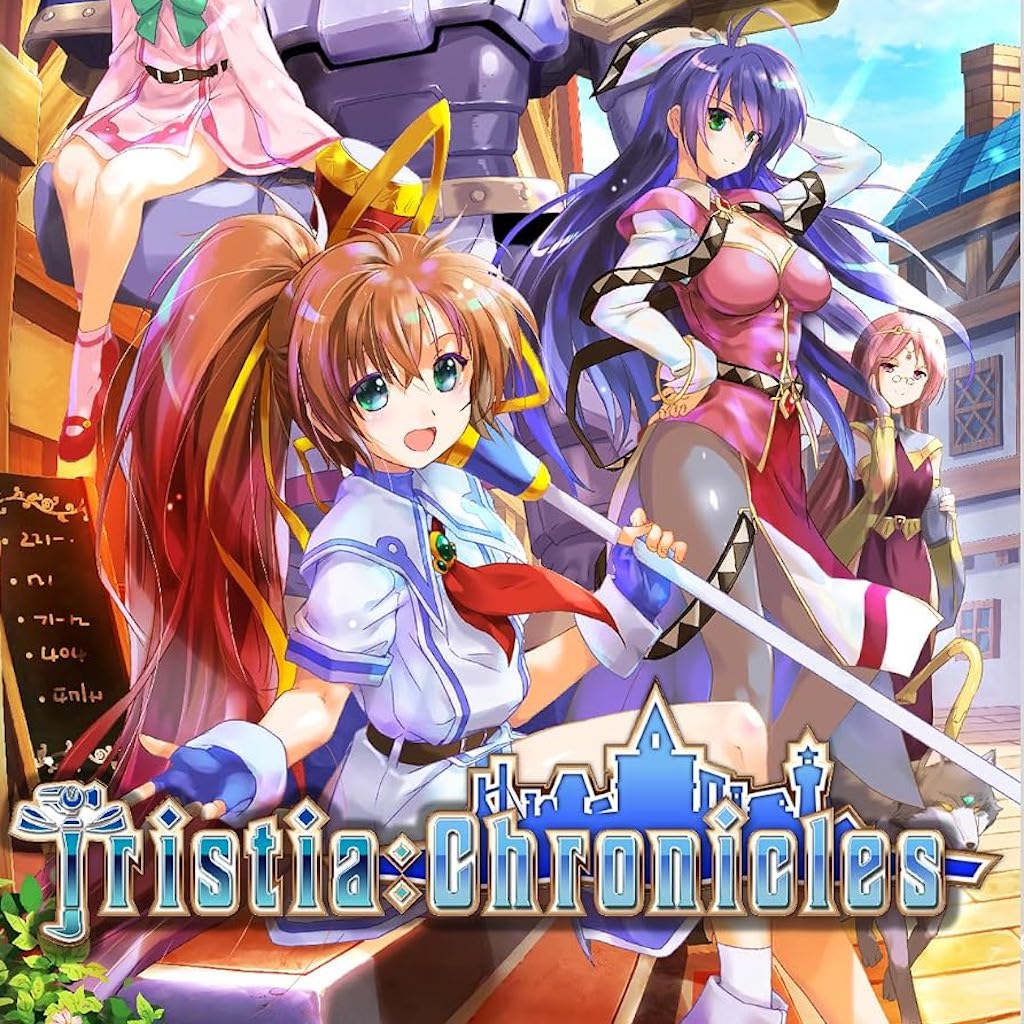
There is something rather lovely about discovering an old game that clearly harks back to a time when developers were not afraid to throw several ideas into the same pot and see what happened. Tristia: Chronicles is very much a product of that era, combining visual novel storytelling, workshop management, crafting, town building and time management into a pair of adventures that feel unmistakably Japanese in design. It is colourful, charming and occasionally quite demanding, but beneath its old-school systems lies a genuinely warm story about rebuilding a place that has almost given up on itself.
Originally created by KOGADO STUDIO in the early 2000s, this collection brings together Tristia: Legacy and Tristia: Restore, giving modern players the chance to experience two connected takes on the same wonderfully eccentric world. Both games put you in the role of Nanoca Flanka, a young inventor with an enormous task ahead of her. Tristia was once known as the Jewel of the Sea, but years of decline and repeated dragon attacks have left the once-thriving port in a sorry state. Nanoca has one year to change that, and whether she succeeds is very much down to you.
Meet Nanoca Flanka
Nanoca is immediately likeable, which matters because you will spend a considerable amount of time with her. She is clever, energetic and clearly more comfortable surrounded by tools, inventions and machinery than by the pressures of everyday life. That makes her an ideal protagonist for a game built around invention and rebuilding, because watching her transform Tristia becomes as important as the systems themselves.
There is also a lovely sense of personality throughout the cast. The people of Tristia are not simply there to hand you objectives and disappear again. Relationships develop through conversations, side stories and events that respond to the progress you make. The fully voiced Japanese dialogue adds considerably to this, giving the characters a warmth that might otherwise be lost beneath the spreadsheets, menus and resource management.
It is perhaps the biggest surprise of Tristia: Chronicles. Beneath all the talk of materials, blueprints, workshops and economic recovery is a game that genuinely wants you to care about its little coastal community. The more you invest in Tristia, the more satisfying it becomes to see the town gradually regain some of the life it had lost.
Building A Better Tristia
Tristia: Legacy is the more substantial of the two games, and it is where the city-building and management mechanics really come into their own. Your main objective is straightforward enough: restore Tristia within a strict one-year deadline. Getting there, however, involves juggling research, invention, manufacturing, sales and the various requests that arrive from the people around you.
The workshop quickly becomes the beating heart of the adventure. You research materials, create blueprints and manufacture new products that can then be supplied to local shops. Successful inventions generate money and stimulate the town’s economy, allowing you to build new facilities and expand your options. There is a wonderfully satisfying rhythm to it all, because an invention is never simply an invention. It is another little piece of the town’s recovery.
The clever part is that you cannot simply do everything at once. Time is constantly moving forward, your energy is limited and there are only so many days available. Every decision therefore carries a little bit of weight. Do you spend the day developing a new invention, visit someone in town, gather resources or concentrate on a request that could benefit the economy? It is an old-fashioned system, but there is something genuinely satisfying about having to plan your days rather than simply wandering through an endless adventure with no real consequences.
The Clock Is Always Ticking
The calendar system is likely to be the biggest hurdle for players coming to Tristia: Chronicles from more modern simulation games. You have a finite amount of time to achieve your goals, and wasting days can have consequences. There is no endless sandbox here where you can happily tinker for hundreds of hours without worrying about the bigger picture.
At first, this can feel restrictive. You are learning how the workshop operates, trying to understand the economy and getting to know the characters, while a large clock is effectively hanging over your head. Once the systems begin to click, though, that pressure becomes part of the appeal. Planning ahead starts to feel like its own little puzzle, and successfully squeezing everything you need into a busy schedule can be surprisingly rewarding.
It also gives the story a sense of urgency that would otherwise be missing. Tristia is not going to wait forever, and Nanoca has not been given an unlimited amount of time to save it. Every successful project feels like progress towards a tangible goal, while watching the town slowly recover gives the management mechanics an emotional purpose.
Invention Is The Name Of The Game
The crafting system is where Tristia: Legacy really finds its personality. There is something wonderfully old-school about gathering materials, researching new possibilities, and gradually expanding your workshop until you are producing increasingly complex creations. It never feels like crafting has simply been bolted on to the side of the adventure. It is the entire reason Nanoca is there.
Finding the right materials and working out which inventions are worth pursuing creates a satisfying sense of progression. You begin with relatively modest creations, but as your knowledge and resources increase, the workshop becomes much more capable. Seeing an item go from an idea on a blueprint to a finished product that can actually help the town is a lovely little feedback loop.
There is also a pleasing amount of personality in the things you create. This is not a sterile management simulator filled with anonymous numbers and percentages. The inventions feel like products of Nanoca’s character, and the fact that they ultimately contribute to the lives of Tristia’s residents gives your work a purpose beyond simply making the next pile of currency.
Restore Changes The Formula
Then there is Tristia: Restore, which takes the same basic premise and approaches it from a more action-focused angle. Rather than concentrating so heavily on rebuilding the town, this companion adventure puts you in the thick of workshop orders and challenges you to complete projects against the clock.
This makes Restore feel considerably more frantic. You are gathering materials, selecting equipment and completing requests while constantly keeping an eye on the remaining time. The pace is completely different from the more methodical nature of Legacy, and that contrast is one of the strongest reasons the collection works so well as a package.
The mini-games add another layer of variety, turning some of the crafting tasks into more active challenges. You cannot simply sit back and wait for the workshop to do everything for you. Quick decisions and good timing become important, particularly when multiple requests begin arriving and the pressure starts to build.
It is not necessarily the deeper of the two experiences, but it does a good job of preventing the collection from feeling like two versions of exactly the same game. Legacy gives you the broader management experience, while Restore provides a faster, more immediate alternative when you want something with a little more urgency.
A Story About Bringing A Town Back To Life
The story is perhaps where Tristia: Chronicles is at its most charming. Beneath the mechanics lies a simple but effective tale about a community that has lost hope and a young inventor determined to prove that its best days are not necessarily behind it. There is nothing particularly revolutionary about that premise, but the execution gives it plenty of heart.
The visual novel structure allows the characters and their relationships to develop alongside the town itself. As Tristia changes, so does the atmosphere around Nanoca. The more successful you become, the more you feel as though you are genuinely affecting the lives of the people around you rather than simply increasing a few statistics on a management screen.
There are multiple story outcomes depending on how you approach the year, which gives the game a nice sense of replayability. Your choices and your success in rebuilding the city can influence where the story eventually leads. This makes the calendar system feel like more than a mechanical limitation, because the passage of time genuinely matters to the narrative.
A Beautiful Piece Of Anime Nostalgia
Visually, Tristia: Chronicles has received a welcome makeover while retaining the unmistakable character of its original artwork. The high-definition character illustrations look crisp and colourful, and the distinctive anime aesthetic has aged surprisingly well. There is a lovely warmth to the presentation that makes Tristia feel like somewhere you would actually want to spend time.
The backgrounds are more functional than spectacular, which suits the game’s origins. This is not an enormous 3D world designed to impress you with technical wizardry. Instead, it is a character-driven setting filled with illustrated locations, expressive characters, and menus that constantly put useful information in front of you.
The updated interface is another welcome improvement. Some of the original design philosophies can still feel dated, but the cleaner presentation makes the collection much easier to approach than it might otherwise have been. It still feels like a game from another era, just one that has been given a little polish before being invited back onto the stage.
The Sound Of A Different Era
The audio presentation is equally nostalgic. The Japanese voice acting remains a highlight, with the cast giving Nanoca and her companions plenty of personality. Ayako Kawasumi’s performance as Nanoca is particularly memorable, helping sell the enthusiasm and determination that make the character so enjoyable.
The soundtrack fits the world beautifully, too. It has that unmistakable early 2000s anime game quality, with upbeat melodies and softer character pieces that complement the story’s shifting mood. It may not be the sort of soundtrack that dominates your attention, but it becomes part of Tristia’s identity surprisingly quickly.
There is a comforting quality to the whole presentation. It feels like opening an old PC game box from another time and discovering that the game inside has somehow retained its original personality. For players who enjoy retro Japanese game design, that alone makes Tristia: Chronicles an appealing proposition.
Not Quite Like Modern Simulators
The game’s age occasionally shows, and this is probably where expectations need to be managed. Modern simulation and management games often explain their systems more clearly, while Tristia: Chronicles can occasionally expect you to figure things out through experimentation and repetition. The menus and mechanics are perfectly functional, but there are moments when you can almost hear the developers saying, “You’ll work it out.”
The strict calendar can also be unforgiving. Making mistakes early on can leave you feeling as though you are falling behind, and the desire to see everything in a single playthrough can be a little stressful. Yet there is something refreshing about a game that lets failure matter. You are not guaranteed success simply because you have played for a few hours.
That old-school design will not appeal to everyone, but for the right player it becomes part of the charm. Tristia: Chronicles is not trying to smooth away every rough edge or hold your hand through every decision. It wants you to learn its systems, make mistakes, and eventually understand how all the pieces fit together.
Two Adventures, One Charming World
As a package, Tristia: Chronicles makes a convincing case for revisiting these older games. Legacy offers a deeper town-building and invention experience, while Restore is quicker and more action-focused. They complement each other well, and having both together gives the collection considerably more value than either would on its own.
More importantly, both games share a distinct personality. There is a genuine warmth to Tristia, its residents and Nanoca herself, that makes the underlying objective feel worthwhile. You are not simply maximising profits because a number on a screen told you to. You are trying to give a dying town another chance.
That is what makes the collection so easy to like. It is quirky, sometimes demanding and undeniably rooted in a different era of game design, but it has a heart that many modern simulations struggle to replicate. There is something special about watching a place come back to life, one invention, one building and one relationship at a time.
Final Verdict
Tristia: Chronicles is a wonderfully charming piece of Japanese game history that proves some ideas really do stand the test of time. The blend of visual novel storytelling, crafting, invention, resource management and town revitalisation is distinctive enough to feel fresh even today, while Nanoca and the residents of Tristia lend the whole adventure a genuine sense of warmth.
It is not without its dated elements. The calendar system can be unforgiving, some menus feel like they have travelled directly from the early 2000s, and the sheer number of mechanics can take time to grasp. Yet once you settle into its rhythm, there is much to appreciate. The satisfaction of creating something useful, watching a shop benefit from your invention, and seeing Tristia gradually regain its sparkle make the slower pace worthwhile.
Most importantly, this is a collection with personality. Tristia: Legacy and Tristia: Restore may come from a very different gaming era, but they still manage to offer something that feels remarkably wholesome. They are games about making things, helping people, and taking a place that has fallen apart and giving it another chance. In an industry increasingly obsessed with bigger worlds and louder adventures, there is something wonderfully refreshing about simply being asked to make a little town better.