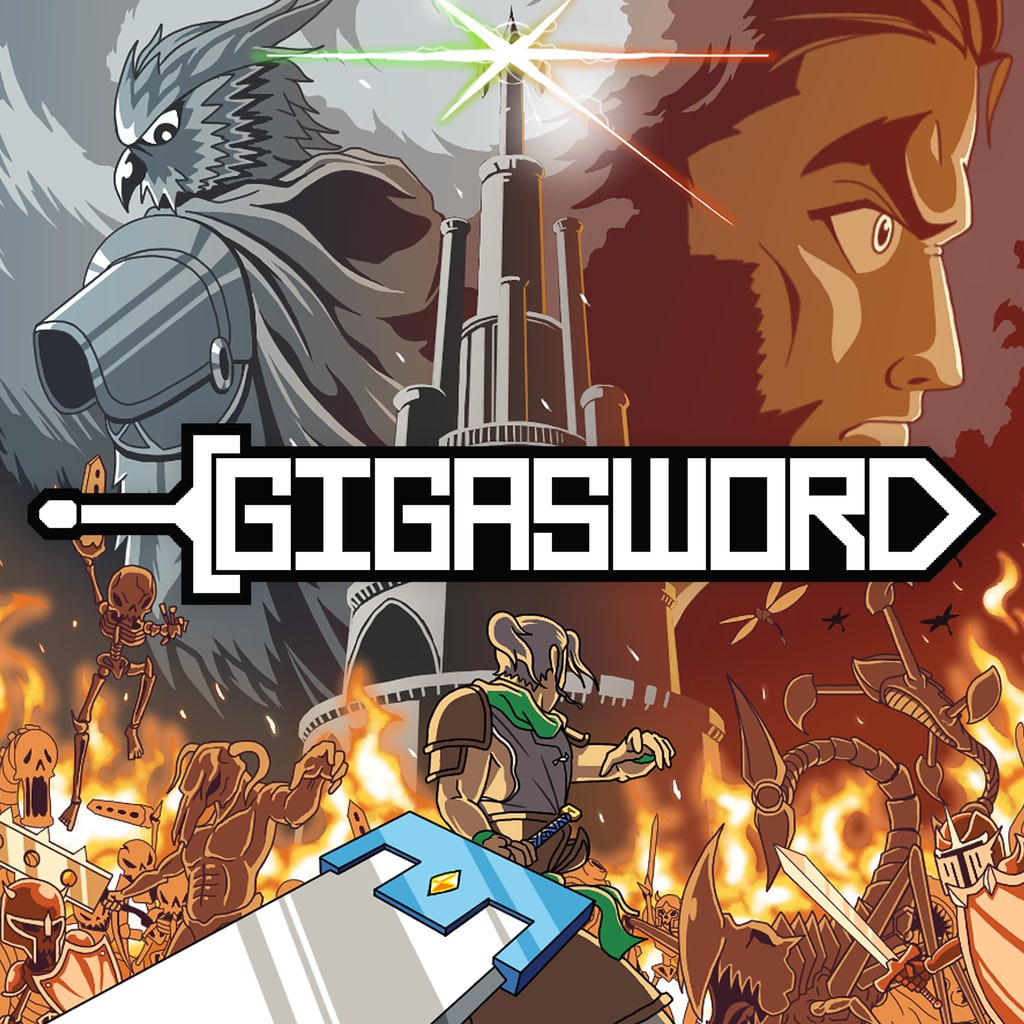
Few indie games wield their central mechanic as confidently as Gigasword, a 2D puzzle-platformer from solo developer Studio Hybrid. What starts as a simple premise—carrying a giant sword through a labyrinthine temple—quickly transforms into one of the most clever, challenging, and rewarding puzzle experiences in recent memory. Equal parts Celeste and Baba Is You, Gigasword proves that the right concept, executed with precision, can cut through the noise of an overcrowded indie scene.
A Blade Worth Bearing
At first glance, Gigasword looks like another pixel-art platformer. You control a nameless knight exploring a mysterious, crumbling temple filled with spikes, switches, and shifting platforms. The twist? You’re burdened by the Gigasword—a weapon so massive that it fundamentally changes how you move, jump, and interact with the environment.
You can’t double-jump while carrying it. You can’t climb ladders. You can’t fit through certain spaces. Yet, the Gigasword isn’t just a hindrance—it’s also the key to progression. Dropping it activates switches, bridges gaps, and serves as a makeshift platform. The puzzle-solving loop revolves around when to carry it, when to let it go, and how to manipulate its weight to reach otherwise impossible areas.
It’s a brilliant conceit that forces you to constantly reassess your relationship with your only weapon. Each level is a small, self-contained puzzle box, built around the simple act of moving this impossibly heavy sword from point A to point B. It’s not about combat or reflexes—it’s about careful thought, precision, and problem-solving.
Gameplay and Mechanics
The beauty of Gigasword lies in its restraint. The controls are simple—move, jump, grab, and throw—but every mechanic interacts meaningfully with the sword’s physics. When you’re holding it, your movement slows, jumps are shorter, and ladders become obstacles. Drop it, and you regain agility but lose access to areas that require the sword’s presence.
This push-and-pull dynamic creates elegant, brain-teasing scenarios. For example, one room may ask you to leave the sword on a pressure plate to open a door, but then you’ll need the sword to climb to the exit on the other side. Solving it means finding creative ways to reposition the blade—perhaps using it as a bridge, or leveraging the environment to “toss” it into place.
Each new zone introduces subtle wrinkles to this formula. Ice floors make handling the sword treacherous. Wind tunnels alter its trajectory when dropped mid-jump. Moving platforms, teleporters, and gravity fields force you to think in new ways about space, timing, and inertia. The brilliance of the design is how it never feels unfair; every solution is logical once you spot it, even if the path there ties your brain in knots.
Importantly, Gigasword respects your time and intelligence. There’s no arbitrary padding, no combat gauntlets or fetch quests. Each puzzle builds naturally on the last, teaching you through play. The difficulty curve is steady but unrelenting—by the second half, you’ll find yourself staring at a single room for minutes on end, analyzing every possible permutation before that satisfying “aha!” moment hits.
Presentation and Atmosphere
While Gigasword’s visuals are modest, they’re wonderfully cohesive. The pixel art is clean and evocative, reminiscent of Celeste’s precision or TowerFall’s minimalism. The environments, though simple, carry an ancient melancholy—temples and caverns bathed in the soft glow of magical runes. The palette shifts subtly between regions, creating variety without visual noise.
The soundtrack, composed by Michael Baker, is a standout element. Its moody synth tones and echoing chimes lend a sense of scale and introspection to the puzzles. It’s contemplative rather than bombastic, reinforcing the meditative rhythm of problem-solving. There’s a loneliness to the music that pairs beautifully with the game’s quiet tone; it feels like you’re exploring a forgotten world, burdened by a relic that once meant something profound.
The story, minimal as it is, unfolds through environmental cues and brief fragments of text. The sword itself seems to hold great significance—perhaps a divine artifact, perhaps a curse. The ending, subtle and somber, leaves enough ambiguity to linger in your mind long after you’ve put the controller down.
Difficulty and Flow
Make no mistake: Gigasword can be tough. It’s not unfairly punishing in the way of old-school platformers, but it demands patience and observation. You won’t die from enemies or time limits—failure here is intellectual rather than physical. A single misplaced drop or misjudged jump can undo minutes of progress, but instant restarts and tight controls ensure frustration never outweighs satisfaction.
If you’re the type who loves deciphering systems and solving spatial puzzles, you’ll find immense joy in its challenges. Players looking for fast-paced action, however, might find the deliberate pacing too slow. Gigasword doesn’t cater to instant gratification; it’s about mastery, not momentum.
Comparisons and Legacy
In many ways, Gigasword feels like a spiritual successor to Celeste’s B-sides or Fez’s cryptic platforming puzzles. It has the precise input feel of a platformer but the cerebral satisfaction of a pure puzzle game. It also shares The Talos Principle’s philosophical undertones—using mechanics to express the burden of purpose, the duality of strength and weakness.
Yet, it stands on its own. The sword mechanic is so well realized that it could easily anchor an entire franchise or inspire future imitators. It’s one of those rare indie concepts that feels instantly iconic—simple enough to grasp in seconds, yet deep enough to explore for hours.
Pros & Cons
Pros:
- Ingenious central mechanic with endless puzzle potential
- Tight, responsive controls and smart level design
- Elegant visual style and atmospheric soundtrack
- Satisfying “aha” moments that reward creative thinking
- Perfect pacing and zero filler
Cons:
- Can feel mentally exhausting during long sessions
- Minimal story may leave narrative-focused players cold
- No traditional combat or action for those craving variety
Verdict
Gigasword is proof that creativity thrives within constraint. It takes one inspired idea and hones it to a razor’s edge, crafting an experience that’s both cerebral and emotionally resonant. Each puzzle feels handcrafted, each challenge a test of logic and perseverance. The absence of bombast or spectacle only strengthens its impact—it’s a quiet triumph of design over flash.
If you come for combat or cinematic storytelling, you won’t find it here. But if you value precision, patience, and the pure joy of discovery, Gigasword offers an unforgettable test of intellect and ingenuity. It’s the kind of indie gem that will quietly earn a cult following — and deservedly so.
A brilliant puzzle-platformer that turns burden into beauty. Thoughtful, challenging, and deeply satisfying, Gigasword wields simplicity like a master-crafted blade.