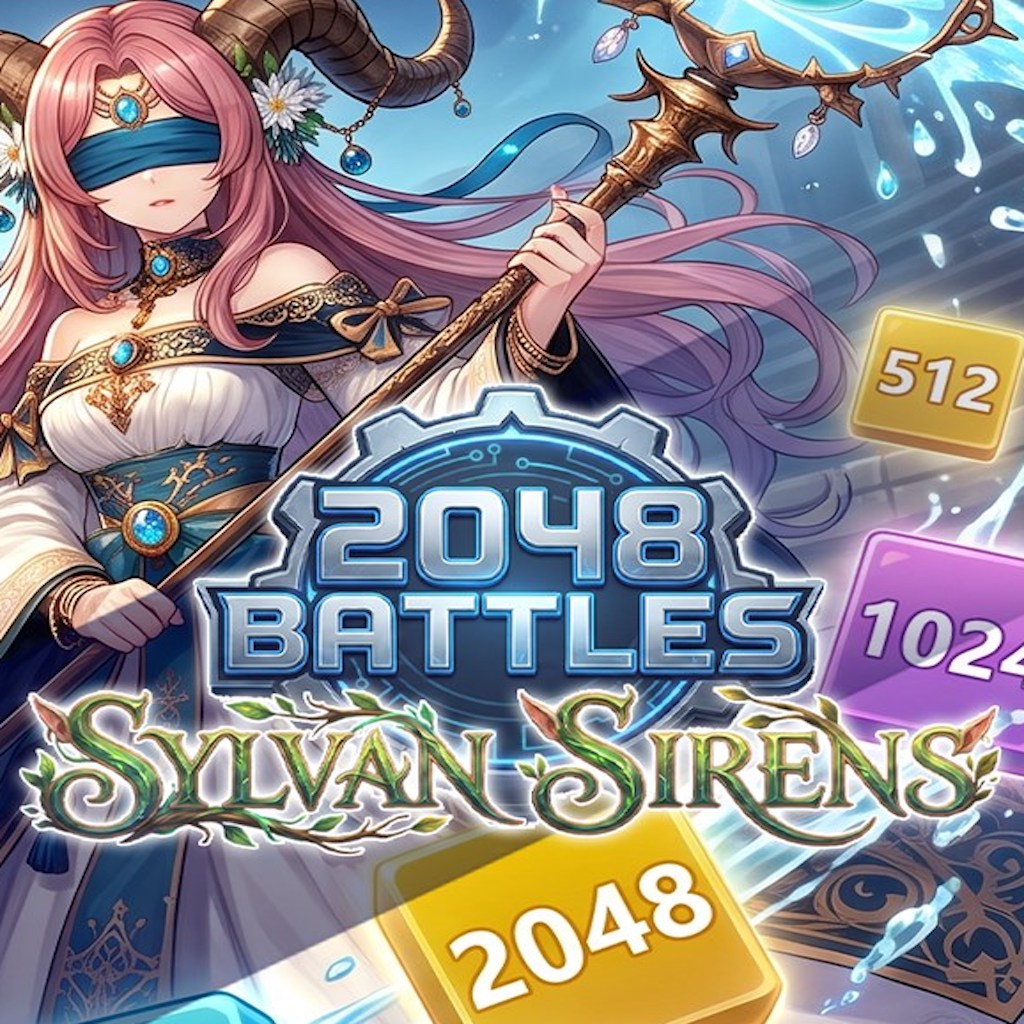
There is something oddly addictive about 2048. On paper, sliding numbered tiles around a grid hardly sounds like the basis for a compelling afternoon of gaming, yet the formula has spawned countless variations over the years. It is simple enough to grasp in seconds, but once the numbers start climbing and the board fills up, things can become surprisingly tense. 2048 Battles: Sylvan Sirens takes that familiar formula and sets it in an enchanted woodland, adding fantasy combat, magical attacks and a collection of rather dangerous inhabitants.
Developed and published by EpiXR Games, 2048 Battles: Sylvan Sirens is not interested in reinventing the basic 2048 concept. Instead, it takes those familiar sliding and merging mechanics and gives them a purpose beyond simply chasing a high score. Every time you combine matching tiles to create a higher number, you are effectively building ammunition for your next attack. It is a small but effective twist that gives the otherwise familiar puzzle loop a little more urgency, particularly when the enemy begins interfering with the board.
The 2048 Formula Gets a Magical Makeover
If you have played 2048 before, you will immediately understand the fundamentals here. Tiles are moved around the grid, matching numbers are combined, and the resulting higher-value tile becomes part of the next calculation. The beauty of the system has always been its accessibility, as no complicated tutorial is required to explain the basic concept. Within moments, you are sliding tiles around and thinking about your next move.
The difference is that Sylvan Sirens turns those numbers into weapons. Rather than simply trying to create increasingly large values for the satisfaction of seeing a bigger number appear on screen, your high-value tiles can be unleashed against the enemies confronting you. That gives the familiar act of merging a little more meaning. Suddenly, getting that elusive combination is not merely about improving your score; it could be the difference between surviving an enemy’s next attack and watching your carefully arranged board fall apart.
It is a clever way of adding another layer to an already established formula without making it inaccessible. Anyone familiar with 2048 can jump straight in, while newcomers can learn the rules almost immediately. The challenge comes from making sensible decisions rather than understanding complicated systems, and that makes the game particularly easy to pick up for short sessions.
Woodland Foes With Teeth
The fantasy setting gives Sylvan Sirens more personality than a straightforward numerical puzzle game might otherwise have. Your opponents include alluring sirens, spellcasting forest witches and majestic fae queens, each with their own abilities in battle. The woodland theme is certainly colourful, giving the game a welcome sense of identity rather than simply presenting the player with another anonymous grid of numbered squares.
More importantly, the enemies are not merely decorative. They actively interfere with the puzzle board, which is where the battle concept becomes more interesting. Some enemies can trap tiles in thorns, restricting your options and potentially ruining a carefully prepared combination. Others can drain your power, while certain magical attacks can manipulate the grid itself by introducing tangled roots and other obstacles.
That interference changes the way you approach the puzzle. In a normal game of 2048, you can spend time patiently arranging the board and preparing your next few moves. Here, there is an additional sense of pressure because the enemy is effectively playing against you. You still need to think several moves ahead, but you also have to account for the possibility that your plans may be disrupted before you get the chance to put them into action.
When Numbers Become Weapons
The combat system is arguably the most important addition to the formula, as it gives a reason to care about those larger numbers beyond personal pride. Building a high-value tile and then using it to hammer an enemy is considerably more satisfying than simply watching the number increase. There is a nice little rhythm to preparing a powerful combination, waiting for the right opportunity, and then turning that work into damage.
It also encourages a little more strategic thinking. Do you immediately use a powerful tile to weaken an enemy, or take the risk of holding onto it while trying to create something even stronger? The answer will depend on the situation, particularly when an enemy has started applying debilitating effects to the grid. That tension gives the otherwise familiar sliding mechanic some extra flavour.
At the same time, experienced 2048 players may find that the underlying formula remains very familiar. The combat mechanics add context and pressure, but they do not fundamentally transform the way the grid operates. This is still, at heart, a sliding tile puzzle, and players looking for a genuinely deep strategy game may eventually find the system’s limits.
Five Levels of Difficulty
One welcome feature is the inclusion of five difficulty levels. This gives the game some flexibility, particularly because 2048 can be a deceptively difficult genre where a seemingly harmless puzzle can suddenly spiral out of control. Having different settings allows players to find a pace that suits them rather than forcing everyone into the same level of pressure.
For newcomers, a gentler difficulty provides an opportunity to learn how the combat mechanics interact with the traditional puzzle rules. More experienced players can increase the challenge and deal with increasingly awkward situations while trying to maintain control of their board. It is a sensible approach that helps broaden the game’s appeal beyond those who already know the 2048 formula inside out.
The difficulty options also contribute to the game’s suitability for short gaming sessions. You can play a few battles, put the controller down and come back later without feeling as though you have forgotten half of a complicated role-playing system. That pick-up-and-play quality is one of the game’s most appealing characteristics.
A Peaceful Forest, Despite the Fighting
Visually, 2048 Battles: Sylvan Sirens adopts a tranquil woodland aesthetic that contrasts nicely with the combat on screen. There is something amusing about battling dangerous magical creatures while surrounded by an environment that feels relatively peaceful. The fantasy presentation gives the otherwise mathematical proceedings a softer, more inviting atmosphere.
The soundtrack follows a similarly relaxing path. Rather than bombarding the player with aggressive battle music, the presentation leans into the enchanted forest setting. That makes the game feel more like a gentle puzzle adventure than an intense tactical battlefield, which is probably appropriate given the relatively casual nature of the experience.
It is not the sort of game that is going to leave you staring at the screen in awe of its technical achievements, but that is not really the point. The presentation serves its purpose, gives the game an identity, and makes the familiar 2048 formula feel a little more interesting. There is enough charm here to stop it from feeling like a purely functional puzzle package.
Infinite Mode and the Long Game
Once you have had your fill of the woodland battles, Infinite Mode offers a more traditional 2048 experience. It is a useful addition, stripping away some of the combat distractions and allowing players to focus on the puzzle itself. For those who simply enjoy the satisfaction of merging tiles and seeing how large a number they can create, it provides a reason to keep coming back.
Infinite Mode is also where the game’s addictive qualities become most obvious. There is always the temptation to make just one more move, create just one more combination, and see whether the board can survive a little longer. It is the same quality that has made the original 2048 concept so enduring, and Sylvan Sirens wisely retains it rather than trying to overcomplicate the experience.
However, the game’s longevity ultimately depends on how much enjoyment you get from the core mechanic. Once you have seen most of what the combat system has to offer, there are only so many ways to dress up the sliding-tile formula. The five difficulty levels and Infinite Mode help, but this remains a game best enjoyed in relatively small doses rather than something likely to dominate your gaming schedule.
A Charming Little Puzzle Hybrid
What I like most about 2048 Battles: Sylvan Sirens is that it knows exactly what kind of game it wants to be. It does not pretend to be a sprawling fantasy adventure or a deeply complex tactical RPG. Instead, it takes one of gaming’s most recognisable puzzle mechanics, sets it in a fantasy world and adds just enough combat to make those familiar numbers feel slightly more meaningful.
There is genuine satisfaction in watching a carefully prepared high-value tile smash into an enemy, especially after several moves spent setting up the combination. Likewise, there is a certain frustration when an enemy ability disrupts your carefully constructed plans, but it is the kind that encourages you to try again rather than throw the controller across the room. The game keeps its systems understandable, which is important for something built on such an accessible foundation.
There is no escaping the fact that the underlying gameplay remains relatively simple. Players seeking enormous strategic depth or a constantly evolving experience may eventually feel they have seen most of what the game has to offer. For everyone else, particularly fans of casual puzzle games and achievement hunters, there is enough here to provide a pleasant diversion.
Final Verdict
2048 Battles: Sylvan Sirens is a charming little experiment that manages to make the familiar 2048 formula feel fresh enough to warrant another visit to the grid. The addition of fantasy combat works better than you might expect, giving players a reason to chase increasingly powerful tiles while enemy abilities introduce just enough disruption to prevent every battle from becoming completely predictable. The woodland setting, relaxing soundtrack and colourful cast of magical opponents also lend the experience a welcome personality.
It is not a revolutionary take on the genre, and the simplicity of its core mechanics means its appeal is likely strongest in short sessions. The combat system adds an enjoyable strategic wrinkle, but it never completely escapes the limitations of the underlying 2048 formula. Infinite Mode is a particularly welcome inclusion for anyone who simply loves the original puzzle concept, while the five difficulty settings make the experience approachable for a broad range of players.
For a budget-friendly puzzle game, though, there is something pleasantly satisfying about what EpiXR Games has created. It takes a mechanic most of us could probably explain to a friend in under a minute and gives it a colourful fantasy playground in which to breathe. Sometimes a game does not need to be enormous or endlessly complicated to be enjoyable. Sometimes all you need is a grid, a few numbers, some troublesome woodland magic and the promise that one more move might finally be the one that saves the day.